Thursday, June 18, 2009

Remember Dan Froomkin?

OC Weekly’s Nick Schou reports (Washington Post fires ex-Register scribe turned White House watcher) that former OC Reg reporter Dan Froomkin has been let go by the Washington Post:
Dan Froomkin...who is best known as the author of the Washington Post's widely-read White House Watch blog, is out of work. According to a story today by Politico blogger Michael Calderone, the Post apparently decided to let Froomkin go because it no longer felt the need for his column. Froomkin drew ire from the Post's conservative readers for his tough coverage of the Bush White House as well as his perceived pandering to President Obama.
Some of you will recall that Froomkin was the reporter who exposed student and parent complaints concerning Steve Frogue’s teaching at Foothill High. According to numerous students, Frogue, a history instructor, repeatedly denied the Holocaust and made racially insensitive remarks. Actually, I think that Froomkin’s article came after Ked Francis’ interview of Frogue, in Irvine Valley College’s Voice, in which Frogue expressed approval of the Institute for Historical Review’s publications and voiced skepticism of the usually-reported extent of the Holocaust. That’s right. IVC used to have a newspaper, and it occasionally did some great work. Let's hope Froomkin finds another gig soon. As I recall, according to former SOCCCD trustee Harriett Walther, after Froomkin's article came out, during board meetings, Frogue would refer to Froomkin, enunciating his name in a deliberately leisurely fashion—allegedly to draw attention to its Jewishness.
REMEMBER KIMBERLY KINDY? I noticed that, these days, Kimberly Kindy is a staff writer for the Washington Post. For several years, as the OC Reg "education" reporter, she covered the various scandals and issues regarding our district, especially stories concerning Raghu P. Mathur.
REMEMBER THE ECONOMY?
UCI workers face possible 8% pay cut (OC Register)
UC Irvine faculty and staff could have their pay cut by 8 percent, unless they earn $46,000 or less, in which case the cut would be 4 percent, says University of California President Mark Yudof. Yudof issued a letter … that says the cuts are needed at all 10 UC campuses to help balance the state budget, which currently has a $24.3 billion deficit. It’s possible that the pay cuts would be smaller; the Legislature could raise taxes and create other forms of revenue to soften the blow. But that would take a two-thirds majority vote by lawmakers, and the public soundly defeated ballot initiatives in March that would have raised some additional public revenue….
• REMEMBER THAT EMERITUS STORY?
As of 5:00 today, the number of angry comments that Monday’s story about Emeritus fitness courses has garnered is over 40. Sheesh.
REMEMBER CHIP BERLET?
In a post earlier today (On the alleged importance of presenting "opposing points of view"), I noted that the “experts” that Trustee Steve Frogue had invited to his 1997 “Warren Commission” (JFK assassination) forum were, well, crackpots. I recalled that noted author, Gerald Posner, for one, had made that point in an LA Times article. I decided to look up the article. Found it. It reminded me that Chip Berlet, senior analyst at Boston’s Political Research Associates, expressed the same view: LA Times (front page) 8/21/97 O.C. College Course Claims JFK By Michael Granberry
…Chip Berlet, who has studied the assassination extensively and is a senior analyst at Political Research Associates, a nonprofit think tank in Somerville, Mass., that examines authoritarian thinking, laughed upon hearing the names of [Frogue’s] panel of experts. "Oh, get out of here!" Berlet said. "You couldn't find ... more embarrassing conspiracists in America. Even among conspiracy theorists, these people represent the outer limits." … The speakers, [author Gerald] Posner said, "are not even mainstream conspiracy theorists. This is the very edge of what passes for somewhat sane discussion, and I find it even more egregious based on the sense of false history they espouse. Clearly, this is the most inflammatory and least supportable edge of that false history."
Well, oddly enough, as I was driving home from the gym tonight, I tuned in to Fresh Air, and Terry’s guest was none other than Chip Berlet: Extremism, Conspiracy Theory And Murder Fresh Air from WHYY, June 18, 2009 ·
Chip Berlet has studied extremism, conspiracy theories and hate groups for more than 25 years. In a recent report for PublicEye.org, he says that the murders of abortion provider Dr. George Tiller and Holocaust Museum guard Stephen T. Johns exemplify the potential for violence that often lurks within extremist groups. Berlet argues that right-wing pundits share some of the moral responsibility for the actions of their followers. He summarizes the analysis in his report in a June 10 Huffington Post article about Johns' murder: "Apocalyptic aggression is fueled by right-wing pundits who demonize scapegoated groups and individuals in our society, implying that it is urgent to stop them from wrecking the nation."
You can hear the whole interview by using the above link. Check it out!

On the alleged importance of presenting "opposing points of view"

SUBSCRACEFUL!

Yesterday, John Dean, author of the Watergate exposé “Blind Ambition” and a guy who nowadays appears on liberal TV and radio shows, gave a lecture at the Nixon Presidential Library & Museum. The Nixon Foundation, which earlier pledged $150,000 to support Library events, is, well, not liberal, for it is dominated by Richard Nixon fans and Nixon was a Republican. Further, since Dean was the guy who blew the whistle on Nixon’s “Watergate” excesses, it's fair to say that the Nixon-loving foundation folks are particularly peeved about Dean and his writings.

They’re unhappy about the Dean visit, so much so that they’ve even decided to withdraw their $150,000. That’s their right.

According to the OC
Reg (Last straw: John Dean still riles Nixon group), “Foundation officials” say that they do not object to Mr. Dean’s appearing at the Library.

Really?

According to the Reg, they object “to a lack of opposing viewpoint.”

Much fun could be had attempting to describe those viewpoints. Pro-corruption? Anti-Constitution? Pro-
cocker spaniel? Anti-telegenic?

It’s clear that at least some foundation officials do object to Mr. Dean and his ideas, and not just to his failure to be accompanied by, say,
G. Gordon Liddy, or maybe Beelzebub. For instance, Sandy Quinn, the foundation’s assistant director, is quoted as saying
"He's disgraced and has been disbarred…He's so controversial … and [Blind Ambition] is not a new book. It's 33 years old. It would have been more serving and non-partisan it [sic] would (have been) point-counterpoint.”

That’s a mighty strange thing for Quinn to say.

It is by no means clear that Dean is still a “disgraced” figure. He’s definitely changed since his bad old Nixon days. And isn’t
Dennis “Abramoff” Hastert, a former Library guest, also a “disgraced” figure? (Hastert has been involved in numerous scandals and controversies going way back.) Did Quinn carp about Hastert’s visit too? Doubt it.

More importantly, if ever a President were “disgraced,” it would be Richard Nixon himself. He had to resign, remember? (Plus, he said all those nasty things about blacks and Jews and Jane Fonda.)

And don’t forget:
Dick Cheney was invited to speak at the Library. Surely that fellow's standing by now is lower than a barefoot rattlesnake. He's a sub-disgrace—a subsgrace.

You’d have to agree that Dean is a “controversial” figure—at least among Republicans. But consider this: according to the Foundation’s
Nixon Library fact sheet, the "Nixon Library’s ongoing Distinguished Speakers Series has brought lively lectures and discussions from such leaders as
Vice President Dick Cheney;
Nobel Peace Prize recipient and former Secretaries of State
Henry Kissinger and George Schultz;
former Secretaries of State and White House Chiefs of Staff
Alexander Haig and James Baker;
former Vice President
Dan Quayle;
Speaker of the House
Dennis Hastert;
former Secretary of State
Madeleine Albright;
former U.N Ambassador
Vernon A. Walters;
Sean Hannity,
Bill O’Reilly,
Larry King,
Laura Ingraham,
Mike Deaver,
Charlton Heston

Obviously, the views of at least some of these "leaders" are as controversial as Dean’s views. Gosh, did Quinn object to the appearance of all these folks too?

Quinn obviously doesn’t care about a speaker’s being “controversial.”
C’mon.

That “Blind Ambition” is 33 years old is irrelevant. It is an important work in the
oeuvre of works about Nixon’s White House.

POINT/COUNTER-POINT

But what about this
“counter-point” business? Is Quinn suggesting that inviting a speaker without throwing in a contemporaneous “counter-point” speaker is somehow inappropriate? That’s absurd. And I doubt very much that the Library has bothered to follow that goofy practice in the case of past speakers. Did Quinn object to Cheney’s showing up sans opponent? I don’t know, but I can guess.

There is such a thing as “balance,” I suppose, though it can never be more than a rough approximation that will inevitably be judged unsuccessful by some. Now, in most situations, balance is not achieved by imposing it on discrete things (a visit, a seminar, a lecture, a purchase, etc.). Rather, it is achieved by imposing it on a
series of discreet things spread over time, or a set of discreet things, viewed as a whole, spread across a zone.

For instance, though, as an academic, I am no fan of instruction that emphasizes advocacy of controversial positions (I’ve discussed this previously), I do not object to “advocacy” instruction
per se. In itself, an instructor’s “teaching” liberal (or conservative or radical) views is not a problem for me (though I would recommend a somewhat different approach). On the other hand, I might object to it if, upon surveying the pattern of instruction at the college, I find that it adds up to a strong bias in favor of some controversial position. (Here, I am referring to controversy relative, not to society, but to academia and expert [“discipline”] communities.)

For instance, if one finds that every instructor in an economics department expressly or tacitly presumes a strong laissez-faire stance regarding the economy and this perspective is incorporated in their teaching, one might worry that students who take economic courses at the college will leave with an “unbalanced” or one-sided view regarding that important matter. One would be relieved were the next hire to recognize regulation of industries as necessary or prudent.

If the Nixon Library were interested in “balance,” it would seek a schedule of lectures including guest speakers representing a range of perspectives. Until two or three years ago, the Nixon Library was private, and it clearly made little effort to provide “balance.” Look at the list of guest speakers above. With two exceptions, they’re all Republicans.

As of two years ago, the Library is a federal facility, and so, nowadays, its director is obliged to pursue guest speakers with an eye to "balance."

It seems to me that, in objecting to the Dean visit, the Nixon Foundation people no longer have a leg (or a
pumpkin) to stand on.

THE CASE OF FROGUE'S "FORUM"

Remember when then-trustee
Steve Frogue arranged a “forum” or “seminar” on the Warren Commission Report on the JFK assassination? Frogue invited four speakers, each of whom took an arguably incompetent, and certainly a marginal, position regarding the assassination. Further, some of these speakers inspired moral outrage. One speaker was the chief reporter for the notoriously anti-Semitic “Liberty Lobby,” and another speaker contributed to that organization’s publications.

To make a long story short, Frogue had organized a crackpot forum. This was explained to the board on the night that the vote approving traveling expenses was taken, but the board majority (John Williams, Steve Frogue, Teddi Lorch, and Dorothy Fortune) were unmoved. The forum went forward. The press learned of the details, and, owing to a public outcry, the forum was soon cancelled and abandoned.

I believe that, when the board approved this daffy Nutcake Forum, they erred. In my view, it is not a simple matter arguing that they erred, for colleges are supposed to be bastions of free speech.

On the other hand, colleges are supposed to have high standards--they do not regard all opinions as equally valid--and so, if one seeks to enrich the community’s reflections on some event such as the JFK assassination, one ought to organize forums comprising competent experts, not crackpots. So this was a case of conflicting values (or desiderata). Which value should prevail?

At the time, many who objected to Frogue's forum explained their objection by appealing to the need for “balance.” As I recall, then-Chancellor
Robert Lombardi took that view, though he waffled a bit. He found fault with the forum owing to its lack of differing points of view. On the other hand, eventually, he said that “free speech” means that the forum should be allowed. “I think it’s terribly important to allow differences of opinion to be voiced,” he said.

Yes, but that can’t mean that a college should provide a forum for any group expressing
any idea—for instance, that the Earth is flat or, say, that President Obama is a Manchurian candidate or a mujāhid. Remember: Frogue and his guest speakers were crackpots from Hell (crells). Even among conspiracy theorists, this crew was viewed as subpar. (I recall that that point was nicely made by noted author Gerald Posner.)

In an editorial that appeared in August of 1997, the
LA Times weighed in on the issue of whether the forum should be allowed:
The seminar was thrown off campus only after the district received more than 200 calls of protest Thursday. The callers had more wisdom than the trustees. There is a difference between airing seemingly crackpot ideas in an intellectual, substantive manner on a campus devoted to academic freedom and giving legitimacy to bigoted ravings with no balance from opposing speakers. [My emphases.]

One things is clear: one does not achieve “balance”—or at least one does not achieve a rationally desirable kind of balance—simply by having “opposing speakers” at one's forum. In fact, Frogue's four "experts" had strongly divergent views. One attributed the assassination to renegade Nazis. (Yep.) Another blamed Israel's Mossad. Another favored Jim Garrison's long-discredited views. Frogue’s pick was the CIA or the ADL or the Brownies (my memory is fuzzy). These people were clearly not on the same page.


OK, so the forum already had a kind of “balance” in that it presented
opposing views. On the other hand, it did not include the view that the Warren Commission was correct: there was no conspiracy. That’s “imbalance,” I suppose.

It’s clear, then, that presenting opposing views does not by itself ensure the quality of the discussion/forum. The views presented might all be lousy. And one can assemble opposing views while leaving out the view that is in some sense best or most defensible among alternatives.

Further, sometimes, rationally speaking, an issue is not controversial and so opposing views
don’t exist. For instance, though there are people who insist that the Earth is flat, among those who can reason, there is no controversy regarding the shape of the Earth. It is spherical. Case closed. Imposing “opposing sides” to the “discussion” of the shape of the Earth (or to whether there was a Holocaust or to whether AIDS is caused by HIV) would actually diminish the quality of the discussion.

That's right. Sometimes, bringing in the "opposing views" just muddies the waters, rationally speaking.

I think that the JFK assassination verges on being an uncontroversial “issue” (or non-issues) that really has only one "side." Evidently, amongst the general public, how JFK was killed is controversial. But, among the relevant experts, the basic facts are not disputed, and the consensus (namely, that the Warren Commission essentially got it right) seems to have grown stronger over the years.

Still, I would not be opposed to a forum on JFK assassination conspiracy theories at a college. That so many Americans—a handful of whom are intellectually estimable, I suppose—suspect a conspiracy might be a reason to arrange or allow a college “forum.”

But you'd better be darned careful who you invite. No crackpots. (That a guest "expert" is
anti-Semitic doesn't strike me as relevant to the quality of his view about the JFK assassination. You wouldn't want your sister to marry the guy, but, hey, even a bigot can have a good theory.)

Should the forum be “balanced”? (In this case, we’re talking about a one-shot event. Hence, any balance will have to be a balance within the event, not some pattern the event fits into.)

BALANCE SCHMALANCE

I think “balance” is overrated. I would not object to inviting one solitary speaker on a controversial topic if the speaker were sufficiently impressive in his/her intellectual attainments and abilities. After all, whether a position should be accepted is not ultimately a matter of
comparing views. A view is worth believing if and only if the grounds for it are logically compelling. (This, of course, is often a matter of degree.)

There’s room for talk of “balance,” I think, for those who seek to promote sound discourse. But surely one betrays misjudgment—a kind of error in proportions—if one approaches a “forum” about X by focusing on “presenting opposing points of view.” Ultimately, we should be judging, not the winner of a debate, but evidence and arguments. There are standards for such things, and, by those standards, some thinkers and some positions
just don’t rate. So don't include 'em.

We need to find a way to encourage “forums” that honor the authority of those standards. That's the crucial thing. If we do that, we won't be yammering so much about "balance" and the need to present "opposing views" and debates.

But, of course, I’m talking as though the public would even know the difference.

Silly me.

(Note: I'd next like to consider J.S. Mill's view concerning the benefits of allowing expression and advocacy of even false and absurd views.)

Wednesday, June 17, 2009

Summer Reading: This Lovely Life


The author of This Lovely Life, Vicki Forman, is a loyal reader and sometime commentator on this blog (aka Special Needs Mama and Leighton Girl) — and Rebel Girl's dear friend. They first met in graduate school. Rebel Girl has followed this book's journey to be for a long time now. Through the years, she has learned much from Vicki about writing and making one's way through life.

from Publisher's Weekly (starred review):
Forman’s enormously affecting memoir—winner of the Bread Loaf Writer’s Conference Bakeless Prize—about the drastic disabilities of her extremely premature child poses challenging questions about parenthood and human compassion. Having given birth to twins at just six months’ gestation (23 weeks), due to an undetected infection she learned of only much later, the author, living with her husband and three-year-old daughter in Southern California, and aware of the daunting health issues facing these babies, begged the doctors to “let them go.” However, the doctors refused the “do-not-resuscitate” order, offering the infants every form of neonatal intensive care available, and while one of the twins died within days, the boy, Evan, survived, spending six months in the hospital before the family could take him home. Evan was plagued by severe developmental difficulties, including seizures, cerebral palsy, mental retardation, congenital heart defect and blindness, and the author writes with unflinching honesty about her raw fear and conflicted feelings. With time, Forman persevered as Evan’s advocate, finding solace in friendships with other mothers of special-needs children and open to experimental therapies that might prove helpful. Numbed by the crass exigencies surrounding the burial of one child (cemetery plots, tax forms), and hardened by what she terms post-traumatic stress syndrome, Forman portrays herself (sometimes shockingly) as deeply flawed and forgivingly human.

Meg Wolitzer, author of The Ten Year Nap and Surrender, Dorothy:
It would be difficult not to be stirred by Vicki Forman’s story; but what makes This Lovely Life so good goes well past story and into idea, with which her book is so rich. The idea of love; of choice; of ambivalence; of imperfection; of purpose: these are all here, in a narrative that is propulsive, startling and vivid, like motherhood itself.”

Tom Bissell, author of The Father of All Things: A Marine, His Son and the Legacy of Vietnam
“This is a story about children born into circumstances medicine cannot currently prevent and no parent could possibly prepare for. It begins with a scene of almost unendurable horror. When the worst (one assumes) has passed, the reader awaits the various authorial balms, tonal coolants, and narrative stand downs demanded by such a trauma-splashed opening. But the reader quickly staggers into another, even more intimate horror, and then another, and then another. A tiny, cherished hope somehow endures that things will eventually improve for the author, Vicki Forman, and her increasingly devastated family. Such hopes are repeatedly incinerated in reality’s unforgiving atmosphere. By the end, the long-delayed first steps of a five-year-old child will seem the fist-pumping stuff of a more traditional triumph narrative. And yet This Lovely Life is not at all depressing. When I finished this book I felt, rather, an electric, wide-awake sadness, as though I had lost and made a close friend on the same day.”

In the upcoming weeks and months, Vicki will be reading throughout the country and in London (!) but those of you in the So Cal area can look for her at Vroman's in Pasadena on Thursday August 27th at 7 PM. Mark your calenders.

For more information, check her website by clicking here.

Elephant in the room (+ cheery videos)

Yesterday: TigerAnn up a tree

UCI fall enrollment to plunge 14 percent (OC Register)
In a move to cope with deep budget problems, UC Irvine is reducing the size of this fall’s freshman class to about 4,056, a roughly 14.2 percent drop from a year ago, when the university enrolled 4,730 freshman, according to the UC Office of the President....

Awesome criminal of the week (OC Weekly)
John Yoo, Orange County's favorite torture enabler, may be back in deep doo-doo over his role in providing the legal justification for the Bush administration's practice of torturing terrorist suspects. Ever since President Obama stated that no government official was "above the law," speculation has abounded that Yoo, a former Berkeley law professor who fled the Bay Area People's Republic for Orange County's friendlier, more conservative shores, might face criminal charges for basically serving as a mafia-style consigliere to the Bush administration.

According to a story that ran yesterday in the Christian Science Monitor, a San Francisco federal judge has ruled that Yoo can "be held personally responsible for the indefinite military detention and alleged torture of an American citizen who was suspected of involvement with Al Qaeda." The U.S. citizen in question, Jose Padilla, is the alleged "Dirty Bomber" who was arrested in Chicago on May 8, 2002 and charged with plotting to blow up buildings in that city. Although no evidence ever emerged that Padilla intended to carry out any such plot, Padilla acknowledged having visited terrorist training camps in Afghanistan.

Yesterday: colorful varmint outside my window

After being held for two years in solitary confinement at a Navy brig in South Carolina, he was convicted in 2007 of conspiracy to commit murder. During his two-year imprisonment, Padilla reportedly had no contact with the outside world except with his interrogators…. He had no window or clock in his room and therefore had no idea whether it was day or night. Guards also subjected him to sleep deprivation via loud noises and the fact that he slept on a cold steel bunk with no mattress.

All of this treatment was endorsed in writing by Yoo, according to Padilla's attorney's, who therefore bears responsibility for what happened. US District Judge Jeffrey White, who wrote the ruling announced yesterday, apparently agrees. "Like any other government official, government lawyers are responsible for the foreseeable consequences of their conduct," he argued….

Trustee Troubles (Inside Higher Ed)

Plenty of community college presidents say they know board members like those described in The Rogue Trustee: The Elephant in the Room.

The new monograph, just released by the League for Innovation in the Community College, was penned by Terry O’Banion, president emeritus of the group and current director of community college leadership at Walden University. The work is based upon the anonymous comments of 59 community college presidents from 16 states who experienced significant conflicts with their governing bodies, largely due to the influence of one troublemaking trustee….

The study attempts to answer the unanswerable by asking the anonymous presidents to guess as to the motivation of their “rogue trustee.” Some of the more popular responses included “championing personal agendas,” “expressing pathological behaviors” and “working against the president.” The most strident motivation offered by the presidents was that their “rogue trustees” were acting in ways that would help them politically. Most believed that their troublemaking trustee was only on the board to leapfrog to higher political office.

“The trustee said to me, Look, I am going to be out of here before you know it,” reads one anonymous comment. “I want to go to the state house then to Washington, D.C., and this is just a stop along the way.”….

Higher Ed and the Third Reich (Inside Higher Ed)

A new book examines American colleges’ ties to Nazi Germany in the 1930s – and chronicles a record characterized by indifference, complicity and collaboration....

Despised chancellor continues to blight district (SoCoLuddite.com)
…I found [Saddleback College Art History instructor Lon Moore] in his office, his head down upon his desk. He appeared to be sick or sleeping or even dead….
...
“This used to be a happy place with lots of exciting things happening. Now, well—not,” said Moore emphatically. “It totally blows.”

I looked more closely. On his door were signs that said, “Checks not accepted” and “Go postal.”

“Yeah,” said Moore. “I’m a big supporter of the USPS.”....

New UC Davis chancellor says she wasn't aware of admission process at current school (The Sacramento Bee)
"Her response is absolutely incredible," he said. "Here you have someone who is the person in charge of admissions and there is a separate admissions policy and a way to get in she didn't know about."

TOO DREARY FOR YOU?
THIS'LL CHEER YOU UP.

A rose by any other name would still poke and stink as good


A man's right to be a woman; the oppressiveness of reality


Neither a Luddite nor a philistine be:
a scene from one of my favorite movies

The Third Man (1949)
Director: Carol Reed

Orson Welles (as Harry Lime)
Joseph Cotton (as Holly Martins)
Alida Valli (as Anna Schmidt)


Post-war Vienna: Author Holly Martins learns that his old friend Harry Lime is dead. He isn't. In fact, Lime has become a black-market racketeer who has made a fortune stealing and diluting penicillin, with tragic consequences. When Martins and Lime meet (on Vienna's famous Ferris wheel), Lime offers his, well, philosophy. Welles' Lime embodies evil and charm.

This is a great movie. The cinematography and music alone are enough to inspire repeated viewings.

To see what I mean, check out the film's famous final scene:


To you young people out there: Be thou not a knucklehead. See what you've been missing!

THIS JUST IN:

Eddie Bauer Files for Bankruptcy, but Roy Bauer doesn’t (New York Times)
Eddie Bauer, the outdoor-clothing chain that sold goose-down coats to Mount Everest mountaineers and college students alike, filed for Chapter 11 bankruptcy protection on Wednesday afternoon, and said it planned to sell itself for $202 million to CCMP Capital, a private equity firm....

ALSO: You might wanna read the comments attached to Monday’s Reg story concerning “Emeritus” PE courses at Laguna Woods Village:

Is college cheating state for seniors’ fitness classes?

See also our

Emeritus PE: the dawning of a BIG FAT scandal?

Tuesday, June 16, 2009

More bullshit (ethics and the blues)

Just got through reading an annoying article in this morning’s Inside Higher Ed (Do as I Say, Not as I Do) about “ethicists” not being particularly moral people.

I don’t hang out with academic philosophers much these days, but I know the field, and my guess is that most philosophy professors would simply shrug if they found out that ethicists are less moral or only as moral as the average person. That’s because Ethics is a field within philosophy—along with Metaphysics and Epistemology and whatnot—and philosophers tend to approach philosophy as an attempt to arrive at understanding, not goodness.

Sure, goodness is important, but philosophy is essentially an intellectual enterprise; its works do not belong in the self-improvement aisle.

The fictional Hannibal Lecter had understanding; he understood people very well. But he was nuts and seriously wicked.

Still, with his intellect, he’d likely be an ace ethicist.

I dunno. It seems obvious to me. Understanding is one thing; being good is another. Aristotle cast much light upon morality. I'm particularly impressed with what he had to say about moral development and how one acquires virtues and vices. But what if we learned that he was in fact a cowardly fellow who often succumbed to temptation and did bad things? It would be disappointing, but would it mean he was wrong about, say, the nature of moral development?

It would not.

Some philosophers of religion are atheists, you know. And some ethicists come to lose their initial sense of the importance or absoluteness of morality. They become a little unhinged about morality. Does this make them bad philosophers? Nope. Whether they’re good or bad philosophers depends on the strength of their arguments and insights.

But the philosopher that is the focus of the IHE article doesn’t make that point. He doesn’t say, “Look, philosophy is mostly about understanding, not about ‘being good.’” Instead, he seems to go along with the misconception.

I can think of two reasons why he might do that.

First, though there is no reason to suppose that ethicists must be moral, there is, I think, a reason to suppose that most ethicists regard morality as an important part of leading a life. Historically, this has been the moral philosopher’s starting point: “we care so much about behaving well, but what’s that all about, anyway?” (But I don't see that having that starting point is essential to "doing ethics.")

So, I suppose, it would be puzzling were it a fact that moral philosophers are not particularly moral. If morality is important to them, why don’t they show that in their lives? But still, I say, the quality of their philosophy depends on the soundness of their arguments. That they are moral midgets (an idea, by the way, I’m inclined to dispute) is philosophically irrelevant.

Second, as Harry Frankfurt has noted, we live in a world of bullshit. I won’t rehearse Frankfurt’s reasoning.

Yes, existence is highly bullshity. There’s no use denying it. You’ve got to deal with it. So when communicating with the public, the specialist is, I think, faced with a Bullshit Mountain; confronted with so great a heap, he or she will be tempted to play with, not to refute, the inevitable preposterous caricature of his or her field. “Philosophers are wise,” says the common man. That, of course, is bullshit (I know few philosophers who concern themselves with wisdom). “Philosophers are deep,” thinks John or Jane Doe. Well, maybe, but that’s not what philosophers think they are. (They might acknowledge pursuing fundamental issues that are hard to think about. Is that deepness? Why would anyone call it that?)

People tend to go with the flow, bullshitwise, it seems to me. That's because it's always a tsunami.

MUSIC FOR SAD PEOPLE
"The blues ain't nothin' but a low down heart disease"
—A traditional blues lyric

THIS REMINDS ME of how people talk about the blues. Yes, the blues—the music of Muddy Waters, Howlin’ Wolf, Charley Patton, Robert Johnson, and Lightnin’ Hopkins, to name a few of its great practitioners.

Blues, of course, is mostly a kind of sexy, good time dance music.

But then there’s the vast and deep bullshit about blues that we simply cannot escape or remove. Even dictionaries fling it. My computer’s dictionary defines blues as “melancholic music of black American folk origin, typically in a twelve-bar sequence.” Merriam-Webster informs us that a blues is “a song often of lamentation characterized by usually 12-bar phrases [etc.].”

Melancholy? Lamentation? Don’t think so.

Well, as they say, a video is worth a billion words: watch this 1964 performance by the great bluesman Robert Nighthawk:


That's the blues.

The blues first developed within rural black communities, where rowdy and impious young men and women would enjoy debauched entertainments at seedy juke joints. Musicians were expected to keep things sexy and thumpin’.

That’s right: they were playing dance music.

When this music moved to the cities, it filled bars and then clubs. Perhaps the pinnacle of this phenomenon was the Chicago blues scene of the 50s and 60s. Those clubs were funky, raucous, and wild.

No lamentations were allowed.

NEVERTHELESS, I don’t know how many times I’ve heard old (and young) blues performers dish out that malarkey about blues being an expression of pain and sorrow for a downtrodden and oppressed people. “You’ve got to suffer to play the blues,” they say, staring sadly at the ground. “You’ve got to know what it’s like to be hungry and without a dime.” They look weary, old.

Yeah right. Check out this video of a 1966 performance by the great Howlin’ Wolf. First, the Wolf provides a few thick slices of that ol’ baloney. —Then he blows some classic blues, blasting that stinky sausage clean out of the room!

As you watch his typically sexy, funny performance, ask yourself: “Gosh, just how melancholy is this fellow? What manner of lamentation is this?”


The next video presents the equally great Muddy Waters, trying to explain the blues to a clueless Norwegian in 1976. (Really.)

It’s about "hard times,” he says. It’s about being poor; it's about not being free.

The Norwegian wants more. Muddy is not inclined to go further down the baloney highway. He becomes uncomfortable.

Well, says Muddy, I've had lots of trouble with "womens" and "money." There. That's the basis of my blues.

The Norwegian wants more.

Muddy hasn't got any more. So he finally says: well, it’s “a good time thing."

Oh.


I’m not saying that the regrettable facts about African-Americans in our history have nothing to do with the blues, its preoccupations, and its themes—sure—but the music itself, when it is performed for real audiences, is not about those things.

It’s entertainment—often sexy, always passionate, sometimes dark 'n' dangerous.

By the way: I found this redolent chunk of mega-balogna on a website for a band:
"This is going to hurt some, but it'll be worth it, I promise you. You're going to experience not just our pain; you're going to feel your own pain deeper than ever before. But feeling it, really feeling it, and then letting it go will give you a sense of renewal like no other. And that, my friend, is the purpose behind the Blues. It's what makes the Blues different than everything else. And when you hear this band play, you're going to hear Blues the way it was meant to be felt!"

Man, that’s some fine bullshit.

Monday, June 15, 2009

TigerAnn goes outside

TigerAnn insisted that I take her outside. OK, I said. I opened the door. She ran out and hid under a chair.

She scoped things out, as usual. She's a cautious individual.

I told her to be careful. I'm not sure why I say these things to her. She gave me a look. What does that look mean? Dunno.

She explored the hillside for quite some time. She was hoping to spot lizards, I think. No lizards.
But TigerAnn lives in the moment. The potential for lizard spottings is enough for her.
She was happy.

After a while, I told her we need to go inside, and so she walked indoors.
She's a fine cat, she is. A very fine cat indeed.

Emeritus PE: the dawning of a BIG FAT scandal?


[NOTE: there's an update below.]

Uh-oh. Teri Sforza of the OC Reg ("OC Watchdog") seems to think she’s dug up a scandal. It's about the apparent way that Saddleback College gets money for "Emeritus" (non-credit courses for the elderly) exercise classes in Laguna Woods Village (note: if there is an issue here, it would seem to apply to Irvine Valley College as well):

Is [Saddleback] college cheating state for seniors’ fitness classes?

When Doug Goforth, retired businessman, was checking out Laguna Woods Village in 2007, one of the things that hooked him was the fully-equipped fitness center. “Residents only!” a real estate agent crowed. “Practically your own private health club!”

So imagine Goforth’s surprise after he bought his place, went to the health club on a weekday morning and was told that he couldn’t use it – unless he registered for a Saddleback College physical education class.

He looked around. Dozens of people, basically exercising on their own. It certainly didn’t look like a class.

“Enroll,” he was told. “It doesn’t cost you anything.”

Couldn’t he use his own gym without signing up for community college classes? he pressed. No; it was an insurance thing, he was told. And so Goforth enrolled....
...
What he found was no class in any traditional sense of the word. “What they really do there is, when they sign up a new student, they take blood pressure, heartbeat, show them a routine on weights and are done. This is while 35 other people are exercising,” Goforth said. “But Laguna Woods Village has its own staff there to do that already.”

He pressed on, and learned that … While the classes didn’t cost him anything directly, Saddleback College collects money from the state for each student enrolled, and that money comes from taxpayers’ pockets. ¶ There were four hour-long “classes” at the … gym, from 8 a.m. through noon, each day, from Monday through Friday. ¶ Some seniors were registered in multiple classes. …It didn’t seem right to collect state money for such an, er, exercise. And after one or two or three—or [more]—semesters, shouldn’t people know how to use the equipment already? Why would they need to re-enroll in a college class every semester?

You can imagine the rest. But do read the whole article. Anybody know about these courses? Is there really an issue here? Or is there some kind of misunderstanding?

Predictably enough, the comments that Sforza's article has thus far attracted are very angry. Waste! Fraud!--that sort of thing. It's the OC Reg, you know. No defenders. Not yet. Our PR people better get on the stick!

EMERITUS?

Yes, Emeritus. The Saddleback College website explains that the “name Emeritus refers to people ‘retired with honor.’ All seniors are welcome.”

It also explains that:

The Saddleback College Emeritus Institute was established [in 1976] as a unique educational opportunity for the pursuit and enhancement of lifelong learning for the adult population.

All of the courses are non-credit. That is, they do not satisfy requirements for a student’s transfer to a university. --Nothing surprising there.

But is Goforth correct in judging that funny business is afoot here?

UPDATE:

Sforza has asked Saddleback College for a response. Here's what was provided (with more information to come, evidently):

Since 1976 the Saddleback College Emeritus Institute has offered classes throughout south Orange County to provide life long learning opportunities to the older adult population. Many of those classes are held in Laguna Woods Village at the invitation of resident groups, including the exercise equipment classes, which are free and open to all interested senior citizens. The Emeritus Institute offers four classes in the Equipment Fitness Room Monday through Friday, 8:00 a.m. to 12:00 p.m. Residents who wish to use the equipment room while classes are in session are asked to enroll due to liability requirements of the South Orange County Community College District. There is no charge to register and attend the classes. The classes were established in 1976 and are consistently very popular. During the spring semester, 1,525 students registered for at least one of the four classes.

These classes are supervised by two highly qualified kinesiology instructors who have master’s degrees in physical fitness and years of experience working with older adults. The instructors provide an individualized exercise program using a variety of equipment and provide information on health and exercise techniques. These classes are state-approved curriculum and are free to all students.

The petition you referenced was reviewed by Laguna Woods Village resident committees, including the Aquatics & Health Fitness Advisory Committee, the Continuing Education Advisory Committee, and the Community Activities Committee, which held a meeting in April 2009 and enabled residents to voice concerns and discuss pros and cons for continuing the classes. The vast majority of residents in attendance were very supportive of continuing the class and it was ultimately decided at the May meeting of the Community Activities Committee that the community wished to continue the classes.

The Emeritus Institute is pleased to continue to offer these equipment classes at the pleasure of the Laguna Woods Village Community.

Jennie McCue
Director, Public Information & Marketing
Saddleback College

The redness is my highlighting. I suppose the gist of Goforth's complaint is that these courses aren't really courses, since they amount to residents exercising by themselves, without regular and ongoing supervision or assistance, sometimes throughout the day (?) and over a period of years. The comment in red seems to be an effort to address (i.e., to refute) some of the complaint.

But is it true that some students take multiples of a course at the same time (if that is the charge)? Do they repeat such "courses" semester after semester? And are the colleges receiving money per student with every instance of a course taken in this way--as though it were a course with a level of student attainment and instructor-student interaction of the kind that is familiar for college courses?

If so, is there a problem with that? It would seem so. Surely such a scheme amounts to funny business bordering on fraud. Am I wrong? No doubt you'll let me know.

(Is anyone even out there?)

I don't see that those concerns are entirely answered by McCue's letter.

SOME PARTICULARS RE EMERITUS PE IN THE SOCCCD:

SADDLEBACK COLLEGE'S EMERITUS PE:

The summer 2009 Emeritus schedule of classes for Saddleback lists classes in philosophy, history, accounting, art, music, photography—and

Emeritus PE/Kinesiology (Fitness) — 44 classes (different kinds)
Emeritus PE/Kinesiology (Adaptive KNES) — 2 classes
Emeritus PE/Kinesiology (Aquatics) — 5 classes

One of the courses listed under "fitness" is PERSONALIZED FITNESS (KNES 2X). It is described in this way:

Supervised, individualized exercise program using a variety of exercise equipment. Includes the various principles and techniques of exercise as they relate to the older adult. Individual assessments will include review of medical history, resting and exercising heart rate, blood pressure, and body weight (formerly PE 2X).

Two instructors are listed. Each has a "Saddleback" email address.

The number of Emeritus "PE" classes offered by Saddleback for the summer: 51, by my count.

IRVINE VALLEY COLLEGE EMERITUS PE:

Irvine Valley College (the other full campus of the SOCCCD district) also offers Emeritus courses, including courses in banking and finance, computer science, film, art, food, music, natural science, photography, political science, and theater.

The remaining category: "Emeritus Physical Fitness and Movement." Again, the courses are non-credit. That makes sense.

Among the Emeritus PE courses offered by IVC this summer is PHYSICAL FITNESS (PE 401), which

...presents exercise and dance techniques designed to develop and maintain balance, coordination, agility, reaction time, and cardiovascular health in older adults. Students participate in exercises focusing on strength, flexibility, aerobic power, and neuromuscular integration. A list of instructional materials will be provided at the first class session. This is an open-entry/open-exit course.

One instructor is listed. His/her contact number is an IVC address.

IVC offers a great many PE courses this summer—54 by my count:

AEROBIC CONDITIONING FOR THE MATURE ADULT (2 classes)
PHYSICAL FITNESS (23 classes)
PHYSICAL FITNESS: YOGA (10 classes)
TAI CHI (4 classes)
BEGINNING CHAIR EXERCISE (3 classes)
INTERMEDIATE CHAIR EXERCISES (1 class)
BEGINNING CHAIR AEROBICS (2 classes)
AQUATIC FITNESS TRAINING (6 classes)
MILD EXERCISE FOR FITNESS (1 class)
PHYSICAL FITNESS/BACK (2 classes)

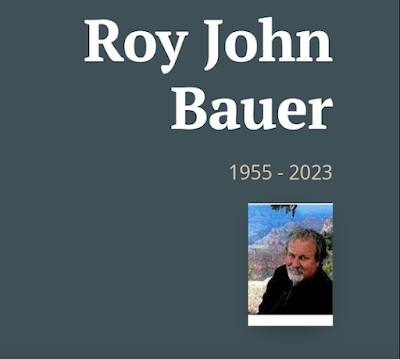
Roy's obituary in LA Times and Register: "we were lucky to have you while we did"

  This ran in the Sunday December 24, 2023 edition of the Los Angeles Times and the Orange County Register : July 14, 1955 - November 20, 2...