Monday, August 27, 2018

What else is new?

Top student loan official at consumer agency quits over Trump policies
(Politico)
By MICHAEL STRATFORD
     The top official overseeing student loans at the Consumer Financial Protection Bureau resigned on Monday in protest of Trump administration policies that he said were harming students and families.
     Seth Frotman, the student loan ombudsman at the CFPB, said in a letter to acting Director Mick Mulvaney that political leadership at the consumer bureau over the last 10 months had repeatedly undermined efforts by career employees to take action against abuses by student loan companies and for-profit colleges.
     "It is clear that current leadership of the bureau has abandoned its duty to fairly and robustly enforce the law," Frotman wrote in the scathing resignation letter, which was obtained by POLITICO. "The Bureau's new political leadership has repeatedly undercut and undermined career CFPB staff working to secure relief for consumers."
     Frotman has served as the consumer bureau’s top student loan official since 2016. He initially joined the CFBP when was being created in 2011, working on military service member issues as a senior adviser to Holly Petraeus.
     Frotman’s resignation, which is effective Sept. 1, underscores the growing frustration by consumer advocates and Democrats that the Trump administration is dismantling protections for the nation’s more than 42 million student loan borrowers who collectively owe $1.5 trillion….
The Incredible, Rage-Inducing Inside Story of America’s Student Debt Machine
(Mother Jones)
     Why is the nation’s flagship loan forgiveness program failing the people it’s supposed to help?
BY RYANN LIEBENTHAL- SEPTEMBER/OCTOBER 2018 ISSUE

Thursday, August 23, 2018

Music for surviving, etc.


Just tell the truth
Did I ever stand a chance?
Against all your rules
And the people that will dance for you


If you're travelin' in the north country fair
Where the winds hit heavy on the borderline
Remember me to one who lives there
She once was a true love of mine


My baby don't care for cars and races
My baby don't care for high tone places


Oh I just wanna go to work --
And get back home, and be something
I just wanna fall and lie --
And do my time, and be something
Well I just wanna prove my worth --
On the planet Earth, and be, something
I just wanna fall in love
Not fuck it up, and feel something


Down in the Willow Garden - Everly Bros
My father he had told me
his money would set me free
if I would poison that dear little girl
whose name was Rose Connelly.

Tuesday, August 21, 2018

A Newsy, Trumpy Kind of Day ("No collusion!")


Saturday, August 18, 2018

Why are land use specific plans violated so often? (More OC corruption)


On OC: Defending Orange County’s Backcountry
(Voice of OC)
     Orange County backcountry activist and land use attorney Gloria Sefton talks about the constant development pressures on Orange County’s land use specific plans, especially those in the canyon areas, and her numerous successful lawsuits to defend the public planning process for canyon residents.
(Podcast)
     OC: Why are land use specific plans violated so often?
     The latest controversy: Santiago Canyon Corridor (Red Rock Canyons)

Another epic economic collapse is coming
George F. Will (Washington Post)

Friday, August 17, 2018

Trump and Truth

A philosopher explains America’s “post-truth” problem (Vox)
“We can never really be post-truth.”
By Sean Illing@seanillingsean.illing@vox.com

     ...To get some answers, I reached out to Simon Blackburn, a philosophy professor at Cambridge University and the author of On Truth. We talked about what’s misleading about the phrase “post-truth,” and why the real problem may stem from a lack of trust....

BLACKBURN: …There’s always been selection of news — people basically read what they want to hear and gloss over things they don’t want to hear. I don’t think that’s a new phenomenon. But it has become easier to do this, and the insidious power of things like Facebook and Twitter exaggerates it.

ILLING: Is the phrase “post-truth” useful? Does it capture something unique about this moment?

BLACKBURN: I think there are legitimate concerns out there, which I sympathize with, but I don’t think this phrase pinpoints them accurately. The message of my book [On Truth] is that you cannot be post-truth.
     You know perfectly well that if you go out in the street and there’s a bus bearing down on you, it’s very important that you believe that there’s a bus bearing down on you. If you’re wrong about that, you could be dead. Your whole life is premised on things like that.
     In that sense, we can never really be post-truth.
     What we do have, though, is a problem in other domains, like politics and religion and ethics. There is a loss of authority in these areas, meaning there’s no certain or agreed-upon way of getting at the truth.
     This is a very old problem in philosophy that goes all the way back to Plato, so it’s not exactly new — although it’s interesting that it’s come to the fore again in the way that it has.
. . .
ILLING: Even the most ardent Trump supporter doesn’t challenge his oncologist’s cancer diagnosis, or walk into a physics conference and question the validity of string theory. It’s only when a proposition is contaminated by politics that truth suddenly flies out the window.

BLACKBURN: The problem is that in politics, people get very attached to hope. They hope for a vision which may or may not be realistic, and may or may not be grounded in truth and facts.
     It’s a bit like conspiracy theorists, who actually thrive on the fact that all the evidence points against their theory, because that just shows that the establishment is clever enough to conceal what’s really going on. People get attached to certain ideas and nothing will shake them. And when convictions start to live in opposition to reason or truth, that’s a very dangerous thing.
     . . . In [my] book, I write about a great American pragmatist, Charles Sanders Peirce, who thought that doubt was such an uncomfortable position that people would do almost anything to seize on a belief or conviction that removed it.
     I think that’s what we’re seeing in politics.
. . .
     One of the first things that a serial liar wants to do is undermine your trust in the providers of fact that would check his lies. If you’re a criminal bent on asserting your innocence, then you undermine trust in the police. You undermine trust in the judiciary. You may be a murderer and a rapist, but you claim it’s the system that’s against you. This is sort of Trump’s best move: It’s the thing he understands most.
     He sprays around accusations of fake news while knowing full well that he’s the liar. It’s a tactical move that absolutely works in a media landscape like ours, and he knows it.

ILLING: …If the choice is between believing something false that provides meaning and comfort or believing something that’s true but inconvenient, why choose the latter?

BLACKBURN: It’s a good question, and I’m not sure how to answer it concisely. Of course, many people vote with their feet, in terms of believing something that’s false but provides meaning and comfort. After World War I, many people thought they could talk through mediums to their dead children, and unsurprisingly, a whole industry of fake mediums appeared to help them.
     Like Nietzsche, who I know you’ve written about, I’m very cautious in matters of truth. If there is no evidence for a belief and lots of evidence against it, it should not matter what you would like to be true or hope or wish to be true. Follow the probabilities and put up with the inconvenience.
     That’s an academic or a scholar speaking, but it has always been the only hope for human progress

Thursday, August 16, 2018

Flex week follies

     Finally went to the college today, a step from a long, hot summer into a chirpy and earnest new semester.
     When I got to the Liberal Arts Building, I encountered several colleagues and friends who complained about President Roquemore’s then-occurring “Breakfast” and “Welcome,” held at the Performing Arts Center. It featured, they said, an inexplicable presentation by an Automobile Club executive about “texting and driving.”
     Don’t do it, he said, I guess.
     Members of the audience were perplexed and annoyed. The situation was sufficiently absurd that some people just walked out.
     “WTF?” they told me.
     I was also told that the session was very poorly attended. The story is that Roquemore had moved the session to Thursday precisely because he was sick and tired of low turnouts on Monday.
     But today’s turnout was especially bad. He even commented on it.
     A sour note.


     Evidently the fellow is unaware that he is a distinctly unpopular president. He is not respected, and he is not liked.
     Nevertheless, the clueless fellow has been the chief exec at IVC for 16 miserable years.
     —Oh. He also showed some baby pics. Sans music.
     Whatever.

     A couple of days ago, at the (new) Chancellor’s welcome, also held at the IVC Performing Arts Center, things came off without a hitch, or so I'm told. The new Chance seemed promising.
     That was followed by the usual SOCCCD Faculty Association Meeting and Luncheon, where the head of the union’s contract negotiating team laid out the facts about summer’s negotiations.
     With the Chancellor and some of the Board present, Comrade Long laid it all out. It was devastating. Or so I'm told.
     The Board is seriously low-balling the faculty, both full-time and part-time. It's as plain as day.

     Below, I’ve posted some videos about opening sessions and board meetings (etc.) from 10 years ago and 20 years ago. Enjoy.

TEN YEARS AGO:


     For some reason, the execrable Raghu Mathur was fascinated with Elvis, and he somehow befriended the "OC Elvis." In the spring of '08, the latter was hired to do his ultra-kitchy Elvis/Neil Diamond show for the Chancellor's Opening Session.
     For this occasion, Raghu arranged for some sort of direct involvement in the entertainment—and it somehow went seriously haywire. Never found out the how or why (Trustee Fuentes alludes to some kind of snafu). And so we all—i.e., OC Elvis, Tom, and the audience—waited while the Vegas-era Elvis music played. But Raghu the Entertainer failed to emerge. Finally, Raghu broke through the drapes and.....
     What did he think he was doing? No-one knows, as near as I can tell. Perhaps the idea was that there can be no greater pleasure, no more elevating experience, than beholding the Great Man, Raghu, lip-sincing Elvis.
     What an asshole.
     One time Raghu showed up as Johnny Carson's "Carnac" character. Sheesh. I'll try to dig that up.

FALL 2008


20 YEARS AGO


Hooker 'n' drug activity?

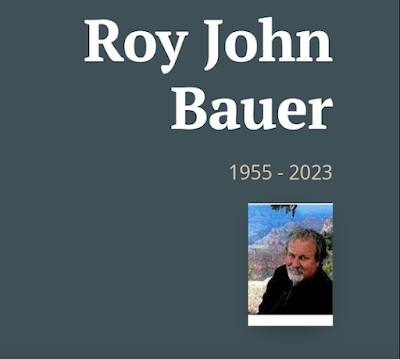
Roy's obituary in LA Times and Register: "we were lucky to have you while we did"

  This ran in the Sunday December 24, 2023 edition of the Los Angeles Times and the Orange County Register : July 14, 1955 - November 20, 2...