Thursday, March 25, 2010

What happened at tonight’s board meeting, mostly

Sheesh. The board is thoroughly settled into a savage Four-to-Three-itude. The New Majority listens to the New Minority carp. Then they wait a beat. Then they do what they wanna.

I’ll have more details tomorrow (or when I get around to it). I’ll just report the big issue tonight: the hire of a consulting firm to help with the Chancellor hire.

VC Bugay contacted 32 consulting firms, got ten responses, and, in the end, five could show for tonight’s board meeting with a presentation.

Board President Don Wagner brought the item (dead last on the agenda) to the front, and so, first thing, we all sat through five—count ‘em, five!—presentations, each taking about twenty minutes, including Q & A.

First at bat was Community College Search Services (CCSS), represented by a fellow named Don (John?) Romo. He sounded like he knew what he was doing. CCSS evidently helped with the hire of the State Chancellor. Sounds like CCSS does the first interviews. They do all the reference checking. They usually help with a “public forum.”

Trustee Fuentes wanted to know if CCSS would be able to find candidates in the private sector and at four-year colleges. Well, said Don, we’ll advertise in the Chronicle, and, dang, everybody reads that. Yeah, said Fuentes, but are we rushing things? Well, no, said Don, there are always great candidates out there. This thing is “doable.”

Fuentes snorted.

Next up was McNaughton and Associates. Mr. Sperry McNaughton (aka Sharp McSlick) was sharp. And slick. After Riverside CCD went out a couple of times and got nowhere, Sharp swooped in and got the job done. He’s into the new technology—two-way live, long-distance interviews. No need to fly everybody around and waste money. Plus streaming video. Would have this thing done by September.

Fuentes asked again about soliciting candidates from the “private sector.” “That is a challenge,” said McSlick. More Fuentean snortage. McSlick seemed to imply that the search committee would work up the brochure/website, and that got Don Wagner worried. This guy was toast, despite his fine suit, expensive shoes, and smooth ways.

Next up was PPL. The only thing I remember about the name is that the “L” is for “leasing.” Mr. Don Averill (aka Mr. Bland Rumple) was as slick as rusty barbed wire, and not nearly as charming. I bet Fuentes brought ‘im in. He opined that quality candidates are not willing to leave their jobs in mid-term, so you’ve pretty much got to aim for a hire for August (maybe no-can-do) or for January. Fuentes purred. [UPDATE: a friend assures me that Mr. Averill, though unslick, has a considerable reputation for integrity. A really good guy, she says.]

Dr. Gary Owens of Academic Search was kinda slick, kinda not. His firm has 32 consultants, and they’re all ready to put in their 2 cents, which adds up to about 64 cents, and I don’t think anybody liked this guy. He reminded me of that guy who played "dirt" on those commercials twenty years ago.

At long last the ACCT gal got up there--I think her name was Judith Breadwine--and presented what that organization does. Gosh, did I hear her say that, usually, you’ve got two trustees on the search committee? Yep. “We’ve got the biggest ‘black book,’” she said. There’re ways of getting around the calendar problem, she said. Gosh, said Don, according to your schedule, we’re not even rushed to hire somebody by August!

I heard yet another snort.

I’ve gotta go, so let’s just say that Fuentes, Lang, and Williams did their predictable “slow down, you move to fast” routine while Padberg, Jay, and Milchiker did a pretty good, “Gosh, let’s get moving!”

Nancy liked CCSS. They’re a California firm. They hired the State Chancellor. Tom didn't like 'em. What else do you need to know!

Bill noted that, quite possibly, by the Fall, we’ll have three new trustees. So let's get moving!

“I call the question!” barked Nancy.

Boom! They hired CCSS.

Fuentes didn’t even bother to snort.

* * * * *
Tonight, a friend sent this:

Underdog candidate for county office takes on OC political machine (Orange County Local News Network)
Colleen Callahan is not a professional politician. By her account, she’s barely even a novice at the game.

But as a candidate for the obscure county office of public administrator, she finds herself taking on an incumbent who Callahan says is part of Orange County’s fabled political machine.
. . .
Callahan and two others – deputy public guardian Kevin Vann and former Orange school board member Steve Rocco – are running in the June 8 primary against incumbent John Williams, a former cop and longtime public official who has connections to many of OC’s top politicians.
. . .
Callahan worked her way up in the agency, eventually being promoted to oversee a clerical unit that handles the legal paperwork necessary to administer estates.

But she said the department took a turn for the worse when Williams was elected and took over in 2003. Williams, who also serves as a board member of the South Orange County Community College District, was often absent from the office and handed off day-to-day management to his deputy, Callahan said.

“I watched the agency deteriorate,” she said. “The way he reorganized the agency and doubled the management, which wasn’t needed … trickled down to where it started affecting the (staff). They had higher caseloads (so) they couldn’t go out into the field and see the mentally ill.”….

Yeah, like I said, only louder

Ah, the news business. I was telling a friend earlier today that, on a particularly slow news day—a glacial day—local reporters will sometimes pick up on some of our fine reporting here at DtB and then run like hell with it.

We laughed. I then briefly checked out the OC Weekly’s crew of bloggers. And waddyouknow. Not for the first time, our old pal Matt Coker did exactly that!

College District Board's Battle Cry: Send Lawyers, Hired Guns and Money
​The South Orange County Community College District … board votes tonight on whether to pay a private lawyer $25,000 in taxpayer funds for helping negotiate what the district calls the "Mathur settlement." Why the district must settle anything with Raghu Mathur, who in January was fired/didn't have his contract renewed/was lovingly told it's time to tackle new career challenges (depending on who is doing the spinning), is unclear. Why it's paying someone other than the lawyers it already pays to handle labor matters is equally murky. What is known is the lawyer in line to get the dough has more skeletons in his closet than a college anatomy department.

He's Phillip Greer, Orange County Republican politicians' attorney of choice.
. . .
Many GOP movers and snakers hire Greer at the recommendation of John Lewis, who is—how did Moxley put it? Oh yes—an "oily" Republican insider from disgraced, possibly prison-bound ex-Sheriff Mike Carona's old camp.

Greer also represents county Treasurer Chriss Street, who a federal judge earlier this month ruled had breached his fiduciary duty when he attempted to build an empire instead of protecting the assets of a trust he was hired to liquidate.

Street was ordered to pay more than $7 million in damages to the End of the Road Trust.
. . .
Irvine Valley College (IVC) philosophy professor and tenacious SOCCCD board critic Roy Bauer is … succinct in his summation of Greer on his Dissent the Blog:

Greer is the OC Republican mafia's consigliere. He's a total creep.
. . .
Your education tax dollars are at work, South County!
U. of California Leaders Call for Expanding Holistic Review in Admissions (Chronicle of Higher Education)
Leaders of the University of California apologized on Wednesday for recent incidents reflecting racial and ethnic intolerance on several campuses and proposed revising admissions policies systemwide to increase the enrollment of minority students. Speaking at a Board of Regents meeting in San Francisco, Mark G. Yudof, the system's president, said he had asked the Academic Senate to consider requiring all nine campuses to adopt consistent holistic-review practices that consider students' life experiences, as well as test scores and grades. The Los Angeles Times quoted Mr. Yudof as saying, "I want a system that is less mechanical and takes a serious look at a range of talents and skills and history, and takes into account poverty."

Mystery Solved!

As duly noted earlier this week, some were puzzled by the absence of requests for IVC Foundation Scholarship letters of recommendation.

Where had all the letters gone?

Now, there's an answer: computer glitch.


Though not really a glitch, per se.

New computer system + modules (podules?) + adaptation time + lack of resources = no letters of recommendation for this season.

Okay, we get it.

Still one wonders about communication. Why no announcement was made early on. Maybe folks thought faculty wouldn't notice or didn't really care.

Rebel Girl is inclined to imagine that we are at our best when we're asked to solve problems together. She thinks, given a chance, we could have worked it out. Maybe someone would have even suggested that we go back to our old ways for just this year. You know, stone tablets. Pen and ink. Letters printed on letterhead.

Too bad this opportunity was missed.

As someone commented earlier this week, faculty often anticipate the scholarship awards ceremony because of their student applicants - because instructors are asked to be part of the process through composing those letters. These instructors are, in a way, rooting for their students. And the students, when they are notified of their awards - are grateful and let their teachers know.

Rebel Girl has no idea of who among her many students applied for scholarship this year.

*

Wednesday, March 24, 2010

Hiring consultant presentations tomorrow night

Item 9.1 on the agenda for tomorrow's meeting of the SOCCCD board of trustees concerns the hiring of consultants to assist in the Chancellor hire:

RE: SOCCCD: Hiring Consultant Presentations
ACTION: Discussion

BACKGROUND

At the February 22, 2010 Board of Trustees meeting, the Board voted to move forward with the Chancellor hiring process per BP 4011.6. The Board appointed a board designee to coordinate the recruitment process. The Board approved a Special Meeting, which was held on March 11, 2010. At this meeting, the Board of Trustees approved the hiring of a consultant to assist with the Chancellor hiring process. The Board approved three consultants to present to the Board at its regular March meeting, as well as any additional consultants the Board felt it appropriate to consider.

STATUS

The Board of Trustees has directed that there be presentations by two consultants in addition to the three previously approved; further, the Board has directed that proposals and possible presentations be sought from four other hiring consultants recommended by Board members.

Tuesday, March 23, 2010

"One Classroom, from Sea to Shining Sea"

Last week in the New York Times Susan Jacoby made a case for real national educational reform in her essay, "One Classroom, From Sea to Shining Sea."

It's a provocative piece that zeros in on local and state control as the root causes that promote inequality of instruction and achievement across the country - along with a "lack of a national curriculum, national teacher training standards and federal financial support to attract smart young people to the teaching profession."

She points out the recent case in Texas:
...the Texas board’s social studies revision forms a blueprint for bad educational decision-making. Chosen in partisan elections, the board members — most lacking any expertise in the academic subjects upon which they are passing judgment — had already watered down the teaching of evolution in science classes when they turned their attention to American and world history. Thus was Jefferson cut from a list of those whose writings inspired 18th- and 19th-century revolutions, and replaced by Thomas Aquinas, John Calvin and William Blackstone. This is certainly the first time I’ve ever heard the “Summa Theologica” described as a spur to any revolution.

No Frenchman could conceive of a situation in which school officials in Marseille decide they don’t like France’s secular government and are going to use textbooks that ignore the Napoleonic code (and perhaps attribute the principles of French law to Aquinas).
Here are her solutions to a problem that is so obvious to all of us who work in higher education:
First, even though a national curriculum cannot be imposed, serious public intellectuals of varying political views need to step up and develop voluntary guides, in every academic subject, for use by educators who do not disdain expert opinion. The historians Diane Ravitch and Arthur Schlesinger Jr., who disagreed politically on many issues, advocated for just such a set of national history standards in the late 1990s. These guidelines met with approval from just about everyone but the extreme fringes of the left and right.

Second, the federal government must invest more in training and identifying excellent teaching candidates. France, faced with a teacher shortage in the early 1990s, revamped its training system so that aspiring teachers would receive a partial salary in the last year of their studies. Prestigious institutes for teacher training were also set up to replace less rigorous programs, with admission based on competitive national examinations. Which makes more sense — investing resources upfront in attracting the brightest young people to teaching, or penalizing teachers who fail further down the road, as No Child Left Behind attempts to do?

Finally, the idea that educational innovation is best encouraged by promoting competition between schools and pouring public money into quasi-private charter schools should be re-examined by both the left and the right. One of the worst provisions in the Obama administration’s $4.3 billion “Race to the Top” program strongly encourages states to remove restrictions on the number of privately managed charter schools. Here again, we have the worst of both worlds: a federal carrot that can lead only to a further balkanizing of a public education system already hampered by a legacy of extreme decentralization.
Yes, now that the reform of our health care system has begun, let's take on the classroom.

To read Jacoby's essay in its entirety, click here.

Monday, March 22, 2010

What’s with South County trustees and the Brown Act?

Capo district violates open-meeting laws for 5th time (OC Reg)
An Orange County judge has ruled that Capistrano Unified's school board violated the state's open-meeting laws in August 2008 when it held a closed-door evaluation of its then-superintendent, the fifth time the governing body had been reprimanded in the past three years for Brown Act violations.

Superior Court Judge David McEachen ... said last week that CUSD did not properly prepare the agenda for the closed-door meeting and thus failed to inform the public that it was holding a discussion about whether to put then-Superintendent A. Woodrow Carter on paid administrative leave. The agenda referred only to a "performance evaluation," not disciplinary action.
. . .
McEachen also ruled that trustees should have provided notice they were bringing in a non-district employee for the evaluation session – school-law attorney Spencer Covert – who served as a one-time, pro-bono consultant during the meeting.

Capistrano Unified's school board has been sternly reprimanded five times for repeated Brown Act violations, the first four by the Orange County District Attorney's Office.

The board was reconstituted entirely between the first four violations and the most recent one, with the new "reform" trustees pledging a new era of accountability and transparency.
. . .
Trustee Mike Winsten stressed that the most recent Brown Act violation was not of the same magnitude as in the past, when the D.A.'s office issued four consecutive stinging reports, the last of which said some former trustees had exhibited "disturbing disdain, if not outright contempt" for constituents when meeting behind closed doors. (Continued)
About a dozen years ago, the SOCCCD board engaged in "persistent and defiant" misconduct re the Brown Act--the anti-secrecy in government law. Or so said the judge.

Their lawyer? That would be CUSD's attorney: Spencer Covert.

CUSD's attorney these days? Phil Greer. Yep. Mathur and Williams' recent advocate.

BTW: The Capo district's current board is dominated by trustees affiliated with Education Alliance. Our own Don Wagner sits on EA's board.

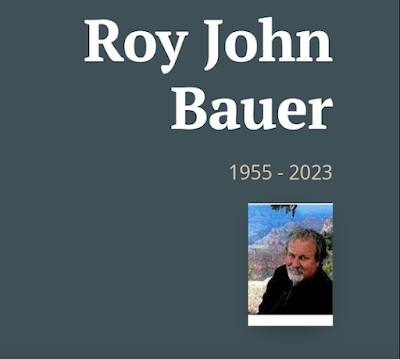
Roy's obituary in LA Times and Register: "we were lucky to have you while we did"

  This ran in the Sunday December 24, 2023 edition of the Los Angeles Times and the Orange County Register : July 14, 1955 - November 20, 2...