Tuesday, November 1, 2005

"COLONIES OF MOLD" AT IVC by Chunk


And they say that IVC doesn’t have any culture!

For quite some time now, faculty have grumbled about the oppressive air in IVC’s A200, a building which houses numerous faculty offices and several classrooms. They grumble about other buildings, too, but today’s story is about A200.

Mr. S has been the noisiest—and the sickliest—wheel on the A200 wagon o' complaint. Last week, he was hackin’ and coughin’ and snivelin’ all over the place, and he sounded like shit. By Thursday, somebody found him drooling, apparently near death, by the water cooler. (Well, not really. But he did squawk a lot.)

Well, that tore it.

And so, on Friday, Ms. P, a scientist who knows her mold, told S to place one of her petri dishes on his office floor. It was the kind of dish used for growing bacteria and whatnot. I think it’s got some kinda slime or something in it, but what do I know?

As per directions, S removed the cover of the petri dish for maybe an hour and a half. He then replaced the cover and put the dish on P’s office desk, where it remained, undisturbed, for the prescribed period.

Peevish Mr. S didn’t think anything would happen. I mean, this “petri dish” is just a little thing of glass, and it was just exposed to the air. —And only for, like, an hour and a half.

Forgetaboutit.

But no. On Monday, Ms. P examined the dish and was amazed to find that over a dozen vibrant and hideous mold cultures had grown in the dish, nearly covering its entire bottom (see).

She studied the spores. She identified several of the cultures, including penicillin.

“Some people are allergic to penicillin,” she declared.

Rebel Girl raised her hand. “Yeah.”


After a while, Ms. P announced that there were one or two little Mold Monsters in the dish that she could not identify! She frowned.

People gathered around and marveled at the mold, careful not to breath. There sure was a lot of it.

“This furry dish was exposed to the air for only an hour and a half?” I asked.

“Yup,” said Mr. S. “Then I put the thing immediately in P’s office.”

I looked at Ms. P. I said: “This can’t be good, right?” Ms. P confirmed that, indeed, it is not good. Indeed, said she, it is very bad.

We all stared at the furry glass. If you squinted, it looked like a tiny spore pizza, with all the fixins.

This morning, P presented the dish to IVC President Glenn Roquemore, a fellow who knows about rocks, I guess, but not about spores. Ms. P communicated her alarm concerning the colonies of mold that had developed so quickly and happily in the A200 petri dish. Reportedly, Glenn didn’t take much convincing.

So it looks like the air conditioning is gonna get a bleach treatment as soon as Glenn can arrange that, cuz he’s on the case.

So expect to see the work done maybe next month.

THE DAY OF THE TEQUILA. Today, at IVC, I encountered a pleasant little “Day of the Dead” exhibit. Rebel Girl had told me about it. She said something about a blender, but I couldn’t find one. Somethin’ about margaritas. She said it was in the A-Quad, which is next to the Clock Tower.

As far as I can tell, nobody at IVC knows that the “A-Quad” exists. Students sure don’t know about it. I once saw a student wander in there. He stopped, looked around, seemingly amazed by the inexplicable nothingness there. He then went off to his class. What was he thinking?

Well, they put this “Day of the Dead” thing right there in the A-Quad, the place least likely to see traffic. When I got there, a pleasant lady was sitting next to the exhibit. She looked like she’d been sitting there, by herself, all morning.

Check out the pics. It’s not a bad exhibit.

But what’s the deal with the Tequila bottle? And what happened to the blender? --CW

UPDATE: (Nov. 2)


I asked Ms. P if she could identify some of the mold in the petri dish. She wrote this down--and I mighta got it wrong, cuz I can't read her writing worth a toot: :

Penicillium - potential allergin

Aspergillus - allergy, resperatory infection

Stachybotrep - allergy, resperatory and skin irritant and some strains give off gases that are nerve toxins.

I noticed some workers on the roof of A200 today, and so it could be that Rocky's on the case after all. (See.)

When I saw her today, Ms. P had a bag with her. Inside the bag was some kind of slime mold or something. She knows about such things. I took a picture.
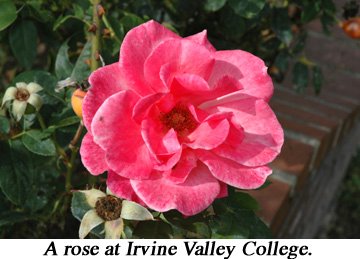
I'm glad I didn't go into the sciences, what with the formaldehyde and the slime and all. I had to get the slime mold out of my mind, so I went out and found a flower. We've got flowers, you know. --CHUNK

Saturday, October 29, 2005

A Clean Well-Lighted Place

“It is the light of course but it is necessary that the place be clean and pleasant.”

--Ernest Hemingway

This week found Rebel Girl making an unlikely tour of campuses: Wednesday found her down at San Diego State, speaking to a bevy of MFAs on the unlikely topic, “Life After the MFA”–-and, especially, life in community colleges--and Friday found her across town at the University Club at UCI, attending an English Faculty Forum where she was pleased to see the high standards and fine teaching at IVC’s department of English generally recognized, and the contributions and leadership of one Kate Clark especially so.

It was an inspiring week, one of those times when one begins to wonder and dream again about what one could do, say, if one worked at a community college where the students were hungry for enrichment: establish a reading series, produce a film series, create a monthly drop-in literary seminar hosted by faculty, design a weekend retreat for creative writers-–one dreams until one returns to reality across town and recognizes the reality of teaching a full load and at the same time managing an academic department (scheduling classes, hiring adjunct, evaluating adjunct (18 evals due by December!), meeting disgruntled students, etc. etc.). Poof! “One,” to quote Three Dog Night, “is the loneliest number that you’ll ever do.”

But it was at San Diego State where Rebel Girl experienced the singular moment of her instructive, if lonely, week. There she was, holding forth in a modest but well-appointed and hygienic room, encircled by graduate students. Previously she had feasted on a wonderful lunch at the Prado at Balboa Park (Black bean soup! Grilled veggie quesadillas! Art on the walls! Lively conversation! Iced tea!) and it had left her feeling not only well-fed, but, gosh darn it all, appreciated.

Anyway, there she was and there they were, 20 some students and their professors. It was going well. I could tell. They asked questions, made notes, smiled at the right moments, laughed at my jokes, looked concerned or alarmed when the rhetorical strategy suggested they should.

Then, at the window, appeared a figure with a squeegee. I watched as the man moved the squeegee across the classroom window. In a few strokes, the window, which hadn’t seemed too dirty to begin with, was even cleaner, sparkling, the bright San Diego sunshine pouring in, brighter than before. And then the man with the squeegee moved on. No one else seemed to notice him. I had the impression that they had seen him-–or someone like him-–before. The man, the squeegee, the window--this wasn’t an unusual occurrence. The man with the squeegee seemed to know what he was doing, as if he had a plan, as if he perhaps did this all the time and had other windows to visit. Perhaps, I thought, he was even paid a living wage to clean these windows in this classroom. Be still my Rebel heart-–social justice and clean windows.

I thought of my office window. It looks out to a faux brick wall. This was someone’s (the architect’s perhaps?) existential joke. In the 14 years I have worked there, I have cleaned the window twice and my officemate, I know, has cleaned it at least once: upon my arrival, he gallantly hung a window box-–but alas, the lack of sunshine and water supply, doomed our greenery. Cleaning the window requires tromping out through ivy and dragging a chair along. Suffice to say, we tolerate the gloom. A colleague in another building confesses that she does her own office windows (another similar tromp through an ivy patch) once a semester, taking along balled up newspaper to swipe away the worst of the clots of cobwebs and leaves. I don’t know what others do.

The windows in our classrooms? See for yourselves. (Pun fully intended.)

Rebel Girl worries that she is writing too much these days about cleanliness, about broom pushing, about dust, grime. She feels as if she’s become one of those scrubbing bubbles one sees on televised commercials, a tornado of eye-watering ammonia, a Ms. Clean to Mr. Clean, he of the bald head and earring, muscleman t-shirt and matching muscles. There are other compelling issues in the world but she is stuck it seems, entranced by the man with the squeegee and what he represents, appalled by the idea of her colleague tromping out through an ivy patch with balled up newspapers and what she represents.

Rebel Girl isn’t involved in facility management at the college and she doesn’t know for sure the source of the disrepair and disregard she sees everywhere. She imagines it is something institutionally pervasive-–the lack of resources, the absence of a systemic plan, the lack of people power to really do the job-–and perhaps, that plague of despair that the Accreditation Team noted. All she knows is that if her mother ran the place (her mother, mother to five daughters), well, none of this would be tolerated; each daughter would be responsible for a single building or quadrant, given a bucket, a mop and toothbrush and other suitable tools and that would be that. My childhood Saturdays smelled of bleach. We lived in the projects but, damn it, we were clean. Of course, if my mother ran the place the cafeteria would serve liquor beginning at noon, but that’s another story.

Rebel Girl does know that she isn’t the only one who desires a clean, well-lighted place, who thinks that perhaps such standards are not extraordinary but instead fundamental for classrooms.

Late last week, before Rebel Girl was visited by the angel with the squeegee, she was talking dirt with another esteemed colleague.

He confided to her that in the late 70s, he worked at The Wherehouse, a chain of what we then quaintly called record stores. Rebel Girl knew what the chain was, even though she was more of a Licorice Pizza gal.

You know what those stores were like, he said, alluding no doubt to the posters and progressive music, the bad t-shirts and incense. But, he added, with emphasis, they were also clean. They cleaned every night, he said, so that when the stores opened in the morning, the workers and the customers were greeted by shining floors and clean counters. It was a given. Every now and again, he said, smiling, not every night but often enough, they’d get out these big floor buffers and buff the floor. "Now, at this place," he said, "twenty minutes after arriving in my office, my eyes water, my nose runs."

The bike racks at the college, he pointed out, have been primed and painted a cheery blue. He doesn’t begrudge the bike racks their paint and primer, he was quick to say, but he did wonder where, in the scheme of urgent tasks, the bike racks came up, before, say, other issues.

What did Rebel Girl tell those MFAs about life in the community college? I praised my students. I bragged about their accomplishments. I commended my colleagues. I acknowledged the attacks on higher education that make the future bleak-–but that make our mission even more necessary. I told them that I never once regretted my decision to teach. It’s all true.

I didn’t mention squeegees and windows and the students who repair furniture for their instructors and bring batteries for the classroom clocks and the mice in the ceiling and the rats’ nests in the portables and the political conditions which find our chancellor obscenely overpaid while the true workers who keep this place going fight for a fair contract. I didn’t mention the sign that, back when he was president, the chancellor famously hung in his meeting room: How do our decisions affect students?

Perhaps the chancellor believes that his salary, the physical conditions of his life and workplace, the resources available to him, his fancy new car, his Big Chair, his fancy new office digs-–perhaps he imagines that he is a symbol of the district’s success, that our students and indeed ourselves can look at him and feel pride. As goes Raghu, so go us all. But he isn’t a symbol of success, of course. He is, if anything, a symbol of wretched excess, squandered resources, the rise of mediocrity and the power of nepotism.

Meanwhile, the lights flicker in my classroom. The mice scurry across the ceiling. The air conditioning fails to work, so we prop open the door with a tin trash can. Soon the room fills with autumn leaves. We laugh and make the most of it. We work hard at transcending our surroundings, very hard. My students know-–they are smart, after all-–that the conditions of their classrooms reveal what the college thinks of them.

To their credit, they think more of themselves than that.

-Rebel Girl

A Prayer for Those Who Cannot Sleep: Many Must Have It

(An adaptation of Hemingway’s adaptation of the Lord’s Prayer-–see his short story: “A Clean Well-Lighted Place.”)

Some lived in it and never felt it but she knew it all was Raghu y pues Raghu y Raghu and pues Raghu. Our Raghu who art in Raghu, Raghu be thy name thy kingdom Raghu thy will be Raghu in Raghu as it is in Raghu . Give us this Raghu our daily Raghu and Raghu us our Raghu as we Raghu our Raghus and Raghu us not into Raghu but deliver us from Raghu ; pues Raghu.

- Rebel Girl

"KILL IT & GRILL IT"--and other FUENTEIAN titles

I’m working on a piece about Trustee Tom Fuentes and his fascinating associations. For instance, there seems to be a Tom Fuentes/Robert Novak connection. Novak, of course, is the reporter/columnist/rat bastard at the heart of the Valerie Plame disclosure scandal that is currently preoccupying the country. He's the guy who allowed himself to be Scooter's megaphone in outing Plame!

Both Novak and Fuentes are on the board of trustees for Phillips Foundation. There are five trustees, including Thomas L. Phillips and Alfred S. Regnery--remember that name. (Phillips’ name has come up before in Dissent. Some of the trustees showed up at a ritzy party put on by Phillips in Corona Del Mar--days before Fuentes was appointed to the board.)

Novak has on occasion quoted Fuentes in his column, and I seem to remember reading an interview by Novak of Fuentes. Once, in a column that discussed the phenomenon of firms giving campaign contributions to both Democrats and Republicans, Novak quoted Fuentes as saying that, in Orange County, "we" call such contributors "whores." Novak seemed to like that. "Whores." (See Townhall.com, March 8, 2002)

Fuentes seems to be a “director” of Eagle Publishing, and Eagle Publishing appears to be the parent company of Regnery Publishing. --Yes, Regnery.

(Digression: according to the Southern Poverty Law Center, in the 30s, a man named William Regnery was one of the signatories of incorporation papers for the "America First Committee," an organization opposed to fighting Nazi Germany. William's brother, Henry, created Regnery Publishing. Henry's son (I think), William Regnery II, is a prime mover in the "white supremacy" movement in the U.S. William II is an heir to the Regnery fortune. As far as I know, William II is not otherwise tied to Regnery publishing. Alfred Regnery, the current director of Regnery, is Henry's son. Got it? Wait a minute! So Alfred is William II's brother, is that right? D'oh!)

If one goes to the website for Regnery Publishing:

http://www.regnery.com/eagle_manage.html

--one will find a section on “corporate information.” There, one finds that, indeed, Fuentes is one among six of the publisher’s “external directors.” (Pat "Wheel" Sajak is another one!)

Regnery’s catalog includes crackpot diet and health books, crackpot conspiracy books, crackpot anti-evolution books, and crackpot Ann Coulter books (is there any other kind?).

Here are some of the fascinating titles I found in Regnery’s catalog [see: http://www.regnery.com/catalog.html]:

Icons of Evolution: Science or Myth?, … "Jonathan Wells has news for you. Everything you were taught about evolution is wrong. Icons of Evolution will light the fires of controversy and provide a brutally honest report of who what we've truly discovered about evolution in recent years"

Kill It and Grill It: A Guide to Preparing and Cooking Wild Game and Fish, … “Filled with hunting anecdotes, detailed instructions on cleaning and dressing your game, helpful hints for those new to cooking wild game….

God, Guns & Rock and Roll, … "Rock and Roll legend, Ted Nugent, contends that a lot of what is wrong with this country could be remedied by a simple, but controversial concept, gun ownership….

Goodbye, Good Men: How Liberals Brought Corruption Into the Catholic Church, Michael S. Rose…“For anyone who has asked how pedophiles or predatory homosexual priests could possibly have been tolerated—here is the answer, in the most explosive book on the Catholic Church in a generation.”

The Millennium Bug: How to Survive the Coming Chaos, Michael S. Hyatt…“Hyatt explains the depth or the millennium crisis in layman’s terms, and discusses how the upcoming situation will affect all of us—and what you can do to protect yourself”

Profscam: Professors and the Demise of Higher Education, Charles Sykes…“Sykes argues that the American universities are turning into professorial clubs where deviation from party lines means expulsion and exile, where perks are paramount, and where taxpayers, parents and students are treated with contempt”

Unfit for Command: Swift Boat Veterans Speak Out Against John Kerry , John E. O'Neill and Jerome R. Corsi…“A shocking indictment of John Kerry by some of the men who know him best.”

Women in the Military: Flirting with Disaster, Brian Mitchell…“Now former Army officer Brian Mitchell offers a sober, thoughtful, but scalding analysis of how the integration of women into our armed forces has proved a national security nightmare”

For an old Dissent article about Fuentes’ associations, see “Trustee Fuentes: some background” in ARCHIVES: September 2002

TRUSTEE FUENTES' "LEISURE WORLD" TV INTERVIEW (2004)

TOM FUENTES AND THE “36-HOUR WORK WEEK”: THE 2004 “LEISURE WORLD” TV INTERVIEW
(October?)

Most of you have heard about this interview, the one in which Trustee Fuentes identifies the unions as a prime source of trouble in education and declares that instructors make on average $100k per year and enjoy a 36-hour work week. Well, I present to you an accurate transcription of that interview, or at least the portion relevant to faculty at SOCCCD. Make of it what you will. --CW

(A portion of the interview only.)

FUENTES: …I am always evermore enthused by the progress of stability that has come to the district…I marvel at what progress in terms of stability has been achieved in recent years. We’re building new facilities…we’re spending the dollars of the district in service to the students by concrete innovation and renovation as is needed for those campuses to be the welcoming places of study for our students.

I can’t give enough recognition to the current leadership of the district. I’m not speaking of myself. I’m speaking of Dr. Raghu Mathur, our Chancellor, who has brought to this district a stability, a professionalism, that is profound. The way that he and his team comes to our board so well prepared, having done the research, having done the planning, having done the preparation for us to be able to continue to move forward.

We’ve had the good fortune in recent years as well to have our trustee colleague Don Wagner at the helm as president. Don, of course, is an attorney locally, a very keen thinker. He’s been a leader of the Federalist Society here in Orange County, which is of course without question one of the most important and significant intellectually recognized voices in the Bush administration currently, and Don serves as a colleague trustee, and he has, along with Raghu and the fine team—especially these…two relatively new and, in the case of Glenn Roquemore, President of Irvine Valley College, and Rich McCullough, our new President at Saddleback College—brought a team together that just has always on their mind, “What serves the students?” “What should be the expenditure of dollars?” We have a budget of $150 million dollars a year. That’s a lot of money to be responsible for, and if it’s not guided by some principled philosophical commitment to serving the students and to being concerned about the taxpayers, it can be wasted.


There are many special interests in the education industry today, and especially the unions. The unions have a very aggressive attitude about getting at the treasury of the school districts, and, uh, community college teachers today, full-time ones as they call it—they call a full-time week a 36-hour work week: 15 hours in the classroom, 15 hours of prep time, 6 hours of office time…

INTERVIEWER: right.

FUENTES: 36 hours, with a two and a half month a year vacation…

INTERVIEWER: right.

FUENTES: One of those [full-time instructors] averages a hundred thousand dollars a year in salary. So it’s a very, very expensive payroll that a community college district has…

INTERVIEWER: But the offset of that is, you have a lot of faculty there who I jokingly refer to—and they don’t like it—as the “freeway flyers”—they may teach one class at Saddleback…

FUENTES: Yeah.

INTERVIEWER: they may teach two classes at Orange Coast; they may go up to Fullerton College one day a week. So those folks—

FUENTES: —those folks


INTERVIEWER: —aren’t making the hundred thousand dollar salary!

FUENTES: They are not, and of course that is one of the issues of concern, because you have about three hundred teachers in a union who garner a very high pay, and then you’ve got freeway fliers, and I have enormous empathy for them because they’re teaching a class or two at Orange Coast, at Fullerton, etc., and not gaining the reward for it because they’re not full-time teachers anywhere.

INTERVIEWER: Some of them have moved into that realm, but some continue to do that until they retire unfortunately…

FUENTES: That’s right.

INTERVIEWER: And you have a mix—I think there’s a formula that the state has imposed on us on that, but you try to hold that balance. You also need of course the stability of those people who are there that 36-hour week to keep the Anthropology department running, to keep the math science department running, because they have to do the structure,

FUENTES: —all part of the balance…

INTERVIEWER: —the department, so that’s obviously one of the challenges that you face as a board member, balancing all of these issues. Another fact that’s always impressed me about the community colleges is an ability to be flexible….

[The interview shifts to a discussion of the “flexibility” of the community colleges and how that flexibility is threatened by a movement in Sacramento to eliminate local control of the colleges. The discussion eventually shifts to a discussion of the Trustees race that was then playing out.]

FUENTES: …there are four seats on the board up this time in the November election. Two of my colleagues have challengers and two do not. And it is unique in that the district is geographically half of Orange County, with perhaps a million residents, and when one has to campaign, it is a very, very costly exercise. And of course in the politics of schools these days, the unions are taking so much more an active role.

INTERVIEWER: Sure.

FUENTES: It was predicted that our own local union here was gearing up in the three hundred thousand dollar range to be able to influence this election. That’s a lot of money, which means that independent or conservative-minded, non-union advocate candidates would have to compete with that, and I think it’s a very dangerous situation that we’re moving in—in all cities and counties and school districts where the labor unions of government employees, be they teachers or be they county workers, have all the more influence through the exercise of dollars from the unions. I think all of us were appalled at the spiking of the county payroll retirement by the board of supervisors recently. I mean we lurch back and say, “How can this happen in Orange County California?” —that you can have such aggressive spiking of retirements and costly imposition on the taxpayers of our community. —Well, it’s the influence of unions in government today, and we need to be very vigilant about that.

[Essentially, the interview ends here.]

—CW

[FOR SOME BACKGROUND ON FUENTES, CHECK OUR ARCHIVES: September 2002]

P.S.;

After I posted the above, I remembered that, when Trustee Fuentes was challenged regarding his "faculty salary" statement, he defended it by saying that the $100K figure includes "benefits," which, as I recall, he valued at $30,000 (or was it $20,000?).

Oh. So that's what you were saying.

I've been working for this district as a full-timer for nearly twenty years, and I make less than 70k. Of course, it's nearly 100k if you add the 30k.

Also, at at least one board meeting, several faculty members showed up to rebut Fuentes' assertion that full-time faculty enjoy a "36-hour work week." Some even presented the fellow with large stacks of grading, explaining how long it takes to work through such stuff!

As I recall, Fuentes' response was to smile a seemingly "knowing" smile. -CW

Thursday, October 27, 2005

"I WILL PREPARE FOR BOARD MEETINGS--IN ADVANCE!"

For their special eight-hour closed session of September 13, the SOCCCD Board of Trustees had but one agenda item: the evaluation of the Chancellor’s performance. But they did not evaluate the Chancellor’s performance at that session. Apparently, the trustees instead focused their attention on developing “goals.”

During that session, the trustees were assisted in developing the “Chancellor’s goals”—and perhaps other goals—by a consultant, Fieldstone Consulting, Inc.

I’ve been told that Fieldstone was paid $6,000 for this work.

Aside from discussing “Chancellor’s goals,” just what the trustees did during that closed session is a bit hazy. You’ll recall that, at that session, the board violated the state’s “open meetings law” by failing to agendize their actual business—namely, the developing of goals—and discussing in closed session a topic (again, developing “goals”) that should be discussed in open session.

On Monday night, the board supposedly corrected that mistake by adopting a series of goals in open session, as the law requires. The resolution that was adopted (on Monday) for the purpose of this correction refers to item 21, and item 21 concerns specifically “board of trustee” goals, not Chancellor’s goals or district goals. So this is all rather confusing.

Let’s move on to other problems.

First, oddly, no one has yet seen the Chancellor’s goals. They remain a secret. They were not revealed on Monday night. They have not been revealed still.

During Monday’s board meeting, IVC Academic Senate President Wendy Gabriella inquired concerning them. Shouldn’t the public be allowed to see the Chancellor's goals?

Trustee Wagner was dismissive. He declared that the public had an opportunity to comment on those goals during the open session immediately prior to the Sept. 13 closed session. (All closed sessions begin with a brief open session in which the board formally adjourns to closed session.)

When the senate president asked how the public could comment on goals it has not seen, Wagner looked miffed, but he didn’t seem to have anything to say. Maybe his lips moved, but nothing memorable came out. Or maybe I've forgotten what he said. Could be.

The “district goals” and “board of trustee” goals (again, their relationship to “Chancellor’s goals” is a bit unclear, at least to me) were, however, revealed to the world on Monday night. At that time, someone (I’ve forgotten who) noted that several—indeed perhaps seven out of the twelve—of the "district goals” are things that the colleges are now doing or have already done. For instance, "goal" 6 is "Develop a public relations, marketing and outreach plan...."

How, it was asked, can these be called the district's “goals,” if they are already achieved or are already being achieved?

Again, as I recall, if there was an answer to this question, it was at best very unclear. Several faces in the board room sported quizzical looks.

I’ve saved the best for last: the “Board of Trustee Goals.” They are remarkable. I will simply list them without commentary. I've highlighted my personal faves.

Do remember, though, that the BOT hired a pricey consultant to help write them:

BOARD OF TRUSTEE GOALS:

1. Establish a vision of the district.

2. Set District and Chancellor goals. Guide and support the Chancellor in accomplishing goals.

3. Adopt an effective instrument to evaluate the Chancellor.

4. Avoid micromanagement of the district and college administration.

5. Be a positive ambassador for the District showing respect for all.

6. Encourage and recognize staff, as appropriate.

7. Prepare for Board meetings in advance.


8. Embrace best practices.

9. Work with fellow Board members and the Chancellor as a team.

10. The Board will conduct annual self-evaluation.


--CW

Tuesday, October 25, 2005

MONDAY'S BOARD MEETING by Chunk

Last night, at an unusually well-attended SOCCCD board meeting, more than seventy members or supporters of the classified employee union (CSEA) showed up in red to try to persuade the board to offer a “fair and decent contract.” Speakers noted that the district’s ratio of classified employee per student is unusually low compared to other systems and districts, and that the classified employees “make this college run.” Faculty members and representatives of the faculty union offered their whole-hearted support. Some who spoke noted that, recently, the Chancellor got a raise—he now makes a quarter million dollars—and that some managers were raised by as much as $40,000. What about classified employees?

The board acted—unanimously—to cure and correct its Brown Act violations of Sept. 13, a victory for open government. IVC Academic Senate Prez Wendy G noted that she as a private citizen, and not as the Senate Prez, asked for the correction, so the senate was not involved. “It could be, but it is not at this point,” she noted ominously.

Evidently, Trustee Padberg won a “5K” race recently, and so there was much blather about that. Marcia Milchiker talked about “Wing Lam Day” at IVC. Evidently, Wing is pleased, for he has never had a “day” before. Wing is a co-founder of something called "Wahoo’s Fish Taco." Go figure.

The trustees yammered a bit about the full-time “Teachers of the Year”: Bob Parsons and Dottie Sherling. Good for them.

Paul Ho described the recent basketball benefit, where he “got to see faculty fall.” Evidently, later, he saw them dance, too. “They are better teachers than dancers,” noted the acutely observant student trustee. Ho explained that he would get a free lunch if he mentioned some of the recent winners of the Model UN competition “on TV.” Congrats to those students.

Ho seems like a breath of fresh air. Have you ever noticed how humorless our board is? The closest thing to laughs with this crew is when Fuentes pulls out one of his harpoons and throws it at an apparent liberal or unionist or Commie or Spaniard. Somebody oughta teach Bill Jay to duck.

Some guy came to discuss the problems with BGS, the building at Saddleback College that has been invaded by “spores.” Apparently, the place is not good for your health. Maybe Dennis White just came from there, cuz he was sporting a patch over his left eye and he sneezed maybe twenty times.

I remember one time goin’ to the bathroom in the IVC administration building. I went in there and did my business with Dennis by my side. “Hi Dennis,” I said. I left him there, and as I exited the bathroom, I saw Dennis walkin’ toward me and then into the bathroom!

“My God,” I thought, “there’s two of ‘em!”

As it turns out, there were three of them, but one died. I.e., Dennis has a twin (a “triplet”?) brother. Whew!

Back to BGS: recently, the Saddleback Valley News (Oct. 21) reported that the "District spent $300,000 to temporarily fix the [mold] problem" since April and that "more than $4 million has been spent to abate and determine the cause of the mold" in the last 19 years. According to the News, the ultimate pricetag for permanently ridding BGS of mold: "an estimated $8.3 million."

Talk about your money pit! BGS is even worse than Raghu! (But not as hard to get rid of.)


Some guy from “GKK”, who is concerned with master planning, came to tell us that our district—especially instruction—is terrific, but our buildings are old and falling apart. He didn’t say anything about the plaques. He also noted an anomaly re Weekly Student Contact Hours. For the first time, the two colleges don’t mirror each other. IVC’s side of the mirror is goin’ down. How come? (See Maas/gkk slide above.)

Another study abroad program in Spain was briefly considered. There was no discussion, and it was quickly approved, but Fuentes and Wagner voted against it. As you know, those pesky Spaniards betrayed our fighting men and women when they pulled out of Iraq. Or so said Mr. Fuentes nearly a year ago.

Suddenly, there were some “Chancellor’s goals,” but we had not seen them. Wagner stated that the public had an opportunity to give the board input about the Chancellor’s goals, since it said right there on the agenda that there was discussion of those goals, but Wendy pointed out that we’ve not seen these goals, so how can the public comment on ‘em? Wagner looked miffed, but he didn’t say anything.

Tracy D came by and asked for $229,850 additional funding for marketing and outreach. As near as I can tell, all the trustees were pleased as punch about our district’s recent marketing efforts. As you know, during the summer, our district ran a 60 second radio commercial (on KROQ-FM) in which a moron represents students, and the announcer, who represents our district, urges the moron to go to college “for hotties.”

Gwen Vendley came by to point out that, at local High Schools, “They do not know in Irvine who we are.” Others nodded gravely.

There were lots of trustee comments, but, for a while, Bill Jay seemed unable to get a word in edgewise. His pressing his button got him nowhere, and so he declared: “my light’s not working!”

Mr Fuentes then quipped: “lights on, nobody home.”

For all I know, lots of important things happened after that, but I wouldn’t know, cuz I left. --CW

Roy's obituary in LA Times and Register: "we were lucky to have you while we did"

  This ran in the Sunday December 24, 2023 edition of the Los Angeles Times and the Orange County Register : July 14, 1955 - November 20, 2...