Wednesday, July 11, 2018

Summer sounds


Well, I feel like an old hobo, I'm sad, lonesome and blue
I was fair as a summer's day, now the summer days are through


Even I've taken my chances
On you and I know


When we laugh into the microphone and sing
With our sunglasses on to our favorite songs


You surely must be trying to break this heart of mine
I thought you knew I loved you and we'd share a love so fine


I was drowned, I was washed up and left for dead
I fell down to my feet and I saw they bled , yeah yeah
I frowned at the crumbs of a crust of bread


     "I consider myself a conservative to a certain extent—you know, I moonlight as an LGBT advocate, I run an LGBT advocacy organization that works with Republicans…and we make the case that freedom is freedom for everyone, and where that really lends itself at this moment in time is to securing full civil rights protections to LGBT Americans because there are still 28 states where you can be fired for being gay—all these things that many Republicans don’t know—and those states are mostly red states, so you need Republicans to engage Republicans on that front. There are many people who are socially conservative who would not say that I’m conservative because of those views."

     [For a helpful account of Buckley's efforts to pull together a conservative movement, consider E.J. Dionne's Why Americans Hate Politics]

Caltech Drops SAT/ACT Writing Test (Inside Higher Ed)
     The California Institute of Technology has announced that it is dropping a requirement that applicants submit the SAT or ACT writing test. Caltech's move follows those of Stanford and Princeton Universities last week. Only 22 colleges appear to still require the writing test, although millions of students take the exams every year. A statement from Caltech said, "Writing and communications skills are valued highly by Caltech and will continue to be evaluated through the information collected in the SAT/ACT verbal sections as well as through required application essays. With this policy, Caltech aims to streamline the application process and eliminate additional testing fees incurred by applicants."....

Tuesday, July 10, 2018

Under Canvas

Canvas Catches, and Maybe Passes, Blackboard (Inside Higher Ed)
     Blackboard dominated the U.S. learning management system market for 20 years, but new data show its cloud-based competitor edging past it.

By Lindsay McKenzie
July 10, 2018

   Canvas has unseated Blackboard Learn as the leading LMS [Learning Management System] at U.S. colleges and universities, according to new data from MindWires Consulting.
     In a blog post on Monday, Michael Feldstein, partner at MindWires Consulting and co-publisher of the e-Literate blog, wrote that Canvas now has 1,218 installations at U.S. institutions, compared with Blackboard’s 1,216. Although the two-figure difference may seem insignificant -- and Blackboard and some of its allies say the data don't accurately reflect the two companies' relative reach -- most analysts agree that Canvas's ascent, largely at Blackboard's expense, is noteworthy.
     “This is a stunning development for a company that seemed to have established an unbreakable market dominance a decade ago,” wrote Feldstein.
     At its peak in 2006, Blackboard controlled approximately 70 percent of the U.S. and Canadian market, with its nearest competitors “far, far behind,” said Feldstein. But slowly Canvas, and others such as Moodle and D2L’s Brightspace, have closed the gap.
Blackboard and Canvas now each control 28 percent of the U.S. higher ed LMS market, followed by 23 percent for Moodle and 12 percent for Brightspace, according to MindWires Consulting's data partner, LISTedTECH.
     The rise of Canvas to near market dominance is one that “nobody would have predicted,” said Feldstein.
     The Canvas LMS is offered by Instructure, a company that was established in 2008 -- several years later than Moodle (2002), D2L (1999) and Blackboard (1997).
     Yet Canvas’s “cloud-based offering, updated user interface, reputation for outstanding customer service and brash, in-your-face branding” have helped it to surpass these more established systems, said Feldstein…. (continue)

Wednesday, July 4, 2018

Hey, baby, it's the 4th of July!


She's waiting for me
When I get home from work
Oh, but things just ain't the same
She turns out the lights
And cries in the dark
And she won't answer when I call her name


Well it's been building up inside of me

For oh I don't know how long

I don't know why

But I keep thinking

Something's bound to go wrong
But she looks in my eyes


Well it seems that everyone we've known
Their love's grown cold, hearts turn to stone
One by one they break, it's such a shame
And now you say you wanna do the same


And each girl in my little red book
Knows you're the one I'm thinking of
Won't you please come back [to me]?
Without your precious love I can't go on
Where can [love] be?


Hey, little girl, you don't have to hide nothin' no more
You didn't do nothin' that hadn't been done before


Well I got down on my knees

(got down on my knees)

The GOP: should I cool it or should I BLOW?


I left the Republican Party. Now I want Democrats to take over.
—Max Boot, WashPost

Conservative, Max Boot
   “Should I stay or should I go now?” That question, posed by the eminent political philosophers known as The Clash, is one that confronts any Republican with a glimmer of conscience. You used to belong to a conservative party with a white-nationalist fringe. Now it’s a white-nationalist party with a conservative fringe. If you’re part of that fringe, what should you do?
. . .
     [Veteran Republican strategist Steve] Schmidt follows in the illustrious footsteps of Post columnist George F. Will, former senator Gordon Humphrey, former representative (and Post columnist) Joe Scarborough, Reagan and Bush (both) aide Peter Wehner, and other Republicans who have left the party. I’m with them. After a lifetime as a Republican, I re-registered as an independent on the day after Donald Trump’s election.
GOP: "Whatever Trump says."
     Explaining my decision, I noted that Trumpkins “want to transform the GOP into a European-style nationalist party that opposes cuts in entitlement programs, believes in deportation of undocumented immigrants, white identity politics, protectionism and isolationism backed by hyper-macho threats to bomb the living daylights out of anyone who messes with us.” I still hoped then that traditional conservatives might eventually prevail but, I wrote, “I can no longer support a party that doesn’t know what it stands for – and that in fact may stand for positions that I find repugnant.”
     I am more convinced than ever that I made the right decision. The transformation I feared has taken place. Just look at the reaction to President Trump’s barbarous policy of taking children away from their parents as punishment for the misdemeanor offense of illegally entering the country. While two-thirds of Americans disapproved of this state-sanctioned child abuse, forcing the president to back down, a majority of Republicans approved. If Trump announced he were going to spit-roast immigrant kids and eat them on national TV (apologies to Jonathan Swift), most Republicans probably would approve of that too. The entire Republican platform can now be reduced to three words: Whatever Trump says.
. . .
A progressive Demo Party?
     Personally, I’ve thrown up my hands in despair at the debased state of the GOP. I don’t want to be identified with the party of the child-snatchers….
     …The current GOP still has a few resemblances to the party of old — it still cuts taxes and supports conservative judges. But a vote for the GOP in November is also a vote for egregious obstruction of justice, rampant conflicts of interest, the demonization of minorities, the debasement of political discourse, the alienation of America’s allies, the end of free trade and the appeasement of dictators.
     That is why I join [George] Will and other principled conservatives, both current and former Republicans, in rooting for a Democratic takeover of both houses in November. Like postwar Germany and Japan, the Republican Party must first be destroyed before it can be rebuilt.
YOU DON'T HAVE TO GO 


GO NOW

STAY

Thursday, June 28, 2018

Miraculous noise


I hand you my ball and chain
You just hand me that same old refrain
I'm walking on a wire, I'm walking on a wire
And I'm falling

I wish I could please you tonight
But my medicine just won't come right
I'm walking on a wire, I'm walking on a wire
And I'm falling

Too many steps to take
Too many spells to break
Too many nights awake
And no one else
This grindstone's wearing me
Your claws are tearing me
Don't use me endlessly
It's too long, too long to myself

Where's the justice and where's the sense?
When all the pain is on my side of the fence
I'm walking on a wire, I'm walking on a wire
And I'm falling

Too many steps to take
Too many spells to break
Too many nights awake
And no one else
This grindstone's wearing me
Your claws are tearing me
Don't use me endlessly
It's too long, it's too long to myself

It scares you when you don't know
Whichever way the wind might blow
I'm walking on a wire, I'm walking on a wire
And I'm falling
I'm walking on a wire, I'm walking on a wire
And I'm falling
I'm walking on a wire, I'm walking on a wire
And I'm falling


When I was a kid, Feliciano lived up the street. But I never saw him, and I'm sure he never saw me.

Wednesday, June 27, 2018

What Socialists were trumpeting in 1906: think "Bernie Sanders" and "Alexandria Ocasio-Cortez"

Ida Crouch-Hazlett, 1904
     Here's my latest post on the Family Jenni Blog. It concerns the existence of a Socialist Party and a Socialist newspaper, in Central Montana, in the early decades of the 20th Century: "Conflict within the ranks": the emergence and disappearance of Socialism in early Twentieth-Century Montana

     Anyone who skims or peruses old Central Montanan newspapers from around the turn of the (19th) century cannot avoid noticing that the denizens of that region were (they still are!) mighty conservative—as in "classical liberal" or "libertarian." True, the conservative and dominant Fergus County Argus had competition, for a time, from the Fergus County Democrat, but these Democrats were not socialists.
     But, as its turns out, socialism did emerge—and soon fade—in Montana during the first two or three decades of the Twentieth Century, and it turns out that Lewistown, of all places, was the locus of the state's first socialist newspaper!.... READ MORE


It's a Barnum and Bailey world...


No, the Supreme Court Won’t Stop a Runaway President (Politico)
The travel-ban ruling today contained a strong rebuke to Trump—but a warning to anyone expecting the Court to be a last line of defense.
By RICHARD PRIMUS
June 26, 2018
     The Supreme Court’s decision upholding President Trump’s travel ban on Tuesday came with a number of interesting wrinkles. It contained an implicit rebuke of Trump’s motives in signing the order, even though it let the order stand. And it repudiated Korematsu vs. United States, a discredited 1944 decision that allowed the U.S. to send Japanese-American citizens to internment camps during wartime, even as it upheld a policy with a discriminatory motive on grounds similar to that 70-year-old ruling….
. . .
     … Sometimes the Court is willing to deem a government action constitutional by pretending that the government’s underlying purpose was something acceptable, rather than something forbidden. And sometimes the Court decides that even if a governmental action is or might be fully unconstitutional, there's simply nothing to be done about it by the justice system. In other words, the Court sometimes lets unconstitutional behavior stand. If Tuesday’s decision is read closely, it is possible to see both of those limits at work. Indeed, it is reasonable to read the opinions to mean that at least five Justices, not just the dissenting four, believe the President acted unconstitutionally in proclaiming his travel ban. But just because something is unconstitutional doesn’t mean that the Court will strike it down.
     Consider first the majority opinion by Chief Justice John Roberts, which found a way to acknowledge the President’s unconstitutional motivations without concluding that the policy itself was unconstitutional. Roberts’s opinion spent no less than a page and a half chronicling some of Trump’s statements, as a candidate and as President, suggesting that the travel ban is motivated by anti-Muslim animus. (The ban, which restricts travel from Iran, Syria, Libya, Yemen, Somalia, Venezuela and North Korea, is the third version of an order that originally applied only to a group of Muslim countries.) An anti-Muslim motive would make the ban unconstitutional under the First Amendment, which forbids the government to disfavor particular religions. But that’s not what Roberts ruled. In the end, the Chief Justice decided for the President on the theory that the policy “can reasonably be understood to result from a justification independent of unconstitutional grounds.” This is what constitutional lawyers call the “rational-basis test”: even if the actual reason the ban exists is rooted in an unconstitutional motive like religious bigotry, the Court will let the ban stand if the judges can imagine some legitimate interest that could have motivated the order….


"I'm Jimmy Carl Black and I'm the Indian of the group."

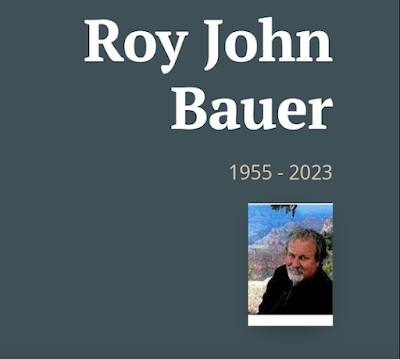
Roy's obituary in LA Times and Register: "we were lucky to have you while we did"

  This ran in the Sunday December 24, 2023 edition of the Los Angeles Times and the Orange County Register : July 14, 1955 - November 20, 2...