Showing posts with label jargon. Show all posts

Friday, September 7, 2012

Taking aim at the technical (vogue) term “rubric”

You should never use jargon for a general audience without first explaining it.
OWL
     Lately, I've been carping about the ubiquitous (in academia) word "rubric." It's cringeworthy.
     Here's a slightly more developed version of my carpage:

The OED:
     I consulted the Oxford English Dictionary, which famously provides the history of words used in the English language.
     Evidently, in English, the word “rubric” was first used, circa 1400, to refer to a “direction in a liturgical book as to how a church service should be conducted…” (OED). Traditionally, these directions were written in red (the word seems to have derived from a French or Middle French word for ocher/ochre).
     That initial meaning quickly gave rise to a prominent new meaning of “rubric” as a “heading” of a section of any book—again, written in red. One hundred and fifty or so years later, the noun “rubric” referred to the heading of a statute in a legal code (the color dimension drops out). By the early 19th Century, the word was used to refer to a “descriptive heading; a designation, a category” (OED).
     Let’s call this the “heading/category” sense of the word “rubric.”
     Also knocking around in recent centuries is/was a meaning of “rubric” such that it refers to an “established custom” or prescription—this strikes me as diverging significantly from the original textual meaning.
     Let’s call this the “rule/prescription” meaning.
     Also, “rubric” was used to refer to a “calendar of saints” or the names on such a calendar, written in red.
     Evidently, by the mid-20th Century, academics (only in England?) used the term as an “explanatory or prescriptive note introducing an examination paper” (OED). This appears to be a very specialized meaning. Interestingly, it seems to derive from “rubric’s” initial meaning as a “direction,” though the color and religious dimensions are absent.

Meanwhile, back in the colonies:
     My Mac’s dictionary* defines “rubric” as a “heading on a document,” but it also cites the original meaning (see above) and two more meanings: a “statement of purpose” and a “category.”
     Merriam-Webster's account of the word starts with the word’s initial meaning: “an authoritative rule; especially: a rule for conduct of a liturgical service….” But it also lists “the title of a statute,” a “category,” a “heading,” an “established rule,” and finally “a guide listing specific criteria for grading or scoring academic papers, projects, or tests.” More on the latter meaning momentarily.

Want rubrics? I'll give yah rubrics
     My own history with the word seems to have brought me in contact with the “category” and “heading” meanings. (“Gosh, doesn’t that investigation belong under the ‘natural philosophy’ rubric?”) Until recently, I had no idea the word is associated with the color red or that it initially referred to directions (in texts, in red) concerning religious rituals. The above lexicographic info does seem to explain why one might have my particular understanding of the word.

* * *
     Nowadays, some academics insist on using the word “rubric” or “rubrics” to refer to assessment tools. They're pretty unapologetic about this peculiar conduct of theirs. No doubt, such use of the word makes them feel special, but it tends to confuse the rest of us, including many academics. It seems clear that this particular usage is new and technical (in some benighted academic circles: education?) and, insofar as it is imposed on a wider (and bewildered) audience, it is classic “jargon,” in the most negative sense of the word. Perhaps the usage derives from the 20th Century usage referred to by the OED: an “explanatory or prescriptive note introducing an examination paper.” But I doubt it. It is a long way from that meaning to the current educationist jargony meaning.

     Wikipedia has an interesting article about “Rubric (academic)”:
     In education terminology, scoring rubric means "a standard of performance for a defined population". The traditional meanings of the word Rubric stem from "a heading on a document (often written in red—from Latin, rubrica), or a direction for conducting church services". …[T]he term has long been used as medical labels for diseases and procedures. The bridge from medicine to education occurred through the construction of "Standardized Developmental Ratings." These were first defined for writing assessment in the mid-1970s and used to train raters for New York State's Regents Exam in Writing by the late 1970s….
. . .
     ...Rubric refers to decorative text or instructions in medieval documents that were penned in red ink. In modern education circles, rubrics have recently (and misleadingly) come to refer to an assessment tool. The first usage of the term in this new sense is from the mid 1990s, but scholarly articles from that time do not explain why the term was co-opted….
     I briefly investigated the history of this entry. In one of its original iterations, the article stated:
     In education jargon, the venerable word rubric has been misappropriated to mean "an assessment tool for communicating expectations of quality." Rubric actually means "a heading written or printed in red" (see main entry for rubric). We may hope that some other term will soon replace the fad for this misuse of rubric.
     In educationese, rubrics are supposed to support student self-reflection and self-assessment as well as communication between an assessor and those being assessed. In this new sense, a rubric is a set of criteria and standards typically linked to learning objectives. [Good God, my eyes are glazing over.]....
     Well, whatever.
   
The "technical terms are superior" fallacy:
     Over the years, I have often encountered a particular fallacy that is available to those who learn the technical terms of a particular field or discipline. The fallacy is committed when one supposes that one’s technical meaning of word X is somehow the true and correct meaning of that word; accordingly, one supposes that that meaning eclipses (or should eclipse) the word’s ordinary meaning (what philosophers call the meanings of “natural language”).
     Utter nonsense. In general, the meanings of words in our language do not require repair or adjustment or replacement. (Admittedly, they do require discerning and informed use.) Technical meanings arise relative to particular disciplines and their particular agendas and issues. Thus, for example, there is a very good reason for the technical term “valid” in logic, just as (no doubt) there is a very good reason for the technical term “mass”** in physics. (I'll stick to logic, which is a discipline within my field.)
     Even so, it would be absurd for logicians to advocate (to the broader community) abandoning the ordinary meaning(s) of “valid” in favor of this technical meaning. The most that can be said in favor of the latter meaning is that our language (as English speakers) would be enriched by adding yet another meaning of “valid,” namely, the logician’s technical meaning. But if we seek to continue to speak (and write) well, we need to keep those non-technical meanings in our quiver.
     It seems to me that it is exactly those fields that are least secure in their standing (in academia, or among intellectuals) that tend to produce “experts” who insist on imposing their technical meanings on the rest of the population. (SLOs, anyone?)
     Education people (or whoever you are): in English, “rubric” means “heading” or “category.” It does not mean “an assessment tool for communicating expectations of quality.”
     If you feel that everyone should adopt this particular technical meaning (shoving aside more venerable meanings), you need to make a case.
     Good luck with that.

*New Oxford American Dictionary, 2nd Edition
**An argument is valid, in the logician’s technical sense, if, upon viewing the premises as true and the conclusion as false, a contradiction arises. Physics: mass is "the quantity of matter that a body contains, as measured by its acceleration under a given force or by the force exerted on it by a gravitational field." --NOAD

Friday, August 26, 2011

Our "strategic plan": a creature of the inane educationist playbook?

     The agenda (available here) for Monday’s meeting of the SOCCCD Board of Trustees (BOT) includes an “information item” (7.3: development of district-wide strategic plan [2011-2014]), which includes a draft of that document. (It’s a three-year plan.)
     Check it out. Arguably, this document is important. Very important.
* * *
     I've begun to read it. I want to say: nothing will ever be right in education until we banish educationists and their idiotic jargon.
     (And I want to say this as well: “poor writing—the only kind found among educationists—is poor thinking.”)
     Here’s the logic of the development of this document—taken right off the page. It’s a marvel of delusion and self-mystification:
First step:
   Identifying CHALLENGES (of next decade). (This is a “DIALOGUE” using “RESOURCES”)

Second step:
   Developing district-wide GOALS [“or institutional goals”(?)] … that articulate … INTENTIONS and AMBITIONS … related to … meeting CHALLENGES

   GOALS are achieved through OBJECTIVES identified in the District Strategic Plan – and the colleges’ Strategic Plans

   In future, district-wide goals will be a CATALYST for, and REINFORCEMENT of, the colleges’ planning [I imagine that this is conceived as a major step in the right direction. I don't mean to question that.]

Third step:
   Developing district-wide OBJECTIVES to identify the INITIATIVES to achieve district-wide GOALS. (Objectives require COLLABORATION and COORDINATION [among various parties])

Fourth step:
   Developing ACTION STEPS to describe ACTIONS to be taken to achieve district-wide OBJECTIVES
     The English language allows its speakers to communicate wonderfully. It is a magnificent thing. Obviously, in some settings, technical terms must be coined and used. Hence, the “mass” of the physicist and the "point" of the geometer.
     But some fields—the notoriously unimpressive field of education is a standout in this regard—seem to generate technical terms unnecessarily, promiscuously, absurdly.
     Educationists will actually stare at you in disbelief if you reveal ignorance of the alleged distinction between, say, “goals” and “objectives.”
     They are clueless. In my experience, they don’t even seem to know that they’ve adopted technical terms. So they impose this idiotic usage on everyone they meet. They manage to be both bullies and dolts.
     Now, suppose that one is reasonably well educated. If so, one will likely be struck by the educationist’s insistence on “the distinction between goals and objectives.”
     Luckily, we have dictionaries. Among other things, dictionaries tell us what we mean by the words we use. An “objective,” according to my dictionary, is “a thing aimed at or sought; a goal." —No surprise there.
     A “goal,” on the other hand (according to my dictionary), is “the object of a person's ambition or effort; an aim or desired result.” Yup.
     Let’s compare these meanings, shall we?
(objective:) a thing aimed at or sought; a goal VS.
(goal:) the object [i.e., the “thing”] of a person's ambition or effort [i.e., what one seeks]
     These words are usually pretty close in meaning. Obviously.
     Now, I did a little looking, and I came across the website for San Diego State University College of Education. SDSUCE’s Department of Educational Technology (EDTEC) provides a glossary of terms.
     Here’s the alleged “Difference between goals and objectives:
Goals are broad objectives are narrow.
Goals are general intentions[?]; objectives are precise.
Goals are intangible; objectives are tangible.
Goals are abstract; objectives are concrete.
Goals can't be validated as is; objectives can be validated.
     Obviously, this is not “the difference between goals and objectives.” It is, rather, the difference between these things when one adopts educationist jargon.

* * *

     Well, OK. If this odd way of thinking and speaking helps, then fine.
     But I’ve never known it to help.
     And here’s a case in point. Read the “strategic plan.” Ask yourself (for instance): how are the participants in this process aided by structuring their thinking in terms of the technical distinction between:
The narrow, precise, tangible, concrete, and “validatable” (“objectives”) VERSES
The broad, general, intangible, abstract, and “unvalidatable” (goals).
—Conceived as the first (the “objectives”) achieving the second (the “goals”)?
     This is so confused, I don’t even know where to begin.
     I’ll leave that for another occasion. (No doubt some of you are way ahead of me.) Let me just say that I long for the day when I can arrive at a meeting in this district in which people just think and speak in plain English:
What is our task? (This ain’t rocket science.)
Will our task change, include more, include less?
Do we anticipate that circumstances will make our task more difficult?
What are our greatest failings and our greatest strengths in pursuing our task?
Etc.
     Now, I know that many who are involved in this strategic plan “development” (many are administrators) are bright and sincere people. My guess is that at least some of them are not (entirely) bedazzled and bedeviled by the above abysmal educationist architectonic.
     But I’m here to tell you: if these people have succeeded at all—and maybe they have—it is despite the nonsense with which this project is saddled from beginning to end.
     And don’t forget: everything in the colleges and the district will be done in terms of this document.
     Isn’t our job hard enough? Must we be forever thwarted by the poor thinking of embarrassing pseudo-experts?

Well, here they are. Presented as "info" Monday night.
FURTHER READING:

• Educating Researchers (pdf), Arthur Levine (2007). An excerpt below:

     This study asked a single question: Do current preparation programs have the capacity to educate researchers with the skills and knowledge necessary to carry out research required to improve education policy, strengthen education practice, or advance our understanding of how human beings develop and learn?
     The answer is that a minority of programs do, but most do not.
     There are three major obstacles to creating and sustaining strong programs:
1. The field of education is amorphous, lacking agreed-upon methodologies for advancing knowledge, common standards of quality and shared mechanisms for quality control;
2. Education doctoral programs have conflicting purposes and award inconsistent degrees; and
3. Research preparation programs are under-resourced, with inadequate funding and insufficient faculty expertise.
     The result is a body of research of very mixed quality, more weak than strong, with low readership by practitioners and policymakers and low citation rates by scholars.
     As a nation, the price we pay for inadequately prepared researchers and inadequate research is an endless carousel of untested and unproven school reform efforts, dominated by the fad du jour. Ideology trumps evidence in formulating educational policy. And our children are denied the quality of education they need and deserve. (P. 71)

• The Awful Reputation of Education Research (pdf) Carl F. Kaestle (1993)

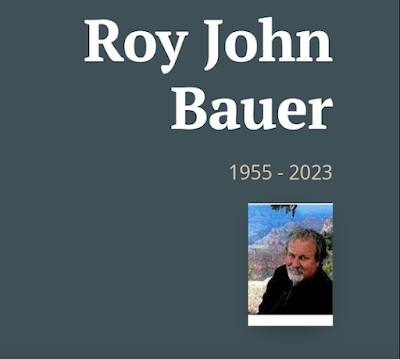
Roy's obituary in LA Times and Register: "we were lucky to have you while we did"

  This ran in the Sunday December 24, 2023 edition of the Los Angeles Times and the Orange County Register : July 14, 1955 - November 20, 2...