Sunday, November 6, 2005

WHAT'S WITH TRUSTEE PADBERG?

1. Old Dissents (and ‘Vines) to be archived at UCI.

Not for the first time, we’ve heard that folks doing archiving at UCI wish to archive the Dissent. We’ll likely pursue that this time. We’ll keep you posted.

2. NANCY PADBERG NO LONGER WORKING FOR THE COUNTY?

There’s been talk that Nancy Padberg no longer works for John Williams in his job at the County. Anybody know anything about that?

Here’s some background:

Back in 2002, John Williams, a former bailiff, ran for county “public administrator.” With tongue firmly in cheek (or no?), the OC Weekly endorsed Williams:

Slim Pickin’s: Hold your nose and vote for these few good candidates

PUBLIC ADMINISTRATOR: John S. Williams

Four people are running for public administrator, the county official who manages the estates of losers who die without wills or anyone willing to handle their affairs. Mark your ballot for John S. Williams, who has no experience for the job (he’s a retired sheriff’s sergeant). He also sits on the SOCCCD board of trustees, thanks to heavy backing from the Christian Coalition and since-deposed leaders of a corrupt college teachers union. Williams has served during a tumultuous period that saw the district nearly go belly-up, a stinging state accreditation report, the departure of several longtime employees (including two chancellors and scores of presidents at Saddleback and Irvine Valley colleges), the obliteration of policies that allowed faculty and staff to have a say in running their campuses, and the fireworks that surrounded allegations that a since-retired trustee (and Williams chum) loved Nazis. South County voters, who are apparently as blind to all the crap going on in the district as they are to Christian fundamentalists’ assault on all of public education, keep electing Williams. So it’s up to the rest of us to help our southern comrades with a three-pronged strategy: elect Williams public administrator, eat your wills, and tell your heirs to butt out when the county comes looking for someone to administer your estate. Bury this guy in so much work he’ll be forced to step down from the college district. Our kids—even our Ecstacy-juiced, Teva-wearing, Girls Gone Wild-watching college kids—deserve better.
(OC Weekly, March 1-7, 2002)

Shockingly, the post-corruption faculty union endorsed Williams too.

(Incidentally, I ran across a page of information that Williams provided to the League of Women Voters of California during his 2002 campaign. Williams here lists his “priorities,” including that he will “OPPOSE EL TORO AIRPORT.” Now tell me, what’s this Corpse Patrol job of his got to do with the airport? Exactly nothing.

Williams also lists his “key endorsements.” Among them: “Armando Ruiz, Coast College Dist. Board President.”

You’ll recall that Mr. Ruiz was one of the few district faculty low enough to play ball with Raghu Mathur and the Board Majority. Not long after he was transferred from Saddleback to Irvine Valley, he became an administrator, a notoriously bad administrator. Naturally, Raghu loved 'im.

Well, while Armando was messing up our colleges, he was messing things up over at the Coast District, where he's been a trustee for years. Recently, he acquired infamy owing to a scam he was running against the taxpayer. I'll let the Committee to Recall Ruiz do the explaining:

“Ruiz has fleeced taxpayers, collecting TWO years of retirement for every ONE year he worked. He also ‘double-dipped,' and now collects BOTH a Board salary and a retired Board member's pension for the same position. In addition, Ruiz deceived voters by using a false ballot designation on last November’s ballot, and has charged taxpayers over $107,000 for ‘conference’ travel during his term—while classrooms are begging for books and supplies.”

While we’re on the subject of boondogglery, I seem to recall some maneuvering at the county that resulted in Williams turning his tiny post into a real gravy train. Does anyone have info on that? Let us know.)

Well, in November of 2002, Williams was succcessful: he won the “Public Administrator" post. But, not long after he started his new job, he caught the attention of the Weekly again:

Anyone who has attended meetings of local boards, councils and commissions is used to the superfluous public ass-kissing elected officials give one another. Taking such manufactured passion to new depths is the SOCCCD board of trustees, which governs Saddleback and Irvine Valley colleges. At a recent meeting, board president Don Wagner paused at one point to congratulate trustee Tom Fuentes for being re-elected to a 10th term as Orange County Republican Party chairman. Fuentes had earlier toasted fellow trustee John Williams for being sworn in as Orange County’s new public administrator—the part-time elected official who oversees conservancies for feeble-minded folks who can’t care for themselves and have no next-of-kin.

But what Fuentes did next says a lot about Orange County Republicans, county government and that particular school board: he congratulated fellow trustee Nancy Padberg for being appointed to Williams’ professional staff. The same board awarded a plum district administrative job to the trustee Padberg replaced [namely, Teddi Lorch]—even though her qualifications were questionable. The funny thing...is Williams was first swept into his trustee seat as a reformer who would protect South County taxpayers by ending rampant cronyism on the part of faculty and administrators.

Dissident trustee David Lang has long complained of cronyism practiced by Fuentes, Williams, Padberg, Wagner and Dorothy Fortune—Republicans who cast identical votes so often you’d think they trained at the old Soviet Politburo. We would have asked Padberg if she foresees any conflicts, but she was too busy nominating her new boss Williams to a seat on the California Community College Trustees board of directors.
—Matt Coker, OC Weekly, 3/14/03

—Well, the days in which Fuentes, Williams, Wagner, Fortune, and Padberg voted as a block are long over, and not merely because Dot “Central Cal” Fortune resigned (amid allegations that she no longer lived in Orange County). Padberg has revealed a reasonable streak—and a dislike of Raghu Mathur—and one suspects that she has thus incurred the wrath of Fuentes and the rest of his Mathur-loving trustee contingent, which seems to include John Williams.

Well, the word is that Padberg no longer works for Williams. Anybody know anything about that? Again, let us know! —CW

Thursday, November 3, 2005

“A PERVASIVE SENTIMENT”—THE ACCRED TEAM MEETS WITH IVC FACULTY

NOVEMBER 3:

At about 12:30 this afternoon, two representatives of the ACCJC/WASC (the accrediting agency) met with about twenty IVC faculty. As you know, full teams visited both colleges of the district about a year ago, and ACCJC subsequently granted both colleges “reaccreditation,” but in the very lowest category. Essentially, each college got a D.

This did not prevent Lang & Mathur from spinning the ACCJC's judgment as a "thumbs up" and a "validation...of the excellence of our institutions.“ (See press release, 2/2/05.) In truth, our colleges were in a bit of trouble.

Colleges that get a D are expected to make improvements in response to the agency's recommendations. Further, the colleges are required to submit “progress reports”—to be followed by a visit from the Accreds. Well the reports are in, and now the Accreds are visiting.

IVC's progress report, which cited many positives and some negatives, was described by more than one of its authors as being "as honest as it could be." Translation: it coulda been much more negative, but an effort was made to look on the bright side. That's hard to do at IVC, which seems to be in an eternal night, especially now that Raghu Mathur has won fabulous cash prizes and the keys to a fancy Mercedes.


Well, Accred bigwig Deborah Blue and her colleague finally showed up in our hideous portable building at about 12:40 and the meeting got underway. Blue asked about the “Technical Assistance” (TA) matter. There are particular issues (e.g., defining faculty duties and responsibilities, I think) that remain unresolved between the district and the faculty, and both the Academic Senates and the district have expressed a desire to pursue “technical assistance,” that is, they desire bringing in objective third parties to hammer out a reasonable agreement.

IVC’s Senate President explained that, in the past, the district (i.e., Chancellor Mathur) has consistently rejected the TA route--until, that is, the intransigent district was smacked around by the Accrediting agency’s recommendations a year ago. She also explained that the two academic senates are pursuing the possibility of having the AAUP, those champions of Academic Freedom, represent faculty in TA.

Blue asked how long it has been that the district has rejected technical assistance. The Senate Prez explained that the district’s anti-TA ways go back at least to 2000, when the district changed Board Policy 2100.1, which concerns delegation of district authority to Academic Senates. The version of 2100.1 that then existed provided that 2100.1 itself could only be changed upon mutual agreement of district and senates.

With typical ruthlessness, back in 2000, the board unilaterally changed 2100.1. Upon doing so, 2100.1 no longer included the “mutual agreement” provision!

No, I’m not making this up. See our ARCHIVES, starting with February, 2000.

Given that TA was impossible (for it can occur only when both parties seek it), the Academic Senates had no recourse but to appeal to the State Chancellor’s Office. That agency ultimately judged that the district’s actions violated Title V of the Ed Code. No surprise there.


THE PLAGUE OF DESPAIR. Blue asked about the campus climate—now, verses a year ago.

Several instructors said that relations between the Academic Senate and the college administration have improved over the past year. Faculty and administration have worked well together. For instance, they successfully collaborated in writing the accreditation “progress report.”

But, according to these instructors, the faculty’s relationship with the district (i.e., with the Chancellor and Board) remains dismal. To illustrate the point, Lewis explained that faculty have enjoyed a good working relationship with Vice Chancellor Tom Anderson. But it appears that, owing to Anderson’s coziness with faculty, he has now been handed his walking papers. The Board has sent the poor fellow to the Siberian frontier of Tustin, where he cleans quonset huts and rotates blimps.

Thus, re relations between IVC and the district, the “plague of despair” detected by the Accreditation team a year ago persists. Or so said several faculty.

OVERWORKED DEANS. Ms. K explained that she has been absent for four years (she was away to serve as president of the state academic senate), and, now that she’s back, here is what she sees: overworked deans, who simply can’t do all that is required of them. Faculty have scrambled to take up the slack, typically without compensation, she said. If I heard her correctly, she asserted that she now finds an “appalling, dismal lack of energy.”

Despite these difficult circumstances, chimed the Senate Prez, remarkable things have been accomplished, e.g., Program Review, work on the SLO initiative, and the progress report, among other things.
A CULTURE OF MICROMANAGEMENT. Among the elements of the Accrediting Agency’s ding-age of last January was that old favorite, board “micromanagement.” (Weren't they dinged for this back in '98? Do these people ever learn?)

Lewis explained that the board has adopted an “interesting” approach to that complaint, namely, the Board President (Lang) has become the de facto Chancellor. Routinely, when asked a question, the Chancellor refers the questioner to Mr. Lang, the man with the answers. (Occasionally, jokesters refer to the omnipresent Lang as "the Chancellor.")

Lewis hypothesized that the trustees are so entrenched in their culture of micromanagement, that they can no longer see it even when they’re in it up to their collective eyeball.

One instructor asserted that some of our administrators try to do a good job, that they genuinely want to do the right thing, but they are fearful. More than one instructor described these administrators as always “looking over their shoulders.” They operate in “an environment of fear.”

“Yeah,” said one wit, “they don’t want to get Andersoned.”

NOT OPTIMISTIC. Greg noted that the Senate has been working very hard to do the necessary work of the college, including writing the progress report. He asserted that the senate has worked diligently for this college to retain its accredited status.

That is true. The senate has led the way in accomplishing necessary tasks, when adminsitration has dropped the ball, or kicked it into the strawberry fields. But the Senate has not received much support. "I'm not optimistic," said one instructor.

There are Mathurians who have joined their hero in consistently portraying faculty as working against the functioning of the college and against reaccreditation. Anyone who has served on the Academic Senate in recent years knows that the truth is entirely to the contrary.

I recall Padberg and Wagner's election to the board in 1998. I invited the two to campus to show them around. Wagner took me up on it. I told him that he needed to get to know us, to talk with us. I suggested that the board is too removed from the actual workings of the colleges. Trustees need to get their own impressions of who faculty are and what we do based on interaction and conversation.

But it was to no avail. It seems that the trustees are largely content to let Mathur do their thinking for them with regard to conditions in the trenches. And, according to the notoriously dishonest Raghu, faculty are trying to "destroy the colleges" and "undermine our accreditation."

Trustees, are you reading this? GO ASK GLENN. Ask him if faculty are working to undermine this college. Skip Raghu. Go to Glenn. Go to Dennis. Got to Gwenn. Please pass Goo. Go directly to THOSE WHO WORK WITH FACULTY. Hear what they have to say. Please!

One instructor noted that IVC has for some time been in the mid-range category for college size, but, recently, the college has officially dipped back down to the “small college” category!

Another instructor explained that, for a time (namely, last spring), the college community was palpably optimistic. That optimism sprung from one thing: the likely prospect of non-renewal of Raghu Mathur’s contract!

The “spirit of despair was lifted,” he said.

Ah, but then, all of a sudden, spirits crashed to earth. Not only was Mathur’s contract renewed, but the fellow received a stunning raise, some of it retroactive. He's the Quarter Million Dollar Man.

One instructor was bothered by such negative talk. She insisted that the college is “moving forward,” that things are “working well.” But others in the room sought to refute her perception.

A long-time supporter of Raghu Mathur—Mr. R, a fellow infamous for his blatant bowdlerization of the 1998 IVC accreditation self-study drafts—spoke in defense of his pal. R reported that he does not see people walking around in despair.

R described a board meeting (in May) in which people emerged from beneath various rocks to offer encomia of praise for Mathur.
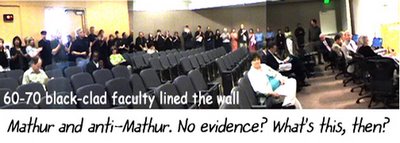
He noted, too, that the final paragraphs of the progress report refer to a “climate of despair.” Mr. R denied that there is any evidence at all that such a climate exists or that Chancellor Mathur’s leadership is unpopular.

Mr. R did not quote from the progress report. Here is what it actually says:

From the faculty and staff perspective, the most significant issue relative to the climate of despair that continues to plague the college is the renewal of the chancellor’s contract on June 21, 2005. On May 17, 2004, 93.5% of the district faculty voted no confidence in the chancellor. (The California League of Women Voters mailed 318 ballots to all full- time faculty within the district. 246 faculty participated in the vote (77% of the faculty responded). 230 votes (93.5%) expressed no confidence in the leadership of the chancellor; 15 votes (6%) expressed confidence in the leadership of the chancellor; one ballot was unmarked, and counted as an abstention. The vote was conducted by and certified by the California League of Women Voters.) It is the view of the faculty that by renewing the chancellor’s contract, the board majority has continued to dismiss the voice of the faculty thereby causing dismay, concern, and further despair…Despite repeated efforts by the faculty association, IVC and SC academic senates, the classified senate, and CSEA to convey their concerns to the board president and other members of the board, the trustees voted 4-2-1 to renew the contract and granted the chancellor a substantial retroactive increase in salary as well as a substantial salary increase. These actions outraged dissenting board members and faculty. Approximately 75 faculty members attended the June 21, 2005 board meeting. Almost all faculty who attended the meeting were there to protest, to voice their opposition to the board’s actions regarding the chancellor’s contract….

DYSFUNCTION. Mr. D spoke up to rebut R’s points. He reminded us of the stunning “no confidence” vote re Mathur (Raghu’s third and least "confident"). If that is not evidence of difficulty with the district's leadership, then what is?

Mr. D described a Board forum that he attended in which participants were inspired to ask such fundamental questions as, “Who are we (as a college)?” That, at this late stage, we must ask such questions reveals our profound dysfunction, he said. We have many highly-paid administrators, said D, and yet the board seems to cast about for volunteers among faculty to assist in recruitment and public relations.

Mr. D noted that we have a culture of “inbreeding”—the same people persist in positions of authority—and that an inbred culture can produce “no new ideas.” We need fresh, new, visionary leadership, he said.
STILL DICTATING. Blue asked about the “Chancellor’s Cabinet,” the weekly occasion in which governance groups interact with the Chancellor. How is that going?

The Senate Prez cited one major improvement, for the senate and other governance groups are now permitted into “docket meetings”—where board topics are decided. But, said she, Chancellor’s Cabinet continues to be the Chancellor’s dictating to other governance groups.

She cited the case of the recently-adopted district and trustee “goals.” These goals were developed in a closed session in mid-September. When these goals were finally revealed, some governance groups noted the curious fact that many of them had already been achieved.

One naturally suspects that the Chancellor and the board were listing such goals merely for the sake of appearing to be achieving things.

When governance groups questioned the inclusion of these curious goals, the Chancellor ”shut them down.”

The good news, said the Senate Prez, is that all of the governance groups, aside from the Board/Chancellor, are on the same page. They express a unified view, but it does not matter. Their view has “no impact.”

THE BIG BUT. After about 35 minutes, time had run out. Dr. Blue then stated that she and her colleague seemed to be sensing a better atmosphere this time, that people at the college were more willing to speak up.

—But there’s always a BIG BUT.
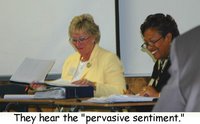
She added: But we hear what the “pervasive sentiment” is.

She did not identify the sentiment. She didn’t have to. —CW

Tuesday, November 1, 2005

"COLONIES OF MOLD" AT IVC by Chunk


And they say that IVC doesn’t have any culture!

For quite some time now, faculty have grumbled about the oppressive air in IVC’s A200, a building which houses numerous faculty offices and several classrooms. They grumble about other buildings, too, but today’s story is about A200.

Mr. S has been the noisiest—and the sickliest—wheel on the A200 wagon o' complaint. Last week, he was hackin’ and coughin’ and snivelin’ all over the place, and he sounded like shit. By Thursday, somebody found him drooling, apparently near death, by the water cooler. (Well, not really. But he did squawk a lot.)

Well, that tore it.

And so, on Friday, Ms. P, a scientist who knows her mold, told S to place one of her petri dishes on his office floor. It was the kind of dish used for growing bacteria and whatnot. I think it’s got some kinda slime or something in it, but what do I know?

As per directions, S removed the cover of the petri dish for maybe an hour and a half. He then replaced the cover and put the dish on P’s office desk, where it remained, undisturbed, for the prescribed period.

Peevish Mr. S didn’t think anything would happen. I mean, this “petri dish” is just a little thing of glass, and it was just exposed to the air. —And only for, like, an hour and a half.

Forgetaboutit.

But no. On Monday, Ms. P examined the dish and was amazed to find that over a dozen vibrant and hideous mold cultures had grown in the dish, nearly covering its entire bottom (see).

She studied the spores. She identified several of the cultures, including penicillin.

“Some people are allergic to penicillin,” she declared.

Rebel Girl raised her hand. “Yeah.”


After a while, Ms. P announced that there were one or two little Mold Monsters in the dish that she could not identify! She frowned.

People gathered around and marveled at the mold, careful not to breath. There sure was a lot of it.

“This furry dish was exposed to the air for only an hour and a half?” I asked.

“Yup,” said Mr. S. “Then I put the thing immediately in P’s office.”

I looked at Ms. P. I said: “This can’t be good, right?” Ms. P confirmed that, indeed, it is not good. Indeed, said she, it is very bad.

We all stared at the furry glass. If you squinted, it looked like a tiny spore pizza, with all the fixins.

This morning, P presented the dish to IVC President Glenn Roquemore, a fellow who knows about rocks, I guess, but not about spores. Ms. P communicated her alarm concerning the colonies of mold that had developed so quickly and happily in the A200 petri dish. Reportedly, Glenn didn’t take much convincing.

So it looks like the air conditioning is gonna get a bleach treatment as soon as Glenn can arrange that, cuz he’s on the case.

So expect to see the work done maybe next month.

THE DAY OF THE TEQUILA. Today, at IVC, I encountered a pleasant little “Day of the Dead” exhibit. Rebel Girl had told me about it. She said something about a blender, but I couldn’t find one. Somethin’ about margaritas. She said it was in the A-Quad, which is next to the Clock Tower.

As far as I can tell, nobody at IVC knows that the “A-Quad” exists. Students sure don’t know about it. I once saw a student wander in there. He stopped, looked around, seemingly amazed by the inexplicable nothingness there. He then went off to his class. What was he thinking?

Well, they put this “Day of the Dead” thing right there in the A-Quad, the place least likely to see traffic. When I got there, a pleasant lady was sitting next to the exhibit. She looked like she’d been sitting there, by herself, all morning.

Check out the pics. It’s not a bad exhibit.

But what’s the deal with the Tequila bottle? And what happened to the blender? --CW

UPDATE: (Nov. 2)


I asked Ms. P if she could identify some of the mold in the petri dish. She wrote this down--and I mighta got it wrong, cuz I can't read her writing worth a toot: :

Penicillium - potential allergin

Aspergillus - allergy, resperatory infection

Stachybotrep - allergy, resperatory and skin irritant and some strains give off gases that are nerve toxins.

I noticed some workers on the roof of A200 today, and so it could be that Rocky's on the case after all. (See.)

When I saw her today, Ms. P had a bag with her. Inside the bag was some kind of slime mold or something. She knows about such things. I took a picture.

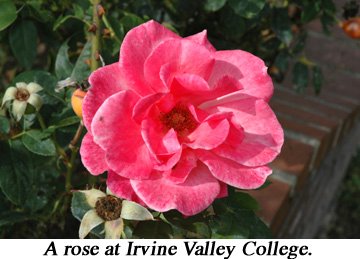
I'm glad I didn't go into the sciences, what with the formaldehyde and the slime and all. I had to get the slime mold out of my mind, so I went out and found a flower. We've got flowers, you know. --CHUNK

Saturday, October 29, 2005

A Clean Well-Lighted Place

“It is the light of course but it is necessary that the place be clean and pleasant.”

--Ernest Hemingway

This week found Rebel Girl making an unlikely tour of campuses: Wednesday found her down at San Diego State, speaking to a bevy of MFAs on the unlikely topic, “Life After the MFA”–-and, especially, life in community colleges--and Friday found her across town at the University Club at UCI, attending an English Faculty Forum where she was pleased to see the high standards and fine teaching at IVC’s department of English generally recognized, and the contributions and leadership of one Kate Clark especially so.

It was an inspiring week, one of those times when one begins to wonder and dream again about what one could do, say, if one worked at a community college where the students were hungry for enrichment: establish a reading series, produce a film series, create a monthly drop-in literary seminar hosted by faculty, design a weekend retreat for creative writers-–one dreams until one returns to reality across town and recognizes the reality of teaching a full load and at the same time managing an academic department (scheduling classes, hiring adjunct, evaluating adjunct (18 evals due by December!), meeting disgruntled students, etc. etc.). Poof! “One,” to quote Three Dog Night, “is the loneliest number that you’ll ever do.”

But it was at San Diego State where Rebel Girl experienced the singular moment of her instructive, if lonely, week. There she was, holding forth in a modest but well-appointed and hygienic room, encircled by graduate students. Previously she had feasted on a wonderful lunch at the Prado at Balboa Park (Black bean soup! Grilled veggie quesadillas! Art on the walls! Lively conversation! Iced tea!) and it had left her feeling not only well-fed, but, gosh darn it all, appreciated.

Anyway, there she was and there they were, 20 some students and their professors. It was going well. I could tell. They asked questions, made notes, smiled at the right moments, laughed at my jokes, looked concerned or alarmed when the rhetorical strategy suggested they should.

Then, at the window, appeared a figure with a squeegee. I watched as the man moved the squeegee across the classroom window. In a few strokes, the window, which hadn’t seemed too dirty to begin with, was even cleaner, sparkling, the bright San Diego sunshine pouring in, brighter than before. And then the man with the squeegee moved on. No one else seemed to notice him. I had the impression that they had seen him-–or someone like him-–before. The man, the squeegee, the window--this wasn’t an unusual occurrence. The man with the squeegee seemed to know what he was doing, as if he had a plan, as if he perhaps did this all the time and had other windows to visit. Perhaps, I thought, he was even paid a living wage to clean these windows in this classroom. Be still my Rebel heart-–social justice and clean windows.

I thought of my office window. It looks out to a faux brick wall. This was someone’s (the architect’s perhaps?) existential joke. In the 14 years I have worked there, I have cleaned the window twice and my officemate, I know, has cleaned it at least once: upon my arrival, he gallantly hung a window box-–but alas, the lack of sunshine and water supply, doomed our greenery. Cleaning the window requires tromping out through ivy and dragging a chair along. Suffice to say, we tolerate the gloom. A colleague in another building confesses that she does her own office windows (another similar tromp through an ivy patch) once a semester, taking along balled up newspaper to swipe away the worst of the clots of cobwebs and leaves. I don’t know what others do.

The windows in our classrooms? See for yourselves. (Pun fully intended.)

Rebel Girl worries that she is writing too much these days about cleanliness, about broom pushing, about dust, grime. She feels as if she’s become one of those scrubbing bubbles one sees on televised commercials, a tornado of eye-watering ammonia, a Ms. Clean to Mr. Clean, he of the bald head and earring, muscleman t-shirt and matching muscles. There are other compelling issues in the world but she is stuck it seems, entranced by the man with the squeegee and what he represents, appalled by the idea of her colleague tromping out through an ivy patch with balled up newspapers and what she represents.

Rebel Girl isn’t involved in facility management at the college and she doesn’t know for sure the source of the disrepair and disregard she sees everywhere. She imagines it is something institutionally pervasive-–the lack of resources, the absence of a systemic plan, the lack of people power to really do the job-–and perhaps, that plague of despair that the Accreditation Team noted. All she knows is that if her mother ran the place (her mother, mother to five daughters), well, none of this would be tolerated; each daughter would be responsible for a single building or quadrant, given a bucket, a mop and toothbrush and other suitable tools and that would be that. My childhood Saturdays smelled of bleach. We lived in the projects but, damn it, we were clean. Of course, if my mother ran the place the cafeteria would serve liquor beginning at noon, but that’s another story.

Rebel Girl does know that she isn’t the only one who desires a clean, well-lighted place, who thinks that perhaps such standards are not extraordinary but instead fundamental for classrooms.

Late last week, before Rebel Girl was visited by the angel with the squeegee, she was talking dirt with another esteemed colleague.

He confided to her that in the late 70s, he worked at The Wherehouse, a chain of what we then quaintly called record stores. Rebel Girl knew what the chain was, even though she was more of a Licorice Pizza gal.

You know what those stores were like, he said, alluding no doubt to the posters and progressive music, the bad t-shirts and incense. But, he added, with emphasis, they were also clean. They cleaned every night, he said, so that when the stores opened in the morning, the workers and the customers were greeted by shining floors and clean counters. It was a given. Every now and again, he said, smiling, not every night but often enough, they’d get out these big floor buffers and buff the floor. "Now, at this place," he said, "twenty minutes after arriving in my office, my eyes water, my nose runs."

The bike racks at the college, he pointed out, have been primed and painted a cheery blue. He doesn’t begrudge the bike racks their paint and primer, he was quick to say, but he did wonder where, in the scheme of urgent tasks, the bike racks came up, before, say, other issues.

What did Rebel Girl tell those MFAs about life in the community college? I praised my students. I bragged about their accomplishments. I commended my colleagues. I acknowledged the attacks on higher education that make the future bleak-–but that make our mission even more necessary. I told them that I never once regretted my decision to teach. It’s all true.

I didn’t mention squeegees and windows and the students who repair furniture for their instructors and bring batteries for the classroom clocks and the mice in the ceiling and the rats’ nests in the portables and the political conditions which find our chancellor obscenely overpaid while the true workers who keep this place going fight for a fair contract. I didn’t mention the sign that, back when he was president, the chancellor famously hung in his meeting room: How do our decisions affect students?

Perhaps the chancellor believes that his salary, the physical conditions of his life and workplace, the resources available to him, his fancy new car, his Big Chair, his fancy new office digs-–perhaps he imagines that he is a symbol of the district’s success, that our students and indeed ourselves can look at him and feel pride. As goes Raghu, so go us all. But he isn’t a symbol of success, of course. He is, if anything, a symbol of wretched excess, squandered resources, the rise of mediocrity and the power of nepotism.

Meanwhile, the lights flicker in my classroom. The mice scurry across the ceiling. The air conditioning fails to work, so we prop open the door with a tin trash can. Soon the room fills with autumn leaves. We laugh and make the most of it. We work hard at transcending our surroundings, very hard. My students know-–they are smart, after all-–that the conditions of their classrooms reveal what the college thinks of them.

To their credit, they think more of themselves than that.

-Rebel Girl

A Prayer for Those Who Cannot Sleep: Many Must Have It

(An adaptation of Hemingway’s adaptation of the Lord’s Prayer-–see his short story: “A Clean Well-Lighted Place.”)

Some lived in it and never felt it but she knew it all was Raghu y pues Raghu y Raghu and pues Raghu. Our Raghu who art in Raghu, Raghu be thy name thy kingdom Raghu thy will be Raghu in Raghu as it is in Raghu . Give us this Raghu our daily Raghu and Raghu us our Raghu as we Raghu our Raghus and Raghu us not into Raghu but deliver us from Raghu ; pues Raghu.

- Rebel Girl

"KILL IT & GRILL IT"--and other FUENTEIAN titles

I’m working on a piece about Trustee Tom Fuentes and his fascinating associations. For instance, there seems to be a Tom Fuentes/Robert Novak connection. Novak, of course, is the reporter/columnist/rat bastard at the heart of the Valerie Plame disclosure scandal that is currently preoccupying the country. He's the guy who allowed himself to be Scooter's megaphone in outing Plame!

Both Novak and Fuentes are on the board of trustees for Phillips Foundation. There are five trustees, including Thomas L. Phillips and Alfred S. Regnery--remember that name. (Phillips’ name has come up before in Dissent. Some of the trustees showed up at a ritzy party put on by Phillips in Corona Del Mar--days before Fuentes was appointed to the board.)

Novak has on occasion quoted Fuentes in his column, and I seem to remember reading an interview by Novak of Fuentes. Once, in a column that discussed the phenomenon of firms giving campaign contributions to both Democrats and Republicans, Novak quoted Fuentes as saying that, in Orange County, "we" call such contributors "whores." Novak seemed to like that. "Whores." (See Townhall.com, March 8, 2002)

Fuentes seems to be a “director” of Eagle Publishing, and Eagle Publishing appears to be the parent company of Regnery Publishing. --Yes, Regnery.

(Digression: according to the Southern Poverty Law Center, in the 30s, a man named William Regnery was one of the signatories of incorporation papers for the "America First Committee," an organization opposed to fighting Nazi Germany. William's brother, Henry, created Regnery Publishing. Henry's son (I think), William Regnery II, is a prime mover in the "white supremacy" movement in the U.S. William II is an heir to the Regnery fortune. As far as I know, William II is not otherwise tied to Regnery publishing. Alfred Regnery, the current director of Regnery, is Henry's son. Got it? Wait a minute! So Alfred is William II's brother, is that right? D'oh!)

If one goes to the website for Regnery Publishing:

http://www.regnery.com/eagle_manage.html

--one will find a section on “corporate information.” There, one finds that, indeed, Fuentes is one among six of the publisher’s “external directors.” (Pat "Wheel" Sajak is another one!)

Regnery’s catalog includes crackpot diet and health books, crackpot conspiracy books, crackpot anti-evolution books, and crackpot Ann Coulter books (is there any other kind?).

Here are some of the fascinating titles I found in Regnery’s catalog [see: http://www.regnery.com/catalog.html]:

Icons of Evolution: Science or Myth?, … "Jonathan Wells has news for you. Everything you were taught about evolution is wrong. Icons of Evolution will light the fires of controversy and provide a brutally honest report of who what we've truly discovered about evolution in recent years"

Kill It and Grill It: A Guide to Preparing and Cooking Wild Game and Fish, … “Filled with hunting anecdotes, detailed instructions on cleaning and dressing your game, helpful hints for those new to cooking wild game….

God, Guns & Rock and Roll, … "Rock and Roll legend, Ted Nugent, contends that a lot of what is wrong with this country could be remedied by a simple, but controversial concept, gun ownership….

Goodbye, Good Men: How Liberals Brought Corruption Into the Catholic Church, Michael S. Rose…“For anyone who has asked how pedophiles or predatory homosexual priests could possibly have been tolerated—here is the answer, in the most explosive book on the Catholic Church in a generation.”

The Millennium Bug: How to Survive the Coming Chaos, Michael S. Hyatt…“Hyatt explains the depth or the millennium crisis in layman’s terms, and discusses how the upcoming situation will affect all of us—and what you can do to protect yourself”

Profscam: Professors and the Demise of Higher Education, Charles Sykes…“Sykes argues that the American universities are turning into professorial clubs where deviation from party lines means expulsion and exile, where perks are paramount, and where taxpayers, parents and students are treated with contempt”

Unfit for Command: Swift Boat Veterans Speak Out Against John Kerry , John E. O'Neill and Jerome R. Corsi…“A shocking indictment of John Kerry by some of the men who know him best.”

Women in the Military: Flirting with Disaster, Brian Mitchell…“Now former Army officer Brian Mitchell offers a sober, thoughtful, but scalding analysis of how the integration of women into our armed forces has proved a national security nightmare”

For an old Dissent article about Fuentes’ associations, see “Trustee Fuentes: some background” in ARCHIVES: September 2002

TRUSTEE FUENTES' "LEISURE WORLD" TV INTERVIEW (2004)

TOM FUENTES AND THE “36-HOUR WORK WEEK”: THE 2004 “LEISURE WORLD” TV INTERVIEW
(October?)

Most of you have heard about this interview, the one in which Trustee Fuentes identifies the unions as a prime source of trouble in education and declares that instructors make on average $100k per year and enjoy a 36-hour work week. Well, I present to you an accurate transcription of that interview, or at least the portion relevant to faculty at SOCCCD. Make of it what you will. --CW

(A portion of the interview only.)

FUENTES: …I am always evermore enthused by the progress of stability that has come to the district…I marvel at what progress in terms of stability has been achieved in recent years. We’re building new facilities…we’re spending the dollars of the district in service to the students by concrete innovation and renovation as is needed for those campuses to be the welcoming places of study for our students.

I can’t give enough recognition to the current leadership of the district. I’m not speaking of myself. I’m speaking of Dr. Raghu Mathur, our Chancellor, who has brought to this district a stability, a professionalism, that is profound. The way that he and his team comes to our board so well prepared, having done the research, having done the planning, having done the preparation for us to be able to continue to move forward.

We’ve had the good fortune in recent years as well to have our trustee colleague Don Wagner at the helm as president. Don, of course, is an attorney locally, a very keen thinker. He’s been a leader of the Federalist Society here in Orange County, which is of course without question one of the most important and significant intellectually recognized voices in the Bush administration currently, and Don serves as a colleague trustee, and he has, along with Raghu and the fine team—especially these…two relatively new and, in the case of Glenn Roquemore, President of Irvine Valley College, and Rich McCullough, our new President at Saddleback College—brought a team together that just has always on their mind, “What serves the students?” “What should be the expenditure of dollars?” We have a budget of $150 million dollars a year. That’s a lot of money to be responsible for, and if it’s not guided by some principled philosophical commitment to serving the students and to being concerned about the taxpayers, it can be wasted.


There are many special interests in the education industry today, and especially the unions. The unions have a very aggressive attitude about getting at the treasury of the school districts, and, uh, community college teachers today, full-time ones as they call it—they call a full-time week a 36-hour work week: 15 hours in the classroom, 15 hours of prep time, 6 hours of office time…

INTERVIEWER: right.

FUENTES: 36 hours, with a two and a half month a year vacation…

INTERVIEWER: right.

FUENTES: One of those [full-time instructors] averages a hundred thousand dollars a year in salary. So it’s a very, very expensive payroll that a community college district has…

INTERVIEWER: But the offset of that is, you have a lot of faculty there who I jokingly refer to—and they don’t like it—as the “freeway flyers”—they may teach one class at Saddleback…

FUENTES: Yeah.

INTERVIEWER: they may teach two classes at Orange Coast; they may go up to Fullerton College one day a week. So those folks—

FUENTES: —those folks


INTERVIEWER: —aren’t making the hundred thousand dollar salary!

FUENTES: They are not, and of course that is one of the issues of concern, because you have about three hundred teachers in a union who garner a very high pay, and then you’ve got freeway fliers, and I have enormous empathy for them because they’re teaching a class or two at Orange Coast, at Fullerton, etc., and not gaining the reward for it because they’re not full-time teachers anywhere.

INTERVIEWER: Some of them have moved into that realm, but some continue to do that until they retire unfortunately…

FUENTES: That’s right.

INTERVIEWER: And you have a mix—I think there’s a formula that the state has imposed on us on that, but you try to hold that balance. You also need of course the stability of those people who are there that 36-hour week to keep the Anthropology department running, to keep the math science department running, because they have to do the structure,

FUENTES: —all part of the balance…

INTERVIEWER: —the department, so that’s obviously one of the challenges that you face as a board member, balancing all of these issues. Another fact that’s always impressed me about the community colleges is an ability to be flexible….

[The interview shifts to a discussion of the “flexibility” of the community colleges and how that flexibility is threatened by a movement in Sacramento to eliminate local control of the colleges. The discussion eventually shifts to a discussion of the Trustees race that was then playing out.]

FUENTES: …there are four seats on the board up this time in the November election. Two of my colleagues have challengers and two do not. And it is unique in that the district is geographically half of Orange County, with perhaps a million residents, and when one has to campaign, it is a very, very costly exercise. And of course in the politics of schools these days, the unions are taking so much more an active role.

INTERVIEWER: Sure.

FUENTES: It was predicted that our own local union here was gearing up in the three hundred thousand dollar range to be able to influence this election. That’s a lot of money, which means that independent or conservative-minded, non-union advocate candidates would have to compete with that, and I think it’s a very dangerous situation that we’re moving in—in all cities and counties and school districts where the labor unions of government employees, be they teachers or be they county workers, have all the more influence through the exercise of dollars from the unions. I think all of us were appalled at the spiking of the county payroll retirement by the board of supervisors recently. I mean we lurch back and say, “How can this happen in Orange County California?” —that you can have such aggressive spiking of retirements and costly imposition on the taxpayers of our community. —Well, it’s the influence of unions in government today, and we need to be very vigilant about that.

[Essentially, the interview ends here.]

—CW

[FOR SOME BACKGROUND ON FUENTES, CHECK OUR ARCHIVES: September 2002]

P.S.;

After I posted the above, I remembered that, when Trustee Fuentes was challenged regarding his "faculty salary" statement, he defended it by saying that the $100K figure includes "benefits," which, as I recall, he valued at $30,000 (or was it $20,000?).

Oh. So that's what you were saying.

I've been working for this district as a full-timer for nearly twenty years, and I make less than 70k. Of course, it's nearly 100k if you add the 30k.

Also, at at least one board meeting, several faculty members showed up to rebut Fuentes' assertion that full-time faculty enjoy a "36-hour work week." Some even presented the fellow with large stacks of grading, explaining how long it takes to work through such stuff!

As I recall, Fuentes' response was to smile a seemingly "knowing" smile. -CW

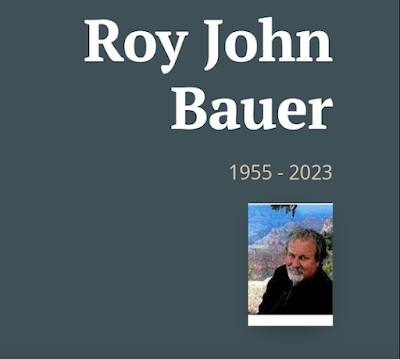
Roy's obituary in LA Times and Register: "we were lucky to have you while we did"

  This ran in the Sunday December 24, 2023 edition of the Los Angeles Times and the Orange County Register : July 14, 1955 - November 20, 2...