Sunday, October 19, 1986

DOWN ON ITS LUCK : Westminster

DOWN ON ITS LUCK : Westminster’s Saddled With a Corrupt Past and Uncertain Future
By ANDY ROSE
Los Angeles Times
OCT. 19, 1986

     These are tough times for Westminster, the city that got the cold shoulder from Queen Elizabeth II, lost its elephant museum to Portland, Ore., once saw four council members and a city administrator jailed on bribery charges and recently teetered on the brink of financial ruin. 

     By outward appearances, Westminster is a quiet little city, an Orange County bedroom community best known for a big mall and for its growing community of former Southeast Asian refugees. 

     But from 1961—when all but one council member was indicted on bribery charges—to today, when the current City Council has had to levy new taxes to stave off bankruptcy by 1988, Westminster has always had more than its share of controversy. 

     Mayor Joy Neugebauer, who is serving her fourth term on the council, said she finds the city’s reputation for controversy “puzzling” because its population really isn’t any different than other cities in Orange County. Perhaps the same things go on in most cities, she speculated, but those who were caught in Westminster “just weren’t as practiced at escaping public scrutiny.” 

     For Democrats, the city has started the political careers of some well-known talent. Among the Democrats who got their starts here in the 1960s and 1970s are state Controller Ken Cory, former Rep. Richard Hanna and former county Supervisor Philip Anthony. “It was an amazing collection of people,” said political consultant Bill Butcher, who grew up in Westminster. 

Grand Theft Charges 

     But not every home-grown politician did well. When former Planning Commissioner Jack Miller was arrested and charged with grand theft in August, it was just the latest chapter for a city that has grown accustomed to visits from the district attorney’s office. 

     “We do have a really poor reputation and it’s too bad, because there are a lot of fine, hard-working people here,” former Mayor Kathy Buchoz said. She said the reputation is such that she gets an occasional comment along the lines of, “Oh yes, we’ve heard of Westminster. You serve on the council, you go to jail.” 

     Councilman Elden Gillespie conceded that Westminster has had a tough rap. But he pointed out that most of the indictments haven’t directly involved city business. 

     “Most of the problems they’ve had have not been city-oriented, they’ve been related to private business dealings,” he said. 

     - Miller, who was appointed to the Planning Commission in 1980 by former Councilman Guinn (Gil) Hodges (who was himself convicted on federal loan fraud charges before successfully getting the conviction overturned last May), has pleaded not guilty to the grand theft charge. A police and district attorney investigation alleges that he used his property management firm, Community Assn. Management Service, to bilk at least 79 homeowner associations of about $1.3 million. 

     - It was land acquisition that got the first City Council in trouble back in 1961. Four council members and the city administrator served time on charges that they got $24,000 in exchange for the city abandoning its effort to annex the Eastgate area, which subsequently became part of Garden Grove. In a separate case, another $24,000 was offered in exchange for a vote on a zone change. 

     “That was the worst case,” Gillespie said. He noted that Orange County was just beginning to boom at the time and “the land grab was on.” 

     - In 1968, the city adopted a new slogan, “The City of Progress Built on Pride,” and then-Mayor Derek McWhinney said the concept was to put the city’s sullied past behind. ¶“People have seen so much controversy here in the past. . . . The new slogan may not fit the past but it is apropos for the present and future,” he said at the time. 

     But in 1972, McWhinney and Planning Commissioner Tad Fujita were indicted on conspiracy charges. The case involved a farmer in Mile Square Park who said the two officials told him the only way he could renew his lease on the property was to pay $5,000 and contribute another $5,000 to a supervisor’s campaign. 

     McWhinney, who owns a city cemetery and mortuary, was sentenced to state prison. Fujita got three years’ probation and six months in the county jail. 

     Gillespie, who said he doesn’t believe that either man needed the money, described the case as “a guy who wanted to be a political bigwig. . . . Yeah, a kingmaker. That’s a good word for it. . . . He (McWhinney) was trying to put the squeeze on this guy and it turned around and bit him.” 

     - Anthony, the former councilman, paid a $12,000 out-of-court settlement in 1981 when his opponent, Harry Yamamoto, filed a libel suit. In addition, Anthony was indicted for not reporting the source of a $30,000 campaign contribution. He was placed on probation and fined $5,000. Anthony won a seat on the Board of Supervisors in 1976, and was defeated by Roger Stanton in 1980. 

     - Former Westminster attorney Richard Hanna, who went on to the state Assembly and then the U.S. Congress, was convicted in 1978 of conspiracy to commit bribery in the South Korean influence-buying scandal. But many locals aren’t convinced that Hanna deserved the jail time. 

     “A lot of people were implicated, but he was the only one to serve time. He was the fall guy,” said Lloyd Thomas, editor and publisher of the Westminster Herald for the past 40 years. The editor said he endorsed Hanna “although he was a Democrat.” 

     - In 1983, Councilman Hodges was convicted of falsely verifying information on real estate loan documents and sentenced to 18 months in prison (all but three months were suspended), five years’ probation and a $2,000 fine. Defense witnesses argued that Hodges was not involved in the scam and that the loans were actually arranged by his late brother, Barclay Hodges. 

     Barclay Hodges was shot to death in a cocktail lounge at John Wayne Airport in 1982, and government documents later alleged that he had attempted to use the real estate scheme to launder profits from cocaine sales. 

     Hodges succeeded in having the loan fraud conviction overturned last year and a Los Angeles federal court jury exonerated him last May. 

     - While Hodges was fighting to clear his name, Miller was attempting to keep Community Assn. Management Service operating. In February, 1983, Miller was kidnaped in a case that Deputy Dist. Atty. Guy Ormes said was not related to the management service. 

     Five men eventually pleaded guilty to duping Miller into driving to the Registry Hotel, where he was held at gunpoint and ordered to make restitution on alleged debts from a business deal. The gunmen purportedly threatened to kill him if he didn’t make good on a six-figure debt, and he eventually paid $40,000 to win his freedom, according to a report filed by the state Bureau of Investigation, which handled the case. 

     “We have had what appears to be more than our fair share (of controversy),” acknowledged Councilman Mel Jay. But he echoed Gillespie’s comment about most of the problems stemming from private rather than city-related dealings. 

     Westminster government is “absolutely” clean today, Jay insisted. “This City Council has probably gone as far as possible to remain above reproach,” he said. 

     Buchoz, who switched from a longtime affiliation with the Democratic Party to become active in Republican Party politics, said she hopes that the controversy is all in the past. Still, “It seems like once a decade, someone’s indicted,” she said. 

     From time to time, Westminster is also the scene of some unusual efforts to boost municipal self-esteem. In 1983, the City Council beseeched Queen Elizabeth II of England to stop by during her tour of California. 

     After all, the reasoning went, the city was founded in 1870 by the Rev. Lemuel P. Weber as a temperance colony based on the tenets of the Westminster, England, Assembly of 1643. And the Civic Center is constructed Tudor-style, as are several redevelopment projects in town, including the Bank of Westminster. 

     But the queen declined. In her stead, she sent a contingent of sailors from the Royal Navy who were feted with hamburgers at Carl’s Jr. in the mall and saluted by Westminster High School cheerleaders, hula dancers and a pair of Playboy bunnies. 

     In 1984, Jack Adams, a retired professor of animal behavior and psychology, persuaded the City Council to help him establish an attraction he was sure would draw tourists to the city. Adams’ elephant museum opened in the city’s auditorium, with such displays as a $40,000 ivory collection, a pachyderm heart, 12 jaws, five skulls and an elephant’s brain. 

     “Anaheim has Disneyland, Long Beach has the Queen Mary. And by God, Westminster will have its elephant museum,” Adams said shortly after the facility opened. 

     Alas, not too many folks came to see the collection. It closed a short while later, to be packed and shipped up to the Portland Zoo. 

     “Maybe you’re interested in elephants, I don’t know,” said City Administrator Chris Christiansen. “I can see having that sort of facility as an adjunct to other facilities, but it’s so specialized, it’s hard for me to see it standing on its own.” 

     The influx of Southeast Asians to Westminster in the late 1970s may some day mean more prominence for the city, officials hope. And many expect the newcomers to become more involved in politics soon. 

     The number of registered voters among Southeast Asians will probably rise, according to demographic information. Statistics from the Westminster school district indicate that Asians and Pacific islanders make up 17% of the area’s elementary school student population. 

     The area along Bolsa Avenue is now dotted with Vietnamese, Cambodian and other Southeast Asian businesses that flocked to Westminster in the late 1970s to take advantage of inexpensive land prices. 

     Christiansen said he expects that the area could become a lucrative tourist attraction for the city. “I can see it becoming, well, I would hope it would become like Chinatown San Francisco, a great tourist attraction,” he said. 

     Although no Asian candidates have run for political office yet, many residents believe it’s only a matter of time before one makes a run at a council seat. Frank Jao, a developer who serves on the city’s Traffic Commission, predicted a candidacy from the Asian community within two to five years. 

     Jao echoed Christiansen’s opinion on the future of the area known as Little Saigon. “I believe so. Some day it will be (a tourist attraction),” he said. “All we have now is commercial activity. We’re trying to add some cultural activity, perhaps a community center, perhaps a Buddhist temple.” 

     Efforts are being made to convince the Orange County Office of Protocol that visiting dignitaries should tour the area, said Mayor Neugebauer. “We really want to encourage that. It could mean a lot of sales tax and tourists,” she said. “There are some great restaurants down there.” 

     Neugebauer said there were a few negative opinions voiced when the first wave of refugees moved in, but acceptance of the Southeast Asian community appears to be widespread today.     “There were no problems that were acute,” she said. “It’s a normal feeling that what is unknown sometimes manifests as fear, an irrational fear.” 

     Christiansen, who arrived in 1983, said city government has been steadily eating into its financial reserves since the passage of Proposition 13 in 1978. The city’s financial health had deteriorated so badly that a recent study indicated that Westminster would be out of money within two years. 

     The most drastic solution, according to the study by former City Administrator Bob Huntley, would be to dissolve the city, which was incorporated in 1957. Christiansen said that was never a real consideration, and that a new 5% utility tax should provide at least a temporary respite. 

     “You never know, I can’t predict the future. We might be awash in money five years from now or we might be broke,” he said. “We projected that if we continued the course we were on without severe cutbacks, we could not get through ’87. For example, just in safety alone, I mean police and fire, we were looking at 30 layoffs.” 

     The taxes aren’t pleasing to a lot of people who call Westminster home. 

     Thomas, the editor of the Westminster Herald, argues that the city should have done something years ago to head off the cash crunch. 

     “I think they’ve been foolhardy,” he said, adding that the city will be in “big, big trouble” if it has to pay off any damage awards in lawsuits. 

     The only major source of income for the city is the Westminster Mall, which provided a major portion of the city’s $6.3 million sales tax revenue in 1985-86. Some residents think the mall is the only reason Westminster is still around. 

     Ed Bynon, former publisher of the Westminster Journal and an unsuccessful candidate for City Council in 1984, said he sometimes thinks Westminster ought to just fold up and become part of Garden Grove or Huntington Beach. “It’s a funny city. If it wasn’t for the Westminster Mall, there’d be no Westminster,” he said.

Thursday, June 26, 1986

Monday, January 15, 1979

Saddleback College North opens


North Saddleback Campus
It’s Small, Has No Name, but a New College It Is
By Thomas Fortune

LA Times, Jan. 15, 1979

     IRVINE – It will start out the size of a junior high school. And it’s a long way from getting a name of its own.
     But students will begin taking classes next Monday at Orange County’s newest community college, known as the north campus of Saddleback College.
     College officials say they expect to enroll about 1,500 persons at the outset, many of them taking courses both at the new campus (carved from an orange grove at Irvine Center Drive and Jeffrey Road) and at Saddleback College (14 miles south in Mission Viejo).
     For a few years, the new school will be merely a satellite campus. No attendance boundaries will be drawn to separate it from Saddleback College. It will not have its own name or a football team.
     But it is planned that eventually the north campus will become a full-fledged community college.
     The initial $6.6 million development is on 20 acres. The college district has a five-year option with the Irvine Co. to buy 80 additional acres at $45,000 an acre.

Groundbreaking, 1977
     The plan is to develop the campus in 20-acre increments. Each new cluster is to have its own educational them and central architectural focus.
     Since passage of Proposition 13, the Saddleback College District has lost the capacity to fund that plan locally. But college officials say they have not abandoned the idea.
     “We’re dependent upon the state, the munificence of the Irvine Co., somebody,” [sic] Board president Larry Taylor said late last week. “But I am convinced this is only the beginning of a 100-acre plant. Our board and the people in the area will not allow it not to happen. I’m sure enrollment will justify our planning.”
     Only two of the three academic buildings in the first cluster will be ready for the start of classes next Monday. A late start on the science building—held up until the college district could secure state money after passage of Proposition 13—will delay its availability by a couple of months. An administration facility also is behind schedule.

C. 1978
     During a press preview last week, the campus was still very much a construction site. The raw buildings were surrounded by mud. A workman was painting a door through which visitors entered.
Campus administrator Ed Hart had his full-time faculty there for introductions—all 11 of them.
     Proposition 13 also cut into staffing. But there will be more school here than at first meets the eye.
     There will be 85 daytime class offerings, Hart said. Another 50 classes will be given at night on campus, and 25 more classes will be held at affiliated locations—including Tustin and Laguna beach high schools.
     The campus has a 150-seat classroom, with curtain and stage, that will be turned over on weekends for community use.
     Some who live at the north end of the district will get all their schooling at the new campus. Others may go there two days and three days to Saddleback.
     After the first three days of registration, classes already were filling. Continuing students from Saddleback took all the photography slots. Math, spelling and business management courses were popular.
     Staff size is going to keep the initial enrollment to about 1,500. But Hart said the first cluster of buildings will accommodate 40 to 45 faculty and up to 4,500 day and night students before bursting at the seams.

c. 1979
     The buildings are of brick with mostly flat roofs. A clock tower is the focus of the central plaza. Lots of outside windows are intended to show off a business machines center and a reading and language lab and entice students inside. The buildings feature solar heating.
     White chalkboards in the classrooms double as movie screens and also conserve light.
     Student services will be handled on an umbilical cord concept. Library books ordered from the Saddleback College library or a student file that a counselor might need will be brought to the campus in a van making a freeway shuttle.
     Greater things are ahead, promised District Supt. Robert Lombardi. He said the new campus probably will be one of the last community colleges built in the state and will have an opportunity to do what others should have already done—establish close ties with local industry.
     He said chemistry, pharmaceuticals, electronics and computer science are prominently represented in the Irvine Industrial Complex and the college could develop specialties in those fields. He said that if things develop well, the college might even take over some of the industrial training within the plants of local firms.

Memorial Scheduled for Edward A. Hart (LA Times, March 20, 1990)

Wednesday, May 24, 1978

The case of Richard Jordan (Casper and Harber's shakedown)


See also OC Register - OC Developer Alleges Political Bribe Demand, May 23, 1978 - By Joe Cordero & Charley Roberts

Casper, Harber and the bribe

From the "Trustee Tom Fuentes files" [Fuentes got his start working for corrupt OC supervisor Caspers; Caspers' chief crony was the corrupt Harber]:

Caspers, Harber Accused of Bribe Try by Developer

LA Times
May 24, 1978
BY STEVE EMMONS Times Staff Writer

     Had not former Orange County Supervisor Ronald Caspers and his campaign adviser, Fred Harber, disappeared when their boat foundered off Baja California in 1974, they might have sailed home to a bribery indictment.
     That allegation is in a sworn deposition made a year later as part of a lawsuit against the county. The deposition was never filed in court and has come to light after an account of it was published in The Register, a newspaper published in Santa Ana.
     In it, developer Richard V. Jordan of Newport Beach swore that in 1974, Caspers strongly urged that he take his development problems to Harber, srategist and fund raiser in county government election campaigns.
     Harber promised that "I'd find it would be much easier to get along with people in the county and that things would run a lot smoother” if Jordan would pay $10,000 plus $2,000 a month, Jordan testified.
     In the deposition, Jordan said he was arranging a second meeting with Harber to help the district attorney's office gather evidence when the boat went down. Jordan's attorney, Robert Barnes of Newport Beach, said Tuesday he had only sounded out Dist. Atty. Cecil Hicks or his chief deputy, James Enright, "without mentioning any names.”
     (Asst. Dist. Atty. Michael Capizzi said Tuesday that he had queried Hicks and Enright "and no one contacted any of us about this, and there is no record of any contact. If any contact was made, it must have been with a deputy or an investigator, perhaps socially.")
     At the time of the alleged bribe attempt, construction on Jordan's mobile home park in El Toro was about to be closed down on a legal technicality —that there had been too little construction to keep his permit in force.
     His permit was eventually reinstated, but by then, leases, financing and construction costs had risen appreciably, and the project folded, Jordan testified.
     He sued Orange County, which last month agreed to pay Jordan $700,000 in damages as part of an out-of-court settlement. The money was paid by the county's insurance carrier.
     On April 5, 1974, a year after the alleged bribe attempt, Jordan made a deposition for use in the lawsuit. In his testimony, made under oath but not in a courtroom, he gave this account of his dealings with Caspers and Harber.
     Jordan's land development firm, Shelter Industries, had developed one mobile home park in San Juan Capistrano and was in the market for another when it agreed in February, 1972, to trade for some land near El Toro Road in El Toro,
     The owner, Thomas Hall, already had a mobile home park plan approved and a permit to build. Jordan said he spent most of a year double checking to be sure that Hall's permits were in order and that Jordan could continue with the project once he owned the land.
     Jordan testified he received assurances from high-ranking officials in the county's Planning Department and Building and Safety Department that all was in order. Escrow closed in January, 1973.
     Jordan said he soon met resistance from Caspers, who said he preferred to have condominiums on the land. Jordan began revising his plans to suit Caspers but abandoned the effort when he met months-long delays in getting the necessary county approval, he said. He returned to the mobile home plan, for which he already had a permit.
     Early in 1974, he testified, associates told him that county building inspectors were ‘nitpicking’ about "little details that normally are not brought up.” He said he had known Caspers a long time and telephoned his office. It was too small a matter to take directly to Caspers, Jordan testified, so he asked one of Caspers’ assistants, Tom Fuentes, to find out which county department was so concerned with his project and why.
     Jordan said he received a call about a month later from Fuentes, who warned that “we were going to have some problems" but wouldn't elaborate over the phone.
     Jordan testified that he hurried to Fuentes’ office where Fuentes said Shirley Grindle, a planning commissioner appointed by Supervisor Ralph Clark, was “asking a lot of questions” about Jordan's mobile home park. Fuentes said Ms. Grindle apparently suspected that construction was deviating from the approved plan, Jordan said.
     Jordan testified that he went back to his office and pored over the plans. The location of five mobile home lots had been moved somewhat, but that, Jordan said, was too minor to cause any trouble. He called Fuentes, who arranged a meeting with Bart Spendlove, Caspers’ planning commissioner.
     Spendlove was at the mobile home park site two days later, Jordan said. Spendlove told him that “no one wants this mobile home park going in here” but that “as far as I'm concerned, you have a permit and you have started on it. I think you should be able to continue with it,” Jordan quoted Spendlove as telling him.
     Jordan agreed to plant a row of trees to further conceal the development, and Spendlove seemed appeased, Jordan testified. (Spendlove died 18 months later in a plane crash.)
     But within a week, Jordan got a telephone call from Caspers, Jordan testified. Caspers told him that Spendlove's solution to the problem “would not put out the fire” and that Caspers himself “felt he had a solution for me," Jordan said. Caspers wouldn't elaborate over the telephone but invited Jordan to meet him “and someone who he felt could solve my problem.”
     Caspers identified the problem-solver as Harber, Jordan testified. Jordan paraphrased Caspers’ proposal:
     "If I would go down to spend the weekend with them to fish (on Harber's boat at La Paz, Mexico), have a lot of fun, and if I would get to know Mr. Harber, Ron Caspers felt that this would be very beneficial for me and my problems with the county.”
     Jordan replied that he would check his schedule and call back, he testified. His second thoughts prompted him to inquire about Harber.
     “I didn't know what he did,” but Jordan testified that he soon found out. “Public relations?” Jordan was asked in the deposition. “Well, that's a nice way to word it,” Jordan answered. Jordan said he heard that Harber had been involved in a bribery scandal.
     (When Harber was city manager of Cypress in the early 1960s, his name was linked to a reported bribery effort there involving a land developer and a city councilman named Job Denmi Jr.
     (Sources close to the investigation have indicated that Harber, in exchange for immunity from prosecution, agreed to testify that he and Denni were receiving $2,000 a month from the developer. Before the case could go to the grand jury, however, Denni was killed in a plane crash [in 1966] and the case was dropped.)
     Jordan testified that he telephoned Caspers and asked why Harber was so influential in county matters. Caspers replied that Harber had clout with Supervisor Clark and Supervisor Robert Battin because he had arranged campaign financing for both, Jordan said.
     On April 26, 1974, Jorden drove with Caspers and some of Caspers’ associates to Los Angeles International Airport for a flight to La Paz and Harber's waiting boat, the Shooting Star.
     Harber was on board when they arrived, Jordan testified, and the whole group sailed to an island off La Paz.
     Jordan testified that Caspers took Jordan alone in a small boat to a nearby reef to fish and told him there that Harber was very influential with "Shirley Grindle's boss," that is, Supervisor Clark, the man who appointed her to the Planning Commission.
     Jordan returned home the following Monday, the same day an order was issued by the county to halt construction on Jordan's project. Ms. Grindle had asked Ralph Benson, the deputy county counsel for Planning Commission matters, to look over Jordan's project. He later concluded that Jordan's permit was void.
     Jordan warned Barnes, his attorney, that "I think he (Harber) is going to hit me up for a bribe," and, Barnes said, he began sounding out the district attorney's office. On the fishing trip, Harber had invited Jordan to his office, insisting however, that “you have to come alone,” Jordan testified.
     Jordan said he asked Harber how long it would take to solve his problems. “Not long,” Harber replied and said “he (Harber) wanted $10,000 now and $2,000 per month,” Jordan testified,
     “And I said, ‘How long does this $2,000 go on?’ And he said, ‘How long do you plan to develop in Orange County?’”
     Jordan testified he left without making a commitment. He said he was in the process of setting up another meeting with Harber when he was invited once again to Mexico for a party aboard Harber's yacht.
     Jordan said he declined because there would be no way for district attorney's investigators to gather evidence there and because he believed from his last trip that the boat was not seaworthy.
     The boat sank off Baja California on the return trip. Parts of the boat wert recovered, but no trace was ever found of Caspers, Harber and the eight others aboard.

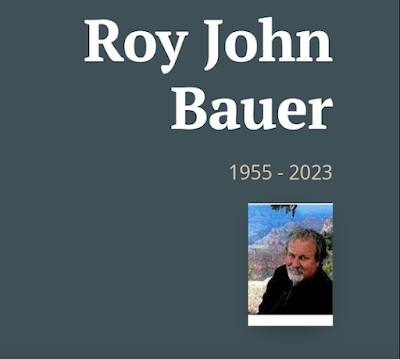
Roy's obituary in LA Times and Register: "we were lucky to have you while we did"

  This ran in the Sunday December 24, 2023 edition of the Los Angeles Times and the Orange County Register : July 14, 1955 - November 20, 2...