Thursday, June 21, 2012

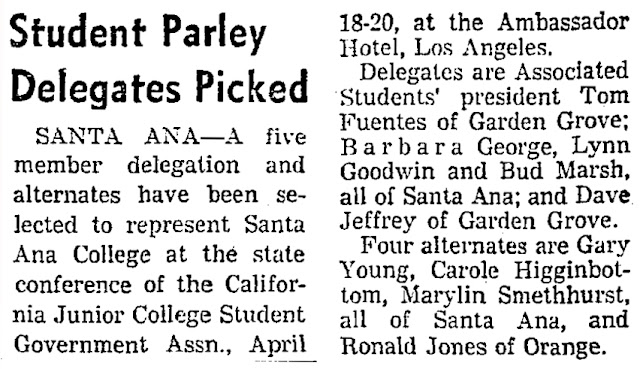
Tom Fuentes qua student—Rumored Clips & Actual Clips, c. 1967-8!

From the OC Weekly's website: DtB graphic of Tom
LA Times, Dec. 8, 1967
     Perhaps inspired by our recent mention of the late Tom Fuentes’ support of John Schmitz during the former's student days, Gustavo Arellano writes today about Fuentes' predictable writings (opinion pieces), 45 years ago, in the Chapman (College) Panther
     One letter is a rebuttal to criticisms of Schmitz. The other is a rant against war protesters.
     Wadja expect?

See
Commentaries Written By Tom Fuentes While a Student at Chapman University Unearthed!

     (Please note that Gustavo borrowed our very own “Tom as devil” graphic for this piece. You're welcome, dude.)
     Check it out.

     I’m especially interested in what Gustavo doesn’t provide about Tom Fuentes’ Chapman College years.
     It concerns a rumored artifact. One about Tom.
     At the start of the piece, Gustavo writes:
A rumored newspaper clipping
     Next to a picture of Walt Disney and Walter Knott together, one of the most famous OC historical artifacts that may or may not exist is a newspaper clipping detailing something that former OC GOP head Tom Fuentes was involved in during his student years, something that dares not speak its name. That clip, if it does indeed exist, is in the bowels of some Orange County archive or other, or in the safe of current GOP boss Scott Baugh, so in the meanwhile Fuentes observers will have to content themselves with two op-ed pieces Fuentes wrote while a student at Chapman College (now University, and my alma mater) during the late 1960s showing that even then, Fuentes was a raging wacko.
     Gracias, source, and cue the microfilm!
     OK, I’ve heard about this article/clip before, but it never seems to surface, if it even exists. More specifically, I’ve heard rumors about something that occurred during, or at the site of, Tom’s college job at a motel in Anaheim, near Disneyland. A prominent political journalist in these parts once told me that there was an article in the Times, or maybe the Register.
     But, again, nothing’s ever turned up, not in my world.
     I think Gustavo’s hoping that somebody will leave something special in his mailbox.
     Do not hold your breath, dude.

STUDENT TOM BACKS COMMUNITY COLLEGE TUITION IDEA:

LA Times, April 17, 1968
     A somewhat related matter:
     I found an old Times article entitled, “Orange County JCs Oppose Tuition” (Oct. 18, 1967). At the time, evidently, State Finance Director Gordon Smith suggested that it might be a good idea to start charging community college students with tuition. (Yes, there was a time when Cal kids paid no tuition at CCs. It was all part of the grand vision of everybody getting an affordable college education. —RIP)
     Naturally, various educators cried foul.
     At one point, the story briefly turns to students and their opinions. The first kid they talk to says, if they charged tuition, he couldn’t attend. Sure.
     Then there’s more “educators,” including “Saddleback Junior College” superintendent Jack Roper, who roars that the question of tuition ought to be left up to the local board. Harrumph!
     Lemme cut to the chase. Eventually, they interview a young Santa Ana College student.
     Guess who?

     Spoken like a politician Tom. 
     I love the blarney about how most students would agree with him.
     Don't think so.

More artifacts:
LA Times, Oct. 26, 1967
LA Times, 3/17/68

The Fuentes file: Puppets and Puppeteers

 
Buena Park politicos, 1958. That's Fred Harber,
left of center
     Orange County Supervisor (1969-1977) Robert Battin was an early beneficiary of the now-notorious political funding operation known as the “Dick and Doc Show” (Dick O’Neill and Louis Cella). Oddly enough, Fred Harber, who was very senior in the larger D&D operation (what Battin, then scrambling to avoid prosecution, later termed the “Coalition”), and who had already served as a Mayor (of Buena Park) and City Manager (of Cypress), briefly served as Battin’s “executive assistant” in 1969, making $12,300 per year.
     According to an old LA Times article (“Battin a Puppet, Ex-Aides Claim; He Denies It,” June 20, 1972), in June of 1972, there was a special press conference down at the county courthouse:
     Two recently fired aides of 1st District Supervisor Robert Battin showed up to publicly accuse their ex-boss of being only a political puppet to his campaign manager and former aide, Fred Harber, a man they described as “Orange County’s kingmaker.”
     Afterward, says the article, Harber showed up, proclaiming, “I am just a lowly worker in the vineyard … of good government.”
     Then Battin himself showed up, stating that the aides’ assertions were “complete bullshit.” (The Times characterized Battin’s remark as “earthy.”)

* * *
     According to the Times, the aides were Steve Polatnick and John Abbott, both 27. The firings were described as an “aftermath” of a recent primary in which Battin had come in second (among Republicans), forcing a runoff in November. (Battin prevailed.)
     The aides claimed that Battin “sat in his inner office with orders that no constituents be allowed to speak to him … or see him.” Polatnick is quoted as adding, “An exception was always made, of course, for big-money contributors.”
     The two said they were fired on Harber’s orders because they didn’t agree that they should work full time on Battin’s reelection campaign. They further asserted that, in Batton’s office, Harber was in charge and that Harber was “behind a school busing ‘smear’ letter aimed at” the candidate who had come in 1st.
Ralph "Super D" Diedrich
     It gets better. They also claimed that Harber controlled Supervisors [Ronald] Caspers and [Ralph] Clark and that “He’s working to get a fourth vote on the board right now.” That would be Ralph Diedrich, who did in fact prevail over incumbent Bill Phillips in November of ’72.
     (Diedrich, known as “Super D” owing to his strong personality, became the leader of the pro-development board; he was indicted for bribery in 1977.)
     Polatnick went on: “It is my impression that Harber sees himself as the most powerful man in Orange County—a real kingmaker.” For Harber, such hegemony wasn’t about money but about “political power,” the two men said.
     And so, a few hours later, Harber showed up at the pressroom, denying those claims, chalking them up to the disgruntlement of fired employees.
     “Bob Battin has a respect for my advice and counsel…and many times he will follow that advice, but not always. But I think you will find some other supervisors who will bitterly resent any allegrations [sic] that I control a whole stable of them….”
     Harber asserted that, as he understood it, Polatnick and Abott could not communicate with community groups that had not been represented by their Supe in the past.
     Had he “ordered” Battin to keep his trap shut?
     “That’s not true. I only advised him not to lose his temper and to be careful to explain what he was saying…I would like him to be more urbane but I’ll settle for his honesty and forthrightness. I’m really just a lonely worker in the vineyard….”
     According to the Times, that last sentiment produced “chuckles in the audience.”
     Harber added: “I just strive to help my friends bring better government to Orange County.”
     At that point, Harber left and Battin came up to speak. He said: “Sometimes he [Harber] calls the shots … sometimes he doesn’t. But, if I’m a puppet, how come he left just now?”
     That's pretty lame, dude.
     But what about the alleged orders not to talk to constituents? –That’s when Battin got “earthy.”
     According to the Times,
     Battin denied other allegations that Harber had determined which companies would get county contracts on the basis of compaign contributions to Battin, or that he was favorable only to firms which gave such contributions.
Bob Battin
     On Monday, I wrote about the 1972 bribery trial of the mayor of Westminster, Derek McWhinney (who was ultimately convicted and served time). In that caseHarber and Tom Fuentes’ names came upa farmer alleged that McWhinney and an associate were shaking him down for $10,000. According to the farmer, McWhinney had told him that six people, including he and Fred Harber, “ran” Orange County.
     According to yet another Times article that I have recently discussed, years earlier, Harber had agreed to testify to his part in a bribe scheme in which a developer paid him and a member of the Cypress City Council $2,000 a month.
     These facts never came to light because the City Councilman—Mr. Job Denni—perished in a plane crash in 1966, necessitating abandonment of the case.
     (The "$10K" amount and the "$2K per month" angle were repeated in the bribe story—about a Harber/Caspers shakedown in 1974—that Richard Jordan told in a 1975 deposition in connection with his lawsuit of the County. The County settled, paying Jordan $700,000.)
     The day after Battin’s press conference, supervisorial candidate Ralph “Super D” Diedrich issued a press statement, denying connections with Harber.
     “I want everyone to know that I am my own man,” it said.
     It is clear today that Caspers, Clark, Battin, and Diedrich were indeed in Dick and Doc's stable. And D&D's main man was Harber.

* * *
     Harber’s name comes up again in a 1973 Times article about the OC supervisors’ “unsung” executive assistants (“7 Supervisors’ Aides Fill Vital but Unsung Role,” April 8, 1973).
     Supervisor Clark was quoted as saying,
     “The EAs … are the only ones we can depend upon to give ... [research] to us. Compared to the days when I was a city councilman, I am much better prepared to make decisions. I feel a lot more comfortable and confident, because I have been given the facts by my staff.”
Ronald Caspers
     Evidently, Clark’s view was more or less shared by the other supervisors.
     According to the Times article, in recent memory, the role of the EAs had expanded:
…[I]t is the assistants who act as primary advisers, researchers, office managers and alter egos of the five board members…. Their roles … generally revolve around researching issues, handling constituent problems, checking the weekly board agendas and monitoring the political pulse of the superbvisor’s district. … At other times, it might mean representing the supervisor at a meeting, talking to homeowner groups, working with county department heads and developing and maintaining liaison with city representatives and state legislators…. …[T]he assistants are considered by many to be among the most important persons in county government.
     Naturally, this state of affairs—immense power in the hands of persons unelected and hired and fired at the whim of supervisors—caused worry among watchdog groups. Thus, in 1972 (says the Times article), the OC Grand Jury handed down “a warning that the EAs should not overplay their parts”:
“Since ... [the EA's] advice concerns so many county decisions,” the jury wrote, “each assistant must be chosen carefully with emphasis on practical experience, ability and character as well as personal loyalty to the supervisor for whom he works. … His briefing is invaluable but unless it is reliable and accurate, many problems may result. In any case, the final decision should come from the supervisor and not from the assistant.”
     "Many problems" indeed. What if, for instance, the EA is closely aligned with people—not the supervisor—who have one of those goshdarned nefarious "hidden agendas"? (That's my question, not the Times'.)
     Tom Fuentes, one of Supervisor Caspers’ assistants at the time, explained that his boss is “highly complex” and an introvert. Still, he’s easy to work with, he said.
     Fuentes has lots more to say:
     For Fuentes, the job of an EA is more that of a political adviser, liaison man and personal assistant, since those are his fields of expertise.

     Fuentes offered his description of the perfect assistant:
     “He is a public relations man, a press agent, a protocol officer, political adviser and strategist, budget expert, a strong researcher and devil’s advocate and has master’s degrees in public administration, finance, engineering, social work and government. In addition, he can work 28 hours a day without tiring.”
     Fuentes’ boss, Ronald Caspers, evidently told the Times that
he sees the EA as the supervisor’s protector who minimizes his mistakes and guides him away from pitfalls.
     “They also have to evaluate and make recommendations on agenda items, although I reserve the right to go a different way at times….”
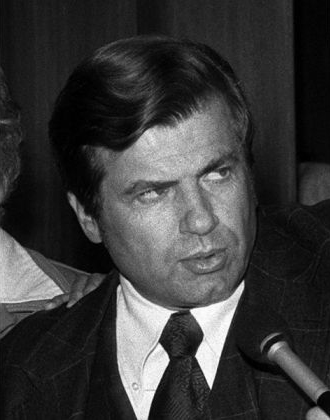
Tom Fuentes, c. 1973
     That seems awfully understated. 
     I don't know about you, dear reader, but it seems to me that, back in the Roaring 70s, depending on the supervisor, an EA could be pretty much anything, including the real brains of the operation. No wonder the Grand Jury fretted!
     The article ends with a focus on former Battin EA Fred "lonely vineyard worker" Harber:
…[U]ndoubtedly, the best-known former EA of all is Fred Harber, a one-time Buena Park city councilman and Cypress city manager, who managed Battin’s winning campaigns in 1968 and 1972.
     Harber, considered by many as a major behind-the-scenes political power in Orange County, recently was picked by former Assembly Speaker Jess Unruh to manage his campaign for Los Angeles mayor [against Sam Yorty].
     Many observers felt that Unruh’s decision was based mostly on Harber’s guidance of Battin’s campaign from what appeared once to be sure defeat to a victory.
     No EA—or former EA—could have been asked to do any better than that.
* * *
     It's pretty obvious that, in truth, Harber was much more than Battin's assistant. He was the guiding force behind, not only hot-headed Battin, but a whole stable of politicians.
     And he was crooked, like so many of his "horses."
     And what about young Tom Fuentes? DtB readers will recall from our extensive "Shooting Star" scribblings that, in the days and weeks following the yacht's disappearance off the coast of Baja, Fuentes had extraordinary authority and staturefor a twenty-five year old "assistant." He seemed to have run the search operation (from Santa Ana), and, at one point (reportedly), it was he who called off the search. 
     Throughout, he was plainly very close to Caspers' wife. (Unsurprisingly, he handled the press.)
     And, even though he had already announced plans to leave Caspers to study to become a priest (see LA Times, May 23, 1974), in the weeks after the tragedy, he was clearly preparing himself to be appointed as Caspers' successor. In fact (evidently), Ronald Reagan had expressed his intention of selecting Fuentes, but then a one-year residency requirement knocked him out of contention. (It's clear that many pols came out of the woodwork, interested in the appointment. At the time, it struck some as unseemly.) So he went back to his original plan: he headed north to St. Patrick's seminary. (A year later, of course, he was back, lobbying for Bein & Frost, hanging with fellow Republicans on the Central Committee, investing in singles bars, etc.)

* * *
     According to the Times ("Caspers Tops Spending Limit, Bents Says," May 14, 1974), two months before the "Shooting Star" tragedy (and a year after the EA article), one of Caspers' Republican primary challengers, Marcia Bents, publicly objected to Caspers' "heavy campaign spending tactics." At the courthouse, accompanied by former OC GOP chief Tom Rogers, she "claimed that Caspers' campaign finance figures show he has broken his promise to hold spending to a limit of 50 cents for each registered voter."
     Oddly, the person on hand to rebut Bents' charges wasn't Caspers. It was Fuentes. 
     Caspers isn't even quoted.

* * *
     Two weeks later, Bents was at it again. According to the Times ("Fund-Raising Tactics by Caspers Criticized," May 31), Bents charged that "Ronald Caspers has 'strong-armed' firms into contributing to his campaign":
     Mrs. Bents, referring to Caspers' latest financial report showing more than $222,000 in contributions, said the firms made contributions "because they were afraid not to give."
     Once again, it is not Caspers who rebuts these charges but Fuentes:
"...[These charges] are only an indication of her own floundering campaign," Fuentes said, "and are unsupported by facts. The people and firms who contribute to Ron do so because they support what he is doing."
     Ignoring the ad hominem, Bents made her case:
     ...Mrs. Bents handed newsmen a list of 26 firms and individuals who have donated or pledged $1000 or more to Caspers' campaign. All of these donors are involved in subdivisions, zone changes, variance use permits, tracts, special projects or contracts with the county.
     "I want to make it clear," she added, "that I am not making the charge that these firms or individuals sought out Caspers and made a donation ... to get an improper concession. I am saying that some of these firms have expressed to me, privately, that they felt they were being forced into making substantial contributions to Caspers' campaign."
     Wow.
     She also presented a signed statement by a former Caspers aide, H. Ronald Jones. Evidently, in the statement, he "charged that he had worked on county time to address and stuff envelopes for a Caspers' testimonial dinner in September, 1971." He also charged "that he had also used county time and a county car to drive to Los Angeles County to pick up materials for Fuentes' campaign for the County Republican Central Committee."
     For Fuentes? The "assistant"?
     Naturally, Fuentes countered with a mere ad hominem, characterizing the former aide as a "disgruntled former employee...."
     Caspers is not quoted in the article.
     [Note to self: McWhinney contributed to Ronald Caspers' campaign in 1970. See Times, 7/8/70.]

See also Mr. Bagman—I spoke with my father and we both remembered a guy who, it turns out, was a close associate of Ronald Caspers before he got the Supervisor gig in 1970. The way my dad remembers it, this guy, Chas. Bottomley, who was one of the adults in our old Boy Scout Troop (#536), was "Caspers' bagman."—Yep, my dad said that without any prompting! Bagman. Or so he was told at the time by a pal at work (I knew that guy, too: Jim C) who part-timed as a bartender in a place Caspers owned next to his S&L. [Actually, I'm not sure my dad understands the connotations of "bagman." Maybe not sinister after all.]
     It's a small world. And darker than you imagine.

BATTIN: the "COALITION" HARBER'S "BRAINCHILD

OC Reg Feb 18 1976

Wednesday, June 20, 2012

1976: Tom Fuentes, lobbyist, deputy—investing in a "singles bar" with Sheriff Brad Gates

The entire “Fuentes/Shooting Star” saga can be found here.


     MONEY TALKS. I found an old LA Times article, dated February 6, 1976, about lobbyists and the gifts they had given to members of the OC Board of Supervisors. —This was about a year and a half after the mysterious sinking of the Shooting Star, which took the lives of OC Supervisor Ron Caspers, political consultant Fred Harber, and eight others.
     1976: those were, of course, the days of Louis Cella and the "Coalition." With the loss of strategist Harber and the reliable DA-hating Caspers, Cella could not effectively block scrutiny of his operation. Soon, OC DA Cecil Hicks, and then the feds, were all over 'im. 
     According to the article:


     Among the lobbyists mentioned was our own (until recently) Tom Fuentes, who was by then working for the engineering firm Raub, Bein & Frost.


     (Also mentioned among lobbyists is Frank Michelena, a ubiquitous [notorious] lobbyist who had worked with Fuentes on campaigns during the Caspers days.)
     A LOBBYIST DOING WHAT LOBBYISTS DO. In 1993, Fuentes was still working for Raub, Bein & Frost (by then called Bein & Frost) as a lobbyist. The company got into hot water for wining and dining officials of the Santa Margarita Water District. Fuentes appeared to be directly involved in these "lobbying" efforts. (See O.C. Company's Gift-Giving Gets Attention.)
     In 1996, as the dust of the scandal settled, Fuentes left BF and joined Tait and Associates. The Times noted the curious circumstances in which Fuentes joined Tait:
     Early last year, while still with the company [i.e., Bein], Fuentes lobbied members of the Anaheim City Council for the appointment of Tom Tait. Tait was appointed to the City Council in January 1995. Shortly afterward, in March 1995, Fuentes became a vice president at Tait and Associates, an Orange engineering firm where Tait is president. (See Guiding With an Iron Hand)
     By then, of course, Fuentes was the chairman of the local GOP (that started in 1985).
     When officials at Bein were asked why Fuentes left the company, they were very vague, saying only that they and Fuentes were on good terms.
* * *
     PIETY BOY INVESTS IN SINGLES BAR. Remember those "deputy" badges that convicted felon (and former OC Sheriff) Mike Carona used to give out, like candy, to campaign contributors? Well, as it turns out, that's an old practice, though, by 1976, it had all but died out everywhereexcept for Orange County. I found a 1976 Times article ("Sheriff Gates grants 'special deputy' status to actors, politicians," 9/23/76) that explains that then-newly-elected Sheriff Brad Gates was giving these things out in very much the same spirit in which Carona did starting in the late 90s.
     One of the "special deputies" was Tom Fuentes.
     Oddly, the article mentions a business deal that Fuentes had gone in with Gates and others:


     OK, "last year" (presumably 1975), Fuentes and these others "invested in a singles bar"? That was the year that Fuentes had returned from the Menlo Park seminary, having abandoned his plan to become a priest.
     He goes from studying for the priesthood to investing in singles bars? (And with the Sheriff?)
     These pious OC Republicans are something else, ain't they?

Monday, June 18, 2012

Harber and Caspers attempt to bribe a developer, but then they die instead

 
Tom Fuentes, 1974
[Part of our "Fuentes Files" series.]

     It’s pretty clear, I think, that Supervisor Ron Caspers was seriously hinky, and his teeming corruptitude was such that it is hard to imagine his close associate and assistant, Tom Fuentes, not participating in it—or at least being aware of it.
     Bear in mind that young Tom was the chief organizing entity of Caspers’ operation. He handled routine complaints, scheduled events, made phone calls, etc.for his boss, all day long, every day.


     FRED HARBER WAS THE BOMB. My most recent research (mostly old LA Times articles) has led me to conclude that Fred Harber, Caspers’ close associate, was much more than might be supposed based on his job descriptions. My reasons will become clear as we proceed. I’ll just say for now that Harber was perhaps the third most important member of what Supervisor Robert Battin called the “Coalition”—the money-distributing venture headed by “Dick and Doc,” i.e., R.J. O’Neill and Louis Cella. As you know, Orange County DA, Cecil Hicks, regarded the “Coalition” as OC’s “shadow government.” Near as I can tell, that’s just what it was, for it “owned” the Board of Supes.
Buena Park pols, 1958
Fred Harber in the middle
     For the core of the Coalition, I think, at least at first, the “Dick and Doc Show” was essentially an effort to give muscle to the Democratic Party in traditionally conservative OC. But it clearly morphed into something less political, more self-aggrandizing and profitable. It reached out to some Republicans, such as Caspers (1970) and Laurence Schmit (1975). Starting with Caspers, it became more about greed. And it seems likely that, for Harber and Cella, though perhaps not for O’Neill, laws and ethics were just things to get around somehow.
     As we’ll see, some of the “inside baseball” about the Supes back in the years 1969-1974 point to Harber’s alarming prominence, despite his having no elected office or appointment. He had served as Mayor of Cypress (among other offices), but, in 1969, he was an “assistant” to Supervisor Battin. He was a curiously highly-regarded assistant among the corps of helpers surrounding the Supervisors.
Ron Caspers
     After Harber dumped that gig, Battin was at one point compelled to complain aloud that, no, he wasn’t Fred Harber’s puppet!
     It was, of course, Harber’s boat that was lost off the coast of Baja California in June of 1974, leaving not a trace of the ten men aboard, including Caspers and Harber.
* * *
     HERE COMES MR. JORDAN. I’ve found two newspaper articles that tell the story of the alleged “shakedown” scheme that, according to developer Richard Jordan, Harber and Caspers approached him with:
OC Register
OC Developer Alleges Political Bribe Demand
May 23, 1978
By Joe Cordero & Charley Roberts 
LA Times,
Caspers, Harber accused of bribe try by developer
May 24, 1978
By Steve Emmons
     As you can see, the Reg scooped the Times—thanks to a timely request for a pubic record. Nevertheless, I’ll start by outlining the contents of the Times’ piece:
Young Tom Fuentes
     Had Caspers and Harber not died in 1974, they might “have sailed home to a bribery indictment.” Or so it is alleged in a sworn 1975 depo by developer Richard Jordan.
     The Reg managed to get that depo.
     In the depo, Jordan explains that he had acquired a 46-acre piece of land in El Toro from a man who had already secured the necessary county permits and OKs for a mobile home park. Jordan even got assurances from county people that everything was set to go, but then, suddenly, in early ’74, he learned that Supervisor Caspers preferred that the land be used for condos.
     So Jordan revised his plans and pursued the condo project, but that soon got mired in complications and red tape. So he returned to plan A: the mobile home park.
     Pretty soon, county inspectors were nitpicking the project to death, so he contacted supervisor Ron Caspers’ office. (Caspers’ area included El Toro.) He figured he’d just deal with Tom Fuentes, Caspers’ assistant. He asked Fuentes to find out just who, down at the county, was concerned about his project and why. Fuentes called back a month later, saying that “we were going to have some problems,” but he couldn’t say more over the phone. Jordan hurried to Fuentes’ office, whereupon Fuentes explained that the Planning Commission’s Shirley Grindle was asking lots of questions about the project. Jordan went back to his plans, looking for a problem, but he could find none. He called Fuentes back.

     Fuentes next arranged for Jordan to meet with Bart Spendlove, Caspers’ planning commissioner. Two days later, at the project site, Spendlove told Jordan that everybody opposed the mobile home park, but “as far as I’m concerned, you have a permit and you have started on it. I think you should be able to continue with it.” Jordan agreed to plant a row of trees to obscure the park and that seemed to make Spendlove happy.
From “Spendlove, Wife, 4 Children Killed in
Utah Plane Crash,” LA Times, Sep. 9, 1975

     (Spendlove, says the Times, died in a plane crash 18 months later. How come so many people die violent deaths in this yarn?)

     A few days later, Caspers called Jordan to tell him that Spendlove’s approach wouldn’t cut it. But Caspers had a plan. He wouldn’t elaborate over the phone but said Jordan should meet a man who could solve the problem. That man was Fred Harber.
     Casper suggested that he, Jordan, and Harber spend some time down in Baja on Harber’s boat. They could get to know each other, have fun, become pals.
     Jordan said he’d get back to him. He looked into Harber’s history and found that Harber had once been involved in a bribery scandal—in Cypress.
Near La Paz
     Years earlier, when Harber was the city manager of Cypress, in exchange for immunity, he agreed to testify about a scheme in which a developer paid him and a member of the City Council $2,000 a month. These facts never came to light because the City Councilman—Mr. Job Denni—perished in a plane crash in 1966, necessitating abandonment of the case.
     So Jordan phoned Casper, asking why Harber was so dang influential. Well, owing to his help with financing their campaigns, Harber had clout with supervisors Clark and Battin. [Supervisors Clark, Battin, and Caspers were, of course, in “Dick and Doc’s” stable of politicians.]
     In April of ’74, Jordan joined Casper and his pals in a drive to LAX; from there the group flew down to Mexico (La Paz) and Harber’s boat, the “Shooting Star.” Harber motored the yacht to an island. Caspers took Jordan and the two took a rubber boat to fish somewhere, whereupon Caspers explained that Harber has sway with Grindle’s boss, supervisor Clark. 
The Shooting Star
     The following Monday, back in the OC, the county ordered a halt to Jordan’s project, evidently because Grindle had asked an official to look it over. That process yielded the voiding of Jordan’s permit.
     Jordan figured he’d next be hit up for a bribe. So (according to Jordan, according to the Times) Jordan’s lawyer contacted someone at the DA’s office, explaining the situation, but without naming names. Jordan then tried to set up another meeting with Harber.
     On the Mexico trip, Harber had invited Jordan to visit his office—but alone. So Jordan set up an appointment. When the two got together, Jordan asked Harber how long it would take to fix the problem with his project. “Not long.” Harber then explained that he wanted $10,000 up front plus $2,000 per month. Jordan asked how long the $2k thing would be necessary. The answer: “How long do you plan to develop in Orange County?”
O'Neill
     [DIGRESSION: MCWHINNEY THE POOAgain, the $2k per month scheme had been employed by Harber before when he was City Manager of Cypress (according to the Times article).
     But there’s another relevant case. In 1972 (two years before this Jordan stuff), a high-profile trial of the mayor of Westminster—Derek McWhinney(see)—also involved bribery and the figure $10,000—the amount demanded of a farmer who sought to lease city land (now part of Mile Square Park). In the course of the trial, both Fred Harber and Tom Fuentes were mentioned—Harber, because he was a source of information and recommendations (to supervisors) that were directly related to the case and because, according to the farmer, McWhinney had told him that six people, including he and Fred Harber, “run” Orange County. Fuentes was mentioned because, at one point, he, acting on behalf of his boss Caspers, informed the county of a complication with regard to the land—conceivably in accordance with one of McWhinney’s shakedown schemes. (My sources: LA Times, August 4, 1972; September 22, 1972; May 30, 1973; July 1, 1973.)] 
Lou Cella
     Jordan was trying to set up yet another meeting with Harber—this time with the DA office’s involvement—but then that fateful trip aboard the Shooting Star occurred—and Harber and Caspers (and eight others) were dead. Jordan had been invited on that trip, but he declined because there was no way of getting the DA office involved in anything happening way down south in Mexico and because he judged the Shooting Star to be less-than-seaworthy.
     (The top men at the DA's office later claimed that they hadn’t heard about any of this—that perhaps Jordan and his lawyer had communicated informally with a deputy DA.)
     After the mysterious Shooting Star disaster (none of the bodies was ever found; see DtB’s extensive scribblings about the tragedy), the county was about to shut down Jordan’s project on technical grounds (not enough work done). By the time the permit was squared away, costs were way up, and the project folded. It was a disaster for Jordan and his company.
     So he sued the county, which, a month prior to the article, had agreed to pay him $700,000 in a settlement deal. [End of précis.]
On that fateful trip 
(the one Jordan missed)
     The Register’s piece doesn’t add much to the yarn. There’s Harber’s elaboration concerning what would be done with the bribe money: “Harber said that he would keep part of the money, and the balance would go to ‘make large loans to people running for political office,’ according to Jordan’s deposition.”
     There also seems to be a disagreement between the Reg and the Times about whether Caspers’ gang (with Jordan) flew or cruised down to La Paz. (They agree that they flew back.)
     And there’s this. According to the Reg,
     Jordan’s deposition describes how [after the trip to La Paz] he and his attorney ... planned to make the payoff with marked money with the cooperation of the district attorney’s office.
     “After we’ve cleared it with District Attorney Cecil Hicks…that we’ll arrange for me to go back to Fred Harber and pay him the money, in marked bills. The exact details of the plan were not worked out at this time, but were, I think, that the District Attorney’s office was going to be involved in how we would work it out,” Jordan said.
     SO. Well, judge for yourself. How believable is Jordan’s story?
     That the county paid Jordan $700,000 in a settlement—one that barred the principles from discussing the case (only the Reg’s request for the documents brought Jordan’s depo to light)—might tell us something.
     And what about those other bribery cases?
     Admittedly, the “McWhinney” case is murky with regard to Harber (or Caspers) involvement, if any, in the bribe. (McWhinney was convicted.) So maybe we’ll turn to that next. 
     Also: I’ve gotta tell you about the time Supervisor Battin protested too much
     One more thing.
     I don’t know if this has anything at all to do with the Jordan business, but, according to a 1976 article by journalists Dan Walters and Al Downer, in 1971, Cella, O’Neill, and Harber joined a partnership that bought some El Toro land. Then, in 1971, the OC Board of Supes—which, of course, included Ron Caspers (and Harber/Cella beneficiaries Bob Battin and Ralph Clark)—made a decision that yielded C, O and H a huge profit:


Unscrambling Dick and Doc’s financial and political empire
California Journal, January, 1976
By AL DOWNER and DAN WALTERS
Parvin
…El Toro Land Company was formed as a partnership in 1970 to develop a 39-acre parcel along the San Diego Freeway in Orange County. One of the original partners, with a $25,000 investment, was Albert Parvin, one-time Las Vegas casino-owner and head of the Parvin-Dohrmann Company and the Parvin Foundation. Meyer Lansky, reputed Mafia financial brain, was one of Parvin’s partners in the Flamingo Hotel and the Parvin Foundation had former Supreme Court Justice William O. Douglas on its payroll for $12,000 per year.... Cella, O’Neill and Harber bought into El Toro Land in 1971 and remain as major partners, along with Parvin, according to corporate records. Shortly after they bought in, the Orange County Board of Supervisors took emergency action to establish a freeway interchange adjacent to that property and the land increased in value by 600 percent, county records show….
     Like I said: dirty.
     —Don’t know what to make of that Parvin connection. Sheesh.

     [Note to self: McWhinney contributed to Ronald Caspers' campaign in 1970. See Times, 7/8/70.]

SLIGHTLY REVISED VERSION of the above [12/17]


Tom Fuentes, 1974
     [June 18, 2012]: It’s pretty clear, I think, that Supervisor Ron Caspers was seriously hinky, and his teeming corruptitude was such that it is hard to imagine his close associate and assistant, Tom Fuentes, not participating in it—or at least being aware of it. 
     Bear in mind that young Tom was the chief organizing entity of Caspers’ operation. He handled routine complaints, scheduled events, made phone calls, etc.for his boss, all day long, every day.

     FRED HARBER WAS THE BOMB. My most recent research (mostly old LA Times articles) has led me to conclude that Fred Harber, Caspers’ close associate, was much more than might be supposed based on his job descriptions. My reasons will become clear as we proceed. I’ll just say for now that Harber was perhaps the third most important member of what Supervisor Robert Battin called the “Coalition”—the money-distributing venture headed by “Dick and Doc,” i.e., R.J. O’Neill and Louis Cella. As you know, Orange County DA, Cecil Hicks, regarded the “Coalition” as OC’s “shadow government.” Near as I can tell, that’s just what it was, for it “owned” the Board of Supes.

Buena Park pols, 1958
Fred Harber in the middle


     For the core of the Coalition, I think, at least at first, the “Dick and Doc Show” was essentially an effort to give muscle to the Democratic Party in traditionally conservative OC. But it clearly morphed into something less political, more self-aggrandizing and profitable. It reached out to some Republicans, such as Caspers (1970) and Laurence Schmit(1975). Starting with Caspers, it became more about greed. And it seems likely that, for Harber and Cella, though perhaps not for O’Neill, laws and ethics were just things to get around somehow.
     As we’ll see, some of the “inside baseball” about the Supes back in the years 1969-1974 point to Harber’s alarming prominence, despite his having no elected office or appointment. He had served as Mayor of Cypress (among other offices), but, in 1969, he was an “assistant” to Supervisor Battin. He was a curiously highly-regarded assistant among the corps of helpers surrounding the Supervisors. 
Ron Caspers
     After Harber dumped that gig, Battin was at one point compelled to complain aloud that, no, he wasn’t Fred Harber’s puppet!
     It was, of course, Harber’s boat that was lost off the coast of Baja California in June of 1974, leaving not a trace of the ten men aboard, including Caspers and Harber.
* * *
     HERE COMES MR. JORDAN. I’ve found two newspaper articles that tell the story of the alleged “shakedown” scheme that, according to developer Richard Jordan, Harber and Caspers approached him with:
OC Register - OC Developer Alleges Political Bribe Demand
May 23, 1978
By Joe Cordero & Charley Roberts [SEE]
LA Times - Caspers, Harber accused of bribe try by developer
May 24, 1978
By Steve Emmons [SEE]
     As you can see, the Reg scooped the Times—thanks to a timely request for a pubic record. Nevertheless, I’ll start by outlining the contents of the Times’ piece:
Young Tom Fuentes
     Had Caspers and Harber not died in 1974, they might “have sailed home to a bribery indictment.” Or so it is alleged in a sworn 1975 depo by developer Richard Jordan.

      The Reg managed to get that depo.

     In the depo, Jordan explains that he had acquired a 46-acre piece of land in El Toro from a man who had already secured the necessary county permits and OKs for a mobile home park. Jordan even got assurances from county people that everything was set to go, but then, suddenly, in early ’74, he learned that Supervisor Caspers preferred that the land be used for condos.
     ¶ So Jordan revised his plans and pursued the condo project, but that soon got mired in complications and red tape. So he returned to plan A: the mobile home park.¶ Pretty soon, county inspectors were nitpicking the project to death, so he contacted supervisor Ron Caspers’ office. (Caspers’ area included El Toro.) He figured he’d just deal with Tom Fuentes, Caspers’ assistant. He asked Fuentes to find out just who, down at the county, was concerned about his project and why. Fuentes called back a month later, saying that “we were going to have some problems,” but he couldn’t say more over the phone. Jordan hurried to Fuentes’ office, whereupon Fuentes explained that the Planning Commission’s Shirley Grindle was asking lots of questions about the project. Jordan went back to his plans, looking for a problem, but he could find none. He called Fuentes back.¶ Fuentes next arranged for Jordan to meet with Bart Spendlove, Caspers’ planning commissioner. Two days later, at the project site, Spendlove told Jordan that everybody opposed the mobile home park, but “as far as I’m concerned, you have a permit and you have started on it. I think you should be able to continue with it.” Jordan agreed to plant a row of trees to obscure the park and that seemed to make Spendlove happy.
From “Spendlove, Wife, 4 Children Killed in
Utah Plane Crash,” LA Times, Sep. 9, 1975
¶ (Spendlove, says the Times, died in a plane crash 18 months later. How come so many people die violent deaths in this yarn?)¶ A few days later, Caspers called Jordan to tell him that Spendlove’s approach wouldn’t cut it. But Caspers had a plan. He wouldn’t elaborate over the phone but said Jordan should meet a man who could solve the problem. That man was Fred Harber.¶ Casper suggested that he, Jordan, and Harber spend some time down in Baja on Harber’s boat. They could get to know each other, have fun, become pals.¶ Jordan said he’d get back to him. He looked into Harber’s history and found that Harber had once been involved in a bribery scandal—in Cypress.
Near La Paz
¶ Years earlier, when Harber was the city manager of Cypress, in exchange for immunity, he agreed to testify about a scheme in which a developer paid him and a member of the City Council $2,000 a monthThese facts never came to light because the City Councilman—Mr. Job Denni—perished in a plane crash in 1966, necessitating abandonment of the case.¶ So Jordan phoned Casper, asking why Harber was so dang influential. Well, owing to his help with financing their campaigns, Harber had clout with supervisors Clark and Battin. [Supervisors Clark, Battin, and Caspers were, of course, in “Dick and Doc’s” stable of politicians.]¶ In April of ’74, Jordan joined Casper and his pals in a drive to LAX; from there the group flew down to Mexico (La Paz) and Harber’s boat, the “Shooting Star.” Harber motored the yacht to an island. Caspers took Jordan and the two took a rubber boat to fish somewhere, whereupon Caspers explained that Harber has sway with Grindle’s boss, supervisor Clark.
The Shooting Star
¶ The following Monday, back in the OC, the county ordered a halt to Jordan’s project, evidently because Grindle had asked an official to look it over. That process yielded the voiding of Jordan’s permit.¶ Jordan figured he’d next be hit up for a bribe. So (according to Jordan, according to the Times) Jordan’s lawyer contacted someone at the DA’s office, explaining the situation, but without naming names. Jordan then tried to set up another meeting with Harber.¶ On the Mexico trip, Harber had invited Jordan to visit his office—but alone. So Jordan set up an appointment. When the two got together, Jordan asked Harber how long it would take to fix the problem with his project. “Not long.” Harber then explained that he wanted $10,000 up front plus $2,000 per month. Jordan asked how long the $2k thing would be necessary. The answer: “How long do you plan to develop in Orange County?”
O'Neill
¶ [DIGRESSION: MCWHINNEY THE POOAgain, the $2k per month scheme had been employed by Harber before when he was City Manager of Cypress (according to the Times article).¶ But there’s another relevant case. In 1972 (two years before this Jordan stuff), a high-profile trial of the mayor of Westminster—Derek McWhinney(see)—also involved bribery and the figure $10,000—the amount demanded of a farmer who sought to lease city land (now part of Mile Square Park). In the course of the trial, both Fred Harber and Tom Fuentes were mentioned—Harber, because he was a source of information and recommendations (to supervisors) that were directly related to the case and because, according to the farmer, McWhinney had told him that six people, including he and Fred Harber, “run” Orange County. Fuentes was mentioned because, at one point, he, acting on behalf of his boss Caspers, informed the county of a complication with regard to the land—conceivably in accordance with one of McWhinney’s shakedown schemes. (My sources: LA Times, August 4, 1972; September 22, 1972; May 30, 1973; July 1, 1973.)]
Lou Cella
¶ Jordan was trying to set up yet another meeting with Harber—this time with the DA office’s involvement—but then that fateful trip aboard the Shooting Star occurred—and Harber and Caspers (and eight others) were dead. Jordan had been invited on that trip, but he declined because there was no way of getting the DA office involved in anything happening way down south in Mexico and because he judged the Shooting Star to be less-than-seaworthy.¶ (The top men at the DA's office later claimed that they hadn’t heard about any of this—that perhaps Jordan and his lawyer had communicated informally with a deputy DA.)¶ After the mysterious Shooting Star disaster (none of the bodies was ever found; see DtB’s extensive scribblings about the tragedy), the county was about to shut down Jordan’s project on technical grounds (not enough work done). By the time the permit was squared away, costs were way up, and the project folded. It was a disaster for Jordan and his company.¶ So he sued the county, which, a month prior to the article, had agreed to pay him $700,000 in a settlement deal. [End of précis.]
On that fateful trip 
(the one Jordan missed)
 The Register’s piece doesn’t add much to the yarn. There’s Harber’s elaboration concerning what would be done with the bribe money: “Harber said that he would keep part of the money, and the balance would go to ‘make large loans to people running for political office,’ according to Jordan’s deposition.” 
 There also seems to be a disagreement between the Reg and the Times about whether Caspers’ gang (with Jordan) flew or cruised down to La Paz. (They agree that they flew back.)
And there’s this. According to the Reg,
¶ Jordan’s deposition describes how [after the trip to La Paz] he and his attorney ... planned to make the payoff with marked money with the cooperation of the district attorney’s office.
“After we’ve cleared it with District Attorney Cecil Hicks…that we’ll arrange for me to go back to Fred Harber and pay him the money, in marked bills. The exact details of the plan were not worked out at this time, but were, I think, that the District Attorney’s office was going to be involved in how we would work it out,” Jordan said.
 SO. Well, judge for yourself. How believable is Jordan’s story?
 That the county paid Jordan $700,000 in a settlement—one that barred the principles from discussing the case (only the Reg’s request for the documents brought Jordan’s depo to light)—might tell us something.
 And what about those other bribery cases?
 Admittedly, the “McWhinney” case is murky with regard to Harber (or Caspers) involvement, if any, in the bribe. (McWhinney was convicted.) So maybe we’ll turn to that next. 
 Also: I’ve gotta tell you about the time Supervisor Battin protested too much
 One more thing.
 I don’t know if this has anything at all to do with the Jordan business, but, according to a 1976 article by journalists Dan Walters and Al Downer, in 1971, Cella, O’Neill, and Harber joined a partnership that bought some El Toro land. Then, in 1971, the OC Board of Supes—which, of course, included Ron Caspers (and Harber/Cella beneficiaries Bob Battin and Ralph Clark)—made a decision that yielded C, O and H a huge profit:

California Journal, January, 1976
By AL DOWNER and DAN WALTERS
Parvin: casino owner, 
organized crime figure
¶ …El Toro Land Company was formed as a partnership in 1970 to develop a 39-acre parcel along the San Diego Freeway in Orange County. One of the original partners, with a $25,000 investment, was Albert Parvin, one-time Las Vegas casino-owner and head of the Parvin-Dohrmann Company and the Parvin Foundation. Meyer Lansky, reputed Mafia financial brain, was one of Parvin’s partners in the Flamingo Hotel and the Parvin Foundation had former Supreme Court Justice William O. Douglas on its payroll for $12,000 per year.... Cella, O’Neill and Harber bought into El Toro Land in 1971 and remain as major partners, along with Parvin, according to corporate records. Shortly after they bought in, the Orange County Board of Supervisors took emergency action to establish a freeway interchange adjacent to that property and the land increased in value by 600 percent, county records show….
 Like I said: dirty.
 —Don’t know what to make of that Parvin connection. Sheesh.


¶ [Note to self: McWhinney contributed to Ronald Caspers' campaign in 1970. See Times, 7/8/70.]

BATTIN: the "COALITION," HARBER'S "BRAINCHILD

OC Reg Feb 18 1976


See The George Murai case (1972; Harbor gives testimony)

Roy's obituary in LA Times and Register: "we were lucky to have you while we did"

  This ran in the Sunday December 24, 2023 edition of the Los Angeles Times and the Orange County Register : July 14, 1955 - November 20, 2...