Wednesday, December 28, 2011

"Conservative" City Councilman Reeve's latest sideshow (including new specious carnival barkery)


     A friend sent me the agenda for the January 3 San Juan Capistrano City Council meeting. They drew my attention to item I.5:


     This, of course, is Councilman Derek Reeve’s item. (Reeve is also an adjunct Poli Sci professor at Saddleback College, despite its recently having been established that he is a bold and busy plagiarist. Overwhelming evidence to the contrary notwithstanding, Reeve denies that he plagiarized. The episode seems to have led to his sudden mid-semester exit from Concordia University, where he had taught courses for several semesters.)
     As has been reported here and elsewhere, Reeve recently announced his intention to initiate a City Council practice: having guests of various faiths (instead of Councilmembers) perform the invocation at the start of Council meetings.
     Here’s how Reeve explains the “situation” regarding this new practice:


     Note that Reeve's citing of Rubin v. City of Lancaster fails to respond to his colleague's objection (as Reeve reports it): that the "son of our Lord" invocation was "inappropriate." (His point, I assume, was not that the invocation was illegal or unconstitutional, but that it was inappropriate, given the presence of non-Christians and non-theists among the SJC citizenry.)
     Note also that Reeve likely mischaracterizes his colleague's objection when he implies that the issue is the appropriateness "of merely mentioning a deity (Jesus, Allah, etc. [sic]*) during an invocation...." Presumably, his colleague questions the appropriateness of invoking, not merely mentioning, a specific deity, namely, the Christian deity.
     Finally (and I offer this with more tentativeness), in his second paragraph, Reeve assumes that it is possible to invoke "the son of our Lord" (i.e., the Christian God) without "proselytizing." That this is a safe assumption is not clear to me. (Is the guest speaker's invocation, under these circumstances, of specifically the Christian God ipso facto an attempt to convert the non-Christian members of the community to Christianity?)
     Below is the central section of the Laguna Niguel document:


     Naturally, that the Laguna Niguel City Council acted recently to modify their invocation guidelines as they (evidently) did is not an argument for the SJC City Council to do likewise. 
     The question remains: is it appropriate to permit invocations at SJC City Council meetings that invoke the "Son of our Lord"—i.e., that assume narrowly Christian religiousness? 
     Presumably, Reeve will respond by directing us to his intention of inviting non-Christian theists also to perform the (an) invocation.
     I'm guessing that Reeve's colleague supposes that it would be more appropriate to have each of these guest speakers refer generally to "god"—i.e., to have them avoid invocation to their specific deities. That practice is very common, reflecting, I suppose the judgment (right or wrong) that it is possible to join with those of other faiths in an invocation to "god."
     What Reeve seems to have in mind does seem to be a series of non-communal (i.e., sectarian) "community" invocations. It is not clear to me what such a practice could mean to a community.
     Perhaps Reeve wishes to celebrate "difference" in the SJC community.

*Surely this crew deserves "et alii," not "et cetera."

Reductio ad Santorum: red meat from whole cloth!

Dem bones, dem bones,
dem 6,000-year-old dino bones
Santorum: Colleges Have Become 'Indoctrination Centers' (Inside Higher Ed)

     Rick Santorum, who is trying to pull off an upset win in the Iowa caucuses for the Republican presidential nomination, is making higher education a target. In a speech in Mason City, Iowa, Santorum said that it is time to examine support for higher education, the Associated Press reported. "Let's look at colleges and universities," he said. "They've become indoctrination centers for the left. Should we be subsidizing that?" He also criticized Harvard University. Noting that its motto is "Veritas," he said that "they haven't seen truth at Harvard in 100 years."


     Santorum has pursued legislation that would have promoted "intelligent design" in public schools. Meanwhile, Harvard promotes, um, science.

Tuesday, December 27, 2011

Good news, sort of, about Amy Ahearn

     OC Reg columnist Frank Mickadeit has decided to update some stories he’s done in the past year, including the Amy Ahearn disappearance saga.
     You’ll recall that Ahearn, an English professor at Saddleback College, never showed for her fall classes (in August). Her family (back east) theorized that she was suffering from dementia owing to Huntington’s Disease and was perhaps wandering the streets. Finally, in November, she was found by LA cops and was placed in a hospital, but, owing to the law, there was nothing preventing her from leaving the hospital again, which she did. She went missing again. We've heard nothing new since.
     Here’s Mickadeit’s update regarding the Ahearn case:
     About a week after Amy was hospitalized, authorities released her. She never signed any documents that allowed them to waive her privacy rights and share her situation with her family. She went missing again for another month, her sister Margie Ahearn told me, and presumably resumed wandering homeless in the same area. "I thought they would keep her longer than they did," Margie told me. Then, last Thursday, Amy was picked up again by L.A.-area police and again taken to a hospital for evaluation. But she still hasn't waived her privacy rights, so Margie remains largely in the dark. "It's like talking to a brick wall," she told me about her contact with authorities. Margie is evaluating the legal options for a conservatorship but at this point has no way of controlling when her sister might be released again.

Accreditation explained (On Mythbusters)


The explanation starts at about 00:37

UC Berkeley: "One employee mows the entire campus"


UC-Berkeley and other ‘public Ivies’ in fiscal peril (Washington Post)

     Across the nation, a historic collapse in state funding for higher education threatens to diminish the stature of premier public universities and erode their mission as engines of upward social mobility.
. . .
     Not even the nation’s finest public university is immune. The University of California at Berkeley — birthplace of the free-speech movement, home to nine living Nobel laureates — subsists now in perpetual austerity. Star faculty take mandatory furloughs. Classes grow perceptibly larger each year. Roofs leak; e-mail crashes. One employee mows the entire campus. Wastebaskets are emptied once a week. Some professors lack telephones.
     Behind these indignities lie deeper problems. The state share of Berkeley’s operating budget has slipped since 1991 from 47 percent to 11 percent. Tuition has doubled in six years, and the university is admitting more students from out of state willing to pay a premium for a Berkeley degree. This year, for the first time, the university collected more money from students than from California.
     “The issue that’s being addressed at Berkeley, fundamentally, is the future of the high-quality public university in America,” said Robert Reich, the former labor secretary, now a public policy professor at Berkeley.
. . .
     In academia, there is particular concern for the sector leaders known as “public Ivies.”
     These top public universities (a group that includes Berkeley, UCLA and the universities of Michigan, North Carolina and Virginia) educate many more students than their Ivy League counterparts. Berkeley alone serves roughly the same number of low-income students — measured in federal Pell grant data — as the Ivies do together.
     Nowhere are the stakes higher than Berkeley. Anchor of the nation’s most prestigious public university system, Berkeley boasts a constellation of graduate programs rivaled only by Harvard. The university consistently tops academic rankings of public institutions. Its campus has parking spaces reserved for Nobel laureates.
     Berkeley’s 25,885 undergraduate and 10,257 graduate students are famously opinionated. It doesn’t take much to get them talking about the many ways their state and their school are letting them down.
     “If you pay more, you want to see more, and we aren’t getting anything more,” said Bahar Na¬vab, a graduate student and president of Berkeley’s Graduate Assembly.
     Today’s Berkeley seniors pay half again more in tuition and fees than when they were freshmen. But the number of students for every faculty member has risen from 15 to 17 in five years. Many classes are oversubscribed, leaving students to scramble for alternatives or postpone graduation, a dilemma more commonly associated with community college….
. . .
     Berkeley became the jewel of a higher-education system that rewarded merit above wealth, access before privilege. This wasn’t mere public education but something more ambitious. State leaders eventually gave the endeavor a fitting name: the California Master Plan.
     But now, the California economy is paralyzed, and the plan is in tatters.
     California Gov. Jerry Brown (D) this month announced an additional $100 million reduction to the $2.3 billion University of California annual budget, already pared by nearly a billion dollars in the downturn….

Monday, December 26, 2011

Family post

     For anyone interested, I posted today on the Bauer Family Blog a little essay about my folks: The Kitchen Table. It is an affectionate broadside against irrationality, I guess.

Sunday, December 25, 2011

California: rationing classes

State community colleges set to ration classes (San Francisco Chronicle)

     During World War II, there was food rationing. In 2012, California's community college leaders are poised to approve education rationing for thousands of students.
     The proposal is controversial, with many students and educators critical of a shakeout that could end free courses offered for generations, including classes such as music appreciation and memoir writing. Also squeezed out would be students who linger at college for years, sampling one class after another.
     The problem is as basic as a butter shortage. Essential classes are in critically short supply as the state's economic crisis lumbers on. Last year, 137,000 students couldn't get into at least one class they needed, including first-year English and math. And many who are entitled to financial aid never apply for it because there aren't enough counselors to help them navigate the complex process.

60% dropout rate
     The result is a dropout rate of 60 percent among students who expect to transfer to a four-year university or earn a vocational certificate, according to a 2010 study by the Institute for Higher Education Leadership & Policy in Sacramento.
     Fixing the problem will require overhauling the vast community college system, according to a task force of 20 academics and college advocates who have wrestled with the issue for a year. Established by the Legislature in 2010, the Student Success Task Force wants campuses to do a better job of helping students reach academic goals, and it wants students to move more quickly and efficiently through school.
     But it won't be done with more money. Lawmakers cut $502 million this year from the system's $5.9 billion budget, on top of hundreds of millions withheld since 2009.
     Instead, the task force wants to change how colleges spend the money they already have. Or, as Chancellor Jack Scott plainly put it, "It's not joyful to have to ration."
     The backbone of the panel's 22 recommendations is to focus community college resources on students seeking degrees or vocational certificates. All students should have an education plan and make steady progress on it. Those who don't would lose registration priority. Those who qualify for a tuition waiver – 47 percent of students – would lose it if they are unfocused and take too many random classes.
. . .
     California's college system is the nation's largest, with 112 campuses and a mandate to admit "any student capable of benefiting from instruction," according to the state's Master Plan for Higher Education, established in 1960. Its main mission is to provide academic and vocational instruction "through the first two years of undergraduate education."
     The plan also points to colleges' role in providing remedial classes, community service courses, workforce training and free, noncredit classes, including English as a Second Language.
     Last spring, 203,500 students statewide took noncredit classes, and 1.5 million took classes for credit.

Fee waiver overhaul
     Nearly half of students taking classes for credit are poor enough to qualify for a waiver of fees: $540 a semester for a full load of 15 credits, at $36 a credit. The price rises to $46 next summer.
     The task force wants to rescind fee waivers after students accumulate 110 credits, well beyond the 60 required for transfer….
. . . .
     "You shouldn't be a professional student," said Scott, the state chancellor. "You're taking up space needed by first-time students."
     But complaints that such a policy would unfairly punish low-income students led the panel to leave the ultimate decision on fee waivers up to individual campuses.
. . .
Centralize testing
     At first the task force recommended changing state law to prevent colleges from spending public funds on such classes. But a public outcry led the panel to soften that stance. Now it directs colleges to verify that funds are spent only on classes that "advance student education plans" and says the law should only change "if necessary."
     The panel also recommends strengthening the power of the state chancellor and implementing centralized testing….

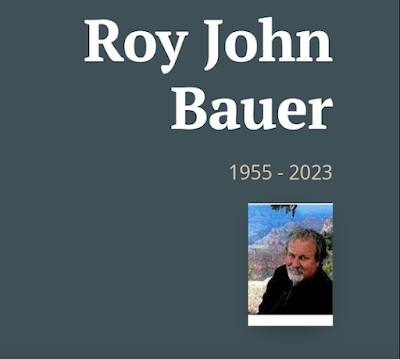
Roy's obituary in LA Times and Register: "we were lucky to have you while we did"

  This ran in the Sunday December 24, 2023 edition of the Los Angeles Times and the Orange County Register : July 14, 1955 - November 20, 2...