Tuesday, November 22, 2011

1998: Should SOCCCD cops have guns?

SC Police Chief Harry P
     Earlier today, in response to a post about the UC Davis “pepper spray” incident, one reader, contemplating the possibility of student protests at Irvine Valley College, wrote
Our campus police carry guns, don't they? I've always thought that unnecessary. I hope there is a policy in place of how to handle student protests peacefully.
     Not sure about policies. The district’s board policies can be found here. The district’s “speech and advocacy” policies can be found here.
     Upon reading the above comment, I recalled a board discussion about campus cops and their pistols that occurred about a dozen years ago. I wrote about it at the time.
     Found it!
     What follows is from the ‘Vine, #7, September 16, 1998. (The ‘Vine was the Dissent's sister publication.) It’s an excerpt from a longer article about the Sept. 14, 1998, board meeting.

Give us our new guns:

Glock 18c
    The “gun” issue emerged once again. At the last board meeting [at which the gun issue was addressed], campus police chiefs [Harry] Parmer and [Ted] Romas asked for money to replace the police forces’ old and relatively unsafe 38s with au courant 9 mm weapons. Their presentation established that, if campus cops are going to have guns, then they should be new 9 mm jobs, not the old 38s. Trustee [Dorothy] Fortune—who, before she decided to call herself a “fiscal conservative,” was active in the Democratic party—emerged that night as a strong proponent of defanging campus cops. (It turns out that most community college cops are gunless; indeed, ours is the only district in OC that arms its cops.) As I recall, then-Chancellor [Kathie] Hodge and Dave Lang agreed with Fortune, which must have been painful for them. In the end, the cops went home without their new guns, but they managed to keep their old ones.
Dave Lang
    Surprisingly, the issue was back on the agenda [for this month’s meeting]. Fortune once again spoke to the issue. In her remarks, she demonstrated her uncanny knack for really pissing people off, for, in effect, she called Parmer and Romas liars. You see, after the October board meeting, she called up the Orange County Sheriff’s Dept. and talked to a “fellow” there. She asked him about the safety of 38s. “They’re safe weapons,” said the fellow. (Of course, Parmer and Romas didn’t exactly say that 38s are unsafe; they said that 9 mms are relatively safe.) The Fortunate One concluded that she had been lied to or misled by Parmer and Romas. “That’s what you get when you only listen to people with a special interest,” she added. “Let’s spend the money on students, not on guns,” concluded Dot.
S&W model 64
    In response, chief Romas acknowledged that 38s are not unsafe; but the district’s 38s are old, he said. Lang jumped in to express both his respect for Romas/Parmer and his inclination to disarm them. “Why are we the exception among community college districts in the area?” asked Lang. [Trustee Steve] Frogue opined that it is unwise to leave cops unarmed. [Trustee John] Williams, finally finding a topic he cares about, stated that it is a “travesty” to suggest not arming police officers. Apparently addressing Mr. Lang, he said, “Get real.” “Stop living in an ivory castle.” (Yes, an ivory castle.)
    [Trustee Teddi] Lorch noted that the presence of guns is a deterrent. Fortune shot back by suggesting that the worst thing that happens on our campuses is the theft of car radios (well, not quite), so the cops don’t need guns. “Even the radicals (i.e., Frogue’s racist friends and their equally polite JDL adversaries) who sometimes come to our board meetings aren’t that bad,” she said.
    At that moment, I felt Dave Lang’s pain.
    Student trustee Marie Hill noted that she has seen men removing their shirts and revealing tatoos on campus. “Gang members,” she said. So cops gotta have guns.

S&W Model 500
    Frogue explained that, if only people knew the details—details, he implied, that were suppressed by the press!—of the Lorches’* fabled encounter with violence (?), they would understand the need to arm campus cops. (Huh?) Idiotically, Lorch explained that only someone who has experienced what she experienced knows whether campus cops should have guns. “You don’t know until you’ve experienced this yourself,” she said, thereby marking the nadir of the evening.

*Teddi Lorch and her husband

Whatever happened to....
Trustee Lorch: she "retired" in 1998, to be replaced by her friend Nancy Padberg. As we reported at the time, Lorch planned to apply for the district's head HR job. That's exactly what happened. Her former trusteeship and her friendship with Padberg made it all look very bad. When she didn't get the job (Chancellor Cedric Sampson didn't want her), she sued the district for age discrimination or some such thing. Oddly, the district settled, giving Lorch the head HR job. She's still got it.
Trustee Frogue: he's the fellow who was dogged by accusations that, in his high school history classes, he often denied the Holocaust, made racially insensitive remarks, etc. Ultimately resigned (summer of 2000).
Trustee Williams: his ignominy is sufficiently fresh that it requires no review. Ultimately resigned about a year ago.
Trustee Fortune: she eventually resigned amid charges that, for some time, she had ceased living in the area she represented. (She was rumored to be living in Central Calif.)
Kathie Hodge: eventually, she continued her administrative career at the North Orange County Community College District.
P.S.: When I was first hired at IVC in 1986, I was told that a campus cop once accidentally "discharged his weapon," and the bullet went through several walls before it came to rest. No one was hurt.

Notorious O.C. political kingmaker dies (OC Reg)

Watching Fox News makes you stupid

Fox News Viewers Know Less Than People Who Don't Watch Any News: Study (Huffington Post)

     Fox News viewers are less informed than people who don't watch any news, according to a new poll from Fairleigh Dickinson University.
     The poll surveyed New Jersey residents about the uprisings in Egypt and the Middle East, and where they get their news sources. The study, which controlled for demographic factors like education and partisanship, found that "people who watch Fox News are 18-points less likely to know that Egyptians overthrew their government" and "6-points less likely to know that Syrians have not yet overthrown their government" compared to those who watch no news.
     Overall, 53% of all respondents knew that Egyptians successfully overthrew Hosni Mubarak and 48% knew that Syrians have yet to overthrow their government.
     Dan Cassino, a political science professor at Fairleigh Dickinson, explained in a statement, "Because of the controls for partisanship, we know these results are not just driven by Republicans or other groups being more likely to watch Fox News. Rather, the results show us that there is something about watching Fox News that leads people to do worse on these questions than those who don’t watch any news at all."
     This isn't the first study that has found that Fox News viewers more misinformed in comparison to others. Last year, a study from the University of Maryland found that Fox News viewers were more likely to believe false information about politics.

UC Davis English Department


from their webpage:
The faculty of the UC Davis English Department supports the Board of the Davis Faculty Association in calling for Chancellor Katehi’s immediate resignation and for “a policy that will end the practice of forcibly removing non-violent student, faculty, staff, and community protesters by police on the UC Davis campus.” Further, given the demonstrable threat posed by the University of California Police Department and other law enforcement agencies to the safety of students, faculty, staff, and community members on our campus and others in the UC system, we propose that such a policy include the disbanding of the UCPD and the institution of an ordinance against the presence of police forces on the UC Davis campus, unless their presence is specifically requested by a member of the campus community. This will initiate a genuinely collective effort to determine how best to ensure the health and safety of the campus community at UC Davis.
*

Monday, November 21, 2011

The latest on Amy Ahearn

     The Lariat provides a mildly informative update on the Amy Ahearn case: What's next for the ailing instructor? Check it out.
     Tom Fuentes’ son, Joey, discusses his family and his father: Boys water polo: El Toro’s Fuentes played inspired in 2011.

Jon Wiener, U.C. Davis and "soul force"


From across town, U.C. Irvine history professor Jon Wiener weighs in at The Nation on the events at UC Davis and beyond:
Two unforgettable videos flew around the world wide web on Saturday, one horrifying, the other inspiring. Everybody knows the first: black-clad cops at UC Davis shooting pepper-spray into the faces of Occupy Wall Street student demonstrators who are sitting passively on the ground with linked arms. More than two million people have watched that video on YouTube—you might title it “the whole world is watching.”

But there’s a second video, shot the next night, that is amazing in a different way: it shows the chancellor of UC Davis, Linda P.B. Katehi, walking to her car after a press conference, with hundreds of students lining her path on one side, sitting on the ground with linked arms – like the students in the first, famous video – but now in a silent protest against the violence she presided over. This video is titled “walk of shame.” [See video above]

The Davis students’ message is clear: we are not the violent ones. We’re not like you. We stand for a different kind of world. And: your violence is not working. We are not afraid. It’s the message of the nonviolent civil rights movement of the 1960s, of Martin Luther King, who spoke of “meet­ing phys­i­cal force with soul force.”
To read "Pepper Spray on Campus: A Tale of Two Videos" in its entirety, click here.

*

• Pepper Spray Outrage (Inside Higher Ed)
• An Open Letter to Chancellor Katehi of the University of California, Davis (Inside Higher Ed)
• UC Davis police chief put on leave after protesters pepper sprayed (OC Reg)

Turkeys

Cruel and Unusual: A President’s ‘Pardon’ as Dark Parody (New York Times)
By JUSTIN E. H. SMITH
     … To riff on Dostoyevsky’s famous line about prisoners: you can tell what a nation is like by the way it treats its turkeys. Obama’s pardoning of one randomly selected bird at Thanksgiving not only carries with it an implicit validation of the slaughtering of millions of other turkeys. It also involves an implicit validation of the parallel practice for human beings, in which the occasional death-row inmate is pardoned, or given a stay by the hidden reasoning of an increasingly capricious Supreme Court, even as the majority of condemned prisoners are not so lucky. In this respect, the Thanksgiving pardon is an acknowledgment of the arbitrariness of the system of capital punishment….


The Willingham case: providing yet another reason to contemn Governor Perry

Sunday, November 20, 2011

Derek Reeve qua Saddleback College instructor

     Earlier today, a DtB reader suggested that I consider Saddleback College Poli Sci instructor Derek Reeve’s conduct—namely, his plagiarism—in relation to the Saddleback College Student Handbook.
     OK. The relevant section of the college student handbook states that
Students may be disciplined for one or more of the following causes related to college activity or attendance: [A through R. Item P is] …Academic dishonesty....
     This is followed by points a, b, and c, which explain "academic dishonesty." Point b defines the form of academic dishonesty known as “plagiarism”:


     Obviously, based on the evidence—including admissions by Reeve—that has appeared in the press in recent months, Reeve plagiarized: on a community newsletter/blog, he engaged in political discourse or argument, repeatedly wielding ideas (or formulations of ideas) not his own but as though they were his own.
     But Reeve is not a student at Saddleback College and the Student Handbook is a handbook for Saddleback students. Of course, I do not deny that the Handbook's code for students implies a standard regarding honesty that applies to others beyond students, including instructors. Perhaps this is what the reader had in mind. But, as we'll see, we need not rely on "implied" standards to see the problem with Reeve's conduct.
     Further, even if Reeve were a Saddleback College student, his plagiarism would not have been a disciplinable offense, since the Handbook's code refers only to student behavior "related to college activity or attendance." The college is unwilling to enforce its honesty code upon students in their lives beyond the college. This raises an interesting question: is there a reason that a college would be so willing in the case of other persons—e.g., professors?
     Reeve is, of course, a student at Claremont Graduate School, or so says his Saddleback profile. Previously (see On Derek Reeve's failure to be honest, Sept. 27), I unearthed the honesty code for CGS, and I suggested that he violated the spirit, if not the letter, of that standard.

* * *
     There is a code explicitly relevant to Reeve’s conduct re honesty/dishonesty insofar as he is a Saddleback College instructor; it is the college's Faculty Code of Ethics and Professionalism. In the aforementioned post, I wrote the following:

     ...As it turns out, a dozen years ago, Saddleback College faculty adopted a “Faculty Code of Ethics and Professional Standards.” It quotes a familiar American Association of University Professors statement:

"Professors, guided by a deep conviction of the worth and dignity of the advancement of knowledge, recognize the special responsibilities placed upon them. Their primary responsibility to their subject is to seek and to state the truth as they see it. To this end professors devote their energies to developing and improving their scholarly competence. They accept the obligation to exercise critical self-discipline and judgment in using, extending, and transmitting knowledge. They practice intellectual honesty…." (AAUP Statement, 1990) [My emphasis.]

The Saddleback “code” goes on to require that

Faculty exhibit intellectual honesty and integrity in all scholarly endeavors.

     …Qua scholar and qua college faculty, Reeve is expected to be honest, and, obviously, one aspect of honesty is not passing off other’s writings and ideas as one’s own—even in less-than-scholarly settings. Jenna Chandler’s recent piece in the SJC Patch makes very clear that Mr. Reeve does exactly that—he passed off others’ ideas and writings as his own—and he has done so repeatedly. [End of quotation.]

     Observe that the prohibition against plagiarism, understood as a professional standard, does not restrict its scope to what one writes or says at one's college or even in academic settings. College professors are supposed to approach authorship honestly period, for they are to seek "the truth," employing competent methods. One who offers others' ideas as his own, even on a blog, is no seeker of truth. He is an enemy of that fine endeavor. 
     Further, academia is all about communities—such as communities of experts/scholars. The effort of some community of experts/scholars (re subject X) to arrive at understanding (re X) and to effectively communicate that understanding to the public is damaged when one of its members engages in discourse about X dishonestly, even in somewhat non-academic settings. That Mr. Reeve publicly argued his political theses fraudulently—i.e., with plagiarized elements—undermined the larger enterprise of the community of political scientists and of scholars. Thus, a college, among other entities, has a good reason to concern itself with the honesty/dishonesty of its "experts," even when the dishonesty occurs outside the strict bounds of the Academy. 
     Especially given Reeve's unambiguous denial that he plagiarized—despite his plainly having done so—I concluded (in Sept.) that he "cannot be trusted to argue honestly; he certainly cannot be trusted to instill academic honesty in his students."
     In any case, it seems clear that Reeve violated the above code—Saddleback College's faculty code of professional ethics.

* * *
     So what is the college doing about that? What is the Academic Senate doing?
     Nothing, it appears.
     Sometimes, one's doing nothing amounts to one's plainly doing something—such as exhibiting one's actual values, despite official verbiage implying very different values.
     Again, SC's inaction contrasts with the action of Concordia U to (evidently) fire Reeve based on his failures of honesty. (See More clarity on Reeve and Concordia.)

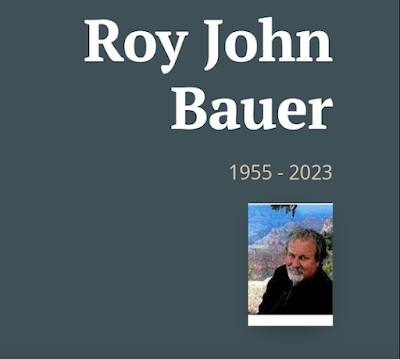
Roy's obituary in LA Times and Register: "we were lucky to have you while we did"

  This ran in the Sunday December 24, 2023 edition of the Los Angeles Times and the Orange County Register : July 14, 1955 - November 20, 2...