Wednesday, June 1, 2011

Annie and "Leena"


     ...Meanwhile, Annie and "Leena" (aka TigerAnn, aka TigerPants, aka TigerAss, aka Li'l Miss Bratty) are relaxing in Trabuco Canyon.
     Annie is fighting the great "Africanized bees" menace and learning new songs on her ukulele.
     Tiger has developed new relaxation techniques.
     In Poland, mom has renewed her passion for chocolate and the like.
     My dad? Well, he called me at 6:45 this morning. I know not why.
     I am researching post-war Stettin and figuring out how to buy a shirt.

Leena in the sun

See How We Are: Extended Play


Rebel Girl's summer travels find her much closer to home than her comrade B. von Traven. But she still has her adventures. Yesterday's perambulations, for example, found her at the Lutheran Thrift Shop in Orange.

Rebel Girl likes the Lutheran Thrift Shop for many reasons especially their unparalleled collection of boy's clothing, all in pristine condition, even the pants because, of course, those Lutheran boys are so well-behaved they don't even wear out the knees of their Levis so Rebel Girl's little atheist can have that particular pleasure for a couple bucks a pair.


Yesterday, at the check-out counter, where two, sometimes three Lutheran ladies often do the tasks that could easily be done by one, thus extending the check-out time exponentially, Rebel Girl admired the stash of the woman in front of her.


It was spectacular. A collection of old parochial school bulletin board pin-ups. Cardboard Biblical characters. Jesus in his robes, various bearded men, little lambs, shepards with their crooks. Faded construction paper silhouettes of Lincoln and Washington. A giant ziploc baggie of all the lost plastic playing pieces from all the old board games in the world: Stratego. Sorry. Battleship. Monopoly. Life.


Who would buy this eclectic hodgepodge? Other than, of course, Rebel Girl, who examined the jumble with some envy and wistfulness. Rebel Girl glanced up and saw that the buyer defied the usual clientele of the Lutheran Thrift Shop which runs to Lutherans, Latino women with children in strollers and disaffected high school students looking for clothing in which to cloak their anxieties.

Then she recognized her.

Exene Cervenka, lead singer of the LA punk band X. Could Rebel Girl count the number of times she'd seen X in concert in clubs, concert halls, demonstrations, festivals? No, she couldn't. Could Rebel Girl sing along, track-for-track to all of the X albums? Yes she could. In that moment of recognition, she resisted that impulse.

She said instead: "Excuse me, I think I've seen you before."

Exene smiled and said, "Do you come to this thrift store often?"

Rebel Girl said, "Yes, but that's not what I mean."

Rebel Girl tried not to gush too much but thought she should say something to this woman whose music has meant so much to her. So she did. Something like: Thanks for the music. It meant and means so much to me. She may have even said, it saved my life, metaphorically, of course.

Yikes.

Exene is older now, like Rebel Girl. They are two middle-aged women counting out their change and handing it over. Exene is in her mid-50s and was recently diagnosed with MS. But she still rocks and she goes to thrift stores and finds what she finds and, Rebel Girl imagines, makes her art of it all.


Before she left, Exene told Rebel Girl, "I'm playing this Saturday."

"I don't get out much," Rebel Girl said and by way of explanation, "I got a kid now, but yeah."

Rebel Girl wanted to say more, so much more, but she didn't. No need to tell Exene who she was and what she meant. She knew. Rebel Girl saved it for the ladies behind the counter and after Exene exited the store, she said, "Do you know who that was?" and launched into an adrenaline-fueled account of Exene's life and career which was lost, alas, on the trio of service-oriented Lutherans behind the counter.

See how we are indeed.


*

From today's OC Register: Exene tells it straight on X, illness and O.C.

*

Stettin (i.e., Szczecin)


Mom's dad: Hermann Schultz
     Well, we’ve made our way west, and we have now arrived at the Hotel Atrium in my mother’s birthplace: Stettin—now Szczecin.
     My mother was born here in this harbor town in 1933. Mom's mother died here in 1934—and that’s when mom was taken east to live with her Aunt Marthe in Bärwalde.
     Her father, who owned a small trucking company, died in Stettin in 1938.
     My mother, who was eleven or twelve when the war ended (in 1945), had made several trips to Stettin and remembers the “big city” well. But she hasn't been back here since 1944 or so.
     Strictly speaking, she last laid eyes on Stettin in 1945, when she fled westward on rail flatcars. Her group's train made it through the Stettin station, despite strafing. (The engineer was a Polish prisoner who was instrumental in keeping everyone alive.)
     The next train was not so lucky. Everyone on board was killed by Russian planes.
* * * * *
     The Polish name, "Szczecin," is pronounced something like this: SHTECH'-eena, with the “e” of shtech somewhere between a soft e and a hard i. Closer to the hard i (to my ears). So it's more SCHTIGHCH'-eena.
     The German name, “Stettin,” is pronounced shtettEEN, more or less

     According to Wikipedia:
     Szczecin … is the capital city of the West Pomeranian Voivodeship in Poland. It is the country's seventh-largest city and the largest seaport in Poland on the Baltic Sea. As of June 2009 the population was 406,427.
     Szczecin is located on the Oder River, south of the Szczecin Lagoon and the Bay of Pomerania. The city is situated along the southwestern shore of Dąbie Lake, on both sides of the Oder and on several large islands between the western and eastern branches of the river.…
     The city's beginnings were as an 8th century Slavic Pomeranian stronghold. Over the course of its history it has been a part of Poland, existed as an independent Duchy, was ruled by Sweden, Denmark, Brandenburg-Prussia, was part of the Holy Roman Empire, German Empire, Weimar Republic and the Third Reich. It was the residence of the Griffin Dynasty from the 12th until the 17th century.
     While the city was ruled by Nazi Germany the Jews, Poles and Rroma were subjected to repression and finally during World War II classified as untermenschen with their fate being slavery and extermination. After Germany was defeated by the Allies in 1945, Szczecin was awarded to the People's Republic of Poland. The city was emptied of its German inhabitants, who either fled before the advancing Soviet Army or were expelled by the Polish government. Poles resettled and rebuilt the war damaged city, which became capital of the new Szczecin Voivodeship. It played an important role in the anti-communist uprisings of 1970 and the rise of Solidarity trade union in the 1980s.
The Hotel Atrium dining room: pizza and asperagus

The majestic Atrium entrance

Stairs. Dark woods

My room. High ceiling

A friend sent this:

Tuesday, May 31, 2011

Once a train station (Jewish friends in Bärwalde)

     When, in1934, my mother, Edith, was christened, a Jewish friend of the family was present and gave her the above hand-made cloth. ("ES" stands for Edith Schultz.)
     When Edith and her Aunt Marthe fled the Russians in 1945, they could take very little with them, but they did take this. When mom emigrated to Canada in 1951, she again took it with her.

An abandoned train station in Bärwalde (Barwice): the last time my mother saw her "Jewish friends" was here

Mom's "mother" (actually, her Aunt Marthe) ran a business, as became necessary when her husband (my mom's stepfather) died in 1941.
Marthe had many good friends in town who were Jewish—evidently in the garment industry. My mother remembers some of these friends well.

This old house was perhaps the home of mom's doctor—likely Jewish.

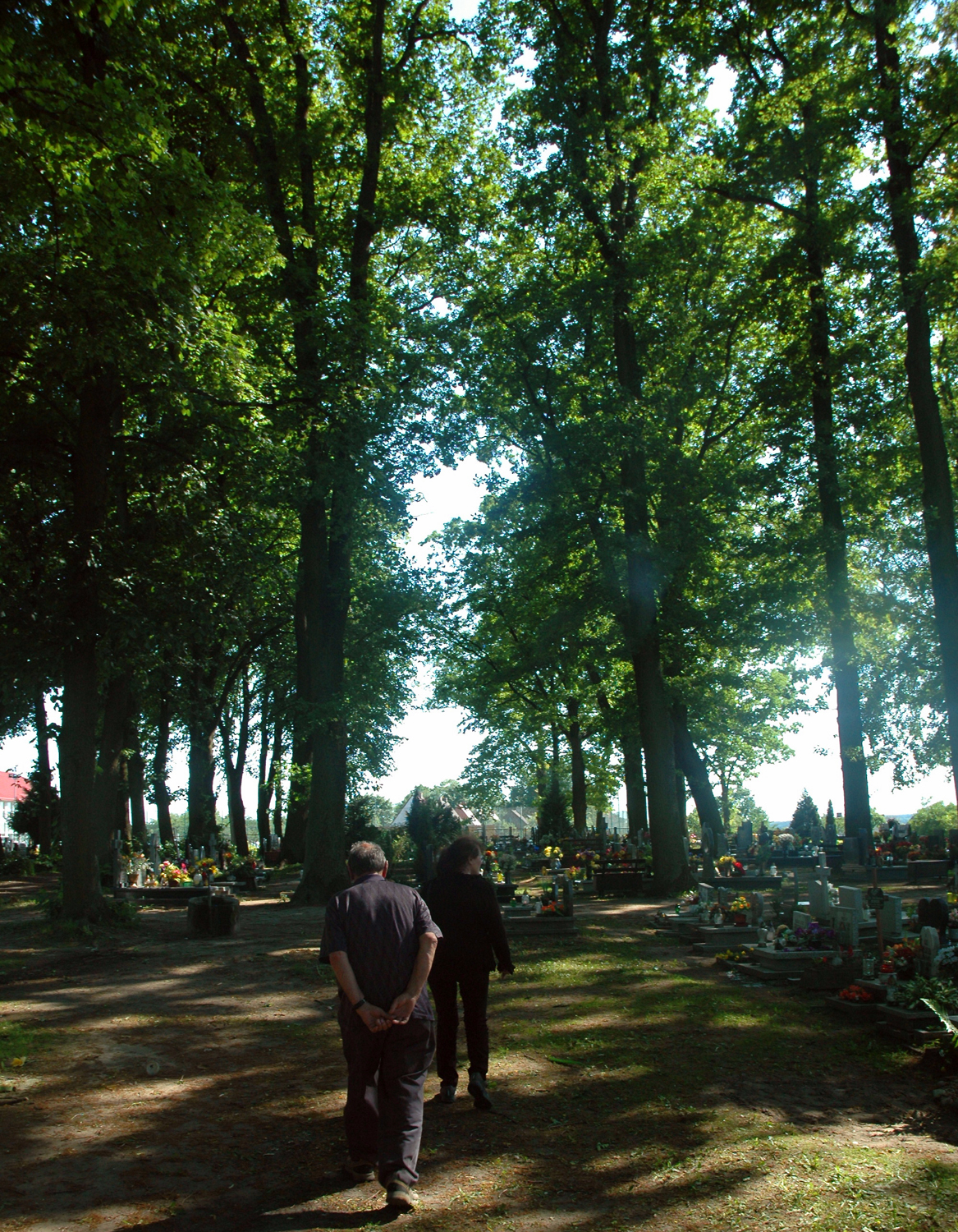
Yesterday: wandering through the graveyard, finding no familiar names.

Yesterday: a random gravestone

My mother and her Aunt Marthe at mom's father's grave, c. 1941

Mom's Bärwalde home, during the war. It was destroyed during the Russian advance

Edith this morning in Bad Polzin, Pommeria

My father this morning

Walking through Połczyn Zdrój this morning


“Park Zdrojowy “

The old hospital is very near the park. This zone seems in between park and hospital.
We appear to be experiencing wonderful, albeit hot and humid, weather

A part of the old hospital where my mother spent many weeks as a 9 and 10-year-old.
I cannot get her to speculate where her hospital room was located. Dang.

Another part of the building

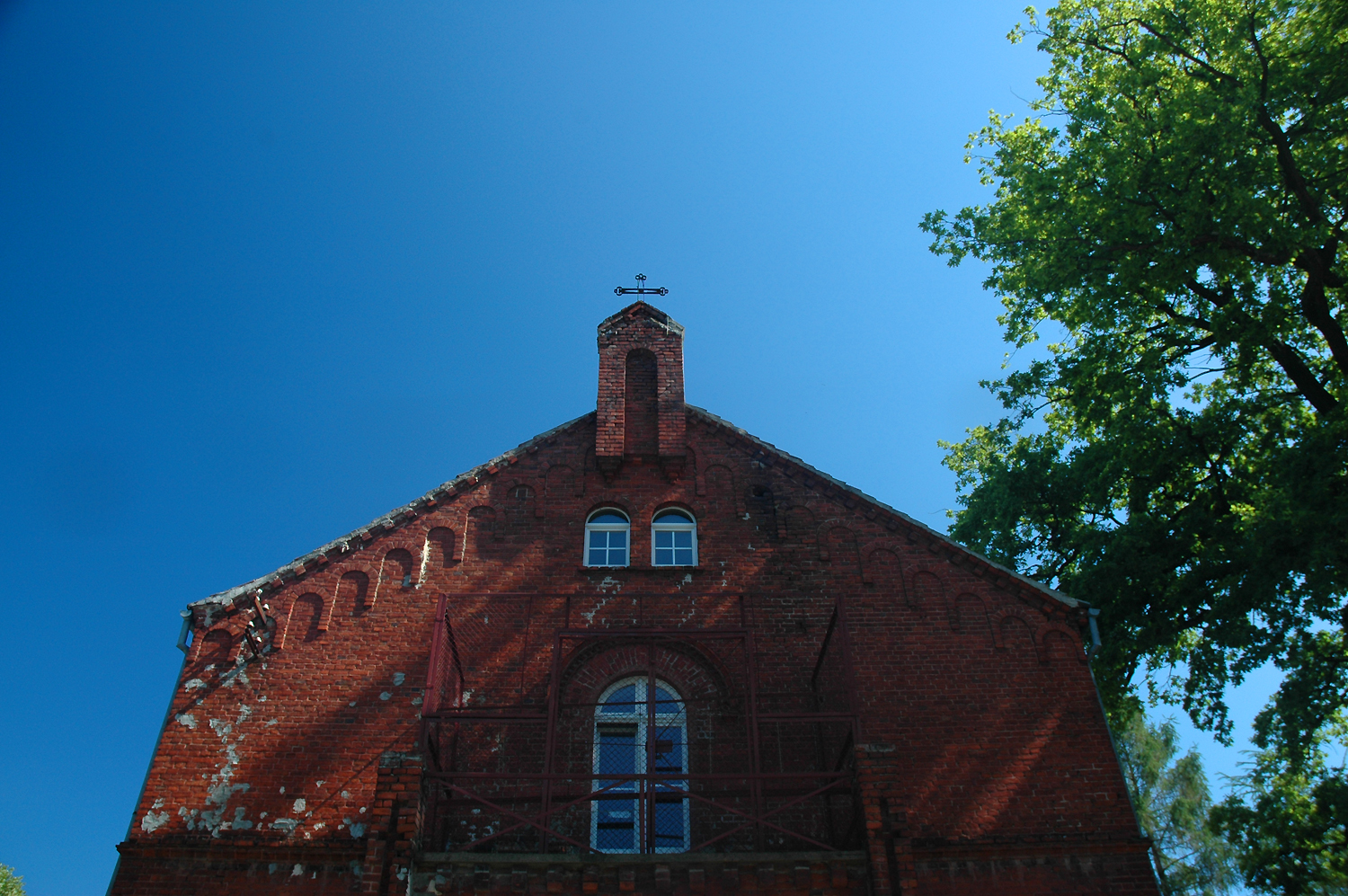
So many of these little towns have magnificent churches

Downtown hustle and bustle on Tuesday morning.

Połczyn-Zdrój factoids:
Połczyn-Zdrój (Polish name)
Bad Polzin (German name, some time after WWI)
• Bad = “bath”
• The town has warm mineral springs, which have been exploited in sanatoriums allegedly to cure rheumatism.
• In 1905 the town had a population of 5,046 predominantly Protestant inhabitants (36 Catholics. 110 Jews), which in the year of 1925 had grown to 5,960 persons.
• Before World War I, the town was known as Polzin. It acquired the name Bad Polzin between the two World Wars.
• In March 1945 the region was occupied by the Red Army, and after the end of World War II it was put under Polish administration. The inhabitants were expelled by the Poles.
• Today, the population has grown to about 8,600
• Its famous park is called “Park Zdrojowy “

Monday, May 30, 2011

It's good; it's over (Bärwalde)

     Bad Polzin, Pommern, in 1902. In those days, the town was German. It seemed to specialize in sanitariums. Still does.

     Here's a pic of the Hotel Marta Spa in Bad Polzin (nowadays, Połczyn Zdrój) in West Pommern (northwestern Poland). It's very European, very quaint. Near the park, which is fabulous.

     When my mother was ten (in 1943), she suffered some sort of appendicitis. She was taken to the hospital in Bad Polzin, where she received various treatments for two weeks or so. Then she was sent home, but, after a few weeks, she took a turn for the worse and was brought again to the hospital, where surgery was performed, removing her appendix. (Oddly, her sister, Ilsa, came down with the same problem and received surgery at the same time.) Mom remembers recuperating in the hospital and occasionally walking through the well-known park nearby.
     That park was fabulous then and it is fabulous now. I don't think I've ever seen a nicer park. Everything is blooming, and the smell is overpowering.

     18 kilometers from Bad Polzin is my mom's actual hometown of Bärwalde. Today, we took mom to this town that she hasn't seen since 1945, when she, her "mother," and her sister escaped from the Russian advance. All they took was what they could carry in a child's wagon.
     I'm afraid that, today, she found things to be disturbingly different than they had been. Her home had been destroyed. Some of her relatives' homes were unrecognizable. 
     She couldn't find any of her relatives at the cemetery. Not her beloved step-father, no one. Evidently, a photo of her had been etched onto his gravestone. But none of the old German graves remained.
     "Well, now I know that the town of my childhood no longer exists," she said. "It's good. It's over."

     We returned to Bad Polzin for dinner. The downtown area is very old, very quaint. Not many restaurants, though.

     We went to a restaurant that was happy to have any customers at all, even German/Americans. The cook made a special pizza for us. Nice people.


Mom's family, on her father's side, circa 1912. That's father Hermann at far right and Aunt Marthe at far left. Marthe and her sister (far right) worked at the time for the Berlin Opera

Rebel Girl's Poetry Corner: Memorial Day


Memorial Day
By Gregory Orr

1
After our march from the Hudson to the top
of Cemetery Hill, we Boy Scouts proudly endured
the sermons and hot sun while Girl Scouts
lolled among graves in the maple shade.
When members of the veterans’ honor guard
aimed their bone-white rifles skyward and fired,
I glimpsed beneath one metal helmet
the salmon-pink flesh of Mr. Webber’s nose,
restored after shrapnel tore it.


2
Friends who sat near me in school died in Asia,
now lie here under new stones that small flags flap
beside.
It’s fifth-grade recess: war stories.
Mr. Webber stands before us and plucks
his glass eye from its socket, holds it high
between finger and thumb. The girls giggle
and scream; the awed boys gape. The fancy pocket watch
he looted from a shop in Germany
ticks on its chain.

*

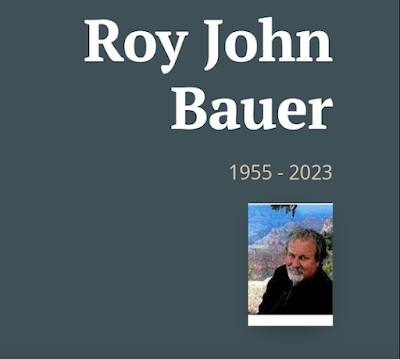
Roy's obituary in LA Times and Register: "we were lucky to have you while we did"

  This ran in the Sunday December 24, 2023 edition of the Los Angeles Times and the Orange County Register : July 14, 1955 - November 20, 2...