Tuesday, May 31, 2011

Once a train station (Jewish friends in Bärwalde)

     When, in1934, my mother, Edith, was christened, a Jewish friend of the family was present and gave her the above hand-made cloth. ("ES" stands for Edith Schultz.)
     When Edith and her Aunt Marthe fled the Russians in 1945, they could take very little with them, but they did take this. When mom emigrated to Canada in 1951, she again took it with her.

An abandoned train station in Bärwalde (Barwice): the last time my mother saw her "Jewish friends" was here

Mom's "mother" (actually, her Aunt Marthe) ran a business, as became necessary when her husband (my mom's stepfather) died in 1941.
Marthe had many good friends in town who were Jewish—evidently in the garment industry. My mother remembers some of these friends well.

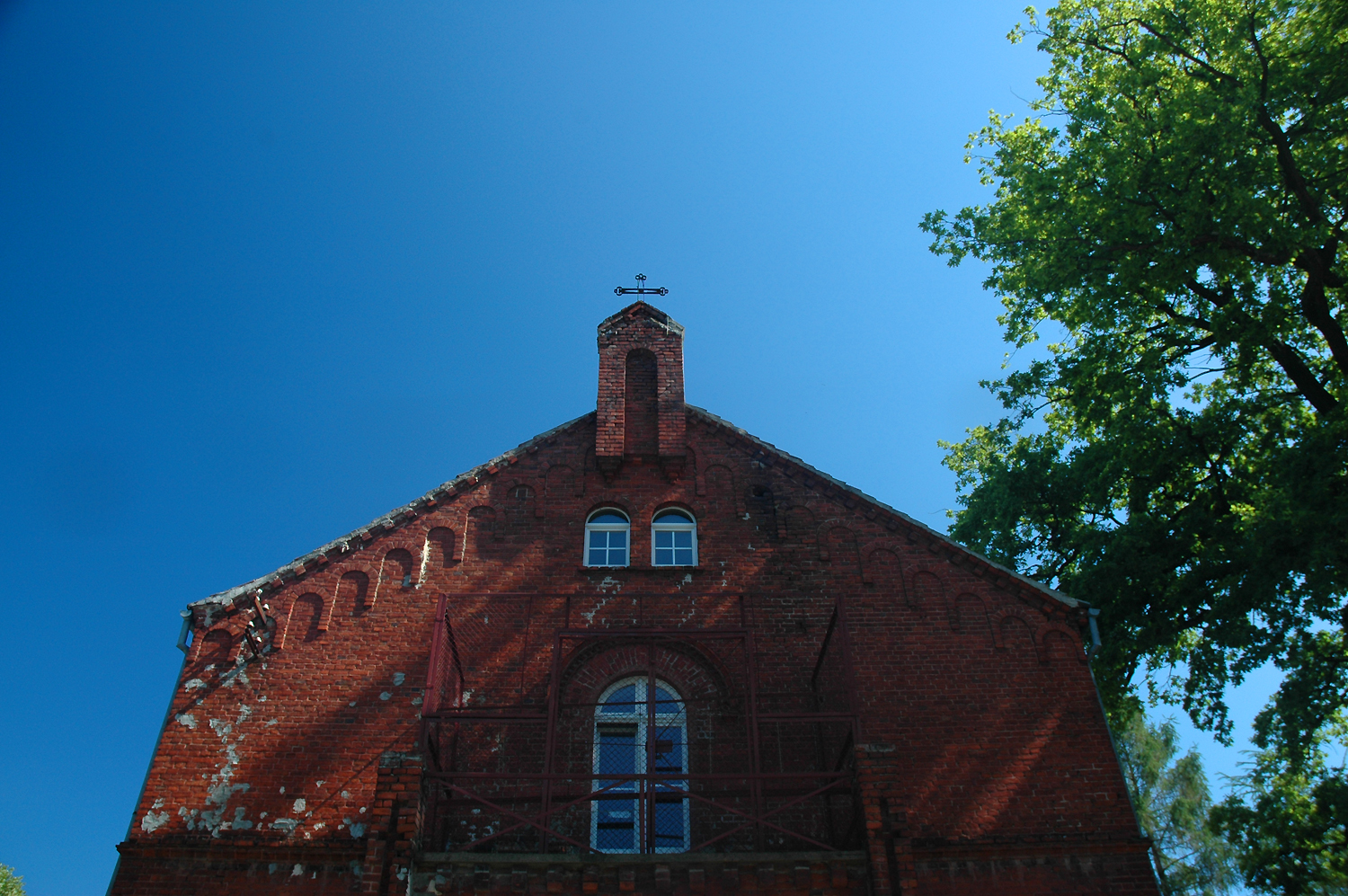
This old house was perhaps the home of mom's doctor—likely Jewish.

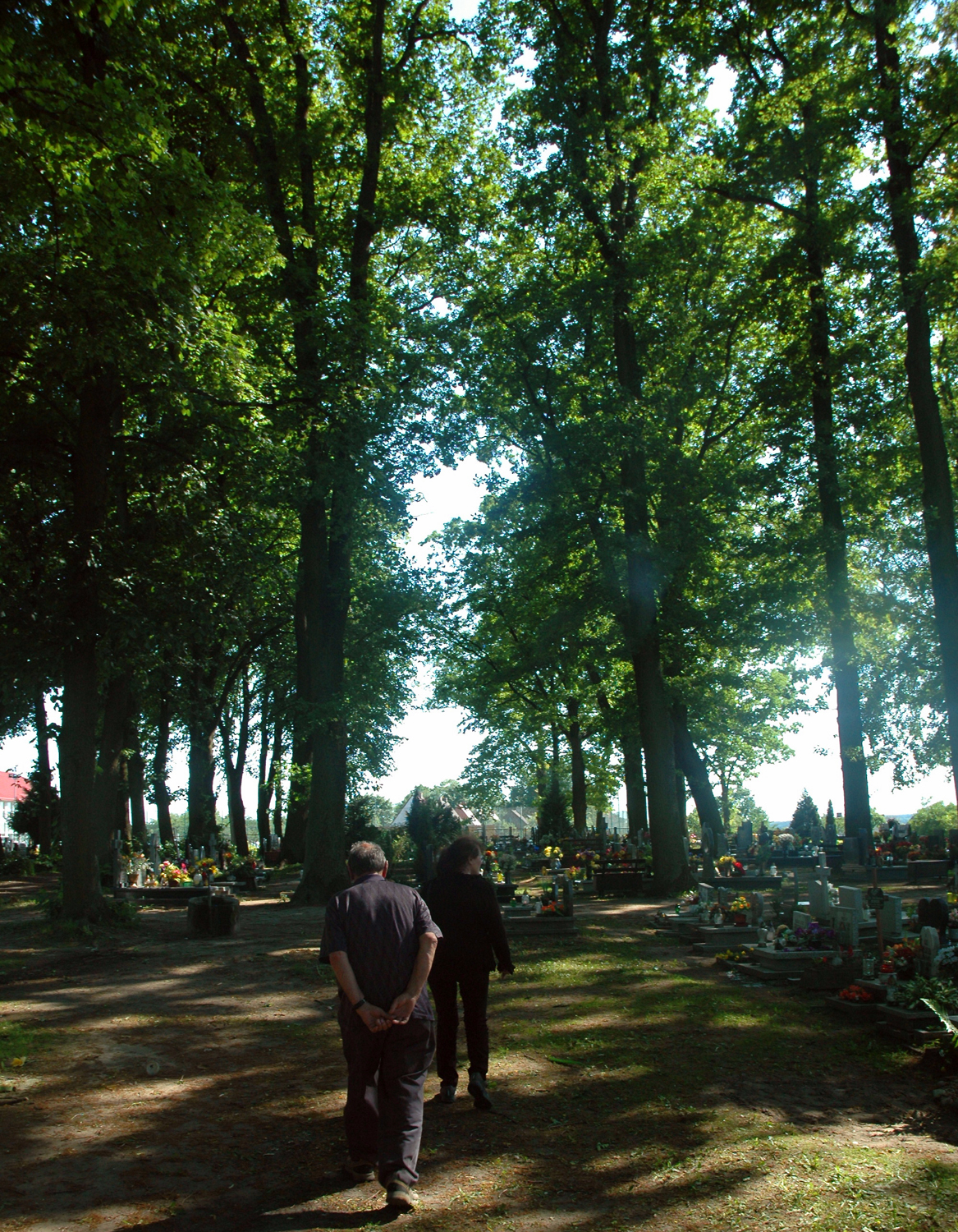
Yesterday: wandering through the graveyard, finding no familiar names.

Yesterday: a random gravestone

My mother and her Aunt Marthe at mom's father's grave, c. 1941

Mom's Bärwalde home, during the war. It was destroyed during the Russian advance

Edith this morning in Bad Polzin, Pommeria

My father this morning

Walking through Połczyn Zdrój this morning


“Park Zdrojowy “

The old hospital is very near the park. This zone seems in between park and hospital.
We appear to be experiencing wonderful, albeit hot and humid, weather

A part of the old hospital where my mother spent many weeks as a 9 and 10-year-old.
I cannot get her to speculate where her hospital room was located. Dang.

Another part of the building

So many of these little towns have magnificent churches

Downtown hustle and bustle on Tuesday morning.

Połczyn-Zdrój factoids:
• Połczyn-Zdrój (Polish name)
• Bad Polzin (German name, some time after WWI)
• Bad = “bath”
• The town has warm mineral springs, which have been exploited in sanatoriums allegedly to cure rheumatism.
• In 1905 the town had a population of 5,046 predominantly Protestant inhabitants (36 Catholics. 110 Jews), which in the year of 1925 had grown to 5,960 persons.
• Before World War I, the town was known as Polzin. It acquired the name Bad Polzin between the two World Wars.
• In March 1945 the region was occupied by the Red Army, and after the end of World War II it was put under Polish administration. The inhabitants were expelled by the Poles.
• Today, the population has grown to about 8,600
• Its famous park is called “Park Zdrojowy “

Monday, May 30, 2011

It's good; it's over (Bärwalde)

     Bad Polzin, Pommern, in 1902. In those days, the town was German. It seemed to specialize in sanitariums. Still does.

     Here's a pic of the Hotel Marta Spa in Bad Polzin (nowadays, Połczyn Zdrój) in West Pommern (northwestern Poland). It's very European, very quaint. Near the park, which is fabulous.

     When my mother was ten (in 1943), she suffered some sort of appendicitis. She was taken to the hospital in Bad Polzin, where she received various treatments for two weeks or so. Then she was sent home, but, after a few weeks, she took a turn for the worse and was brought again to the hospital, where surgery was performed, removing her appendix. (Oddly, her sister, Ilsa, came down with the same problem and received surgery at the same time.) Mom remembers recuperating in the hospital and occasionally walking through the well-known park nearby.
     That park was fabulous then and it is fabulous now. I don't think I've ever seen a nicer park. Everything is blooming, and the smell is overpowering.

     18 kilometers from Bad Polzin is my mom's actual hometown of Bärwalde. Today, we took mom to this town that she hasn't seen since 1945, when she, her "mother," and her sister escaped from the Russian advance. All they took was what they could carry in a child's wagon.
     I'm afraid that, today, she found things to be disturbingly different than they had been. Her home had been destroyed. Some of her relatives' homes were unrecognizable. 
     She couldn't find any of her relatives at the cemetery. Not her beloved step-father, no one. Evidently, a photo of her had been etched onto his gravestone. But none of the old German graves remained.
     "Well, now I know that the town of my childhood no longer exists," she said. "It's good. It's over."

     We returned to Bad Polzin for dinner. The downtown area is very old, very quaint. Not many restaurants, though.

     We went to a restaurant that was happy to have any customers at all, even German/Americans. The cook made a special pizza for us. Nice people.


Mom's family, on her father's side, circa 1912. That's father Hermann at far right and Aunt Marthe at far left. Marthe and her sister (far right) worked at the time for the Berlin Opera

Rebel Girl's Poetry Corner: Memorial Day


Memorial Day
By Gregory Orr

1
After our march from the Hudson to the top
of Cemetery Hill, we Boy Scouts proudly endured
the sermons and hot sun while Girl Scouts
lolled among graves in the maple shade.
When members of the veterans’ honor guard
aimed their bone-white rifles skyward and fired,
I glimpsed beneath one metal helmet
the salmon-pink flesh of Mr. Webber’s nose,
restored after shrapnel tore it.


2
Friends who sat near me in school died in Asia,
now lie here under new stones that small flags flap
beside.
It’s fifth-grade recess: war stories.
Mr. Webber stands before us and plucks
his glass eye from its socket, holds it high
between finger and thumb. The girls giggle
and scream; the awed boys gape. The fancy pocket watch
he looted from a shop in Germany
ticks on its chain.

*

South to Polzin: beautiful countryside

This morning, we headed south/southeast toward Polzin, just a few kilometers from my mother's home town of Bärwalde, in Pommern--now in the northwest corner of Poland.

The countryside continues to be beautiful. This is a typical road scene (just north of Polzin).

No, really, this is what it looks like, mile after mile (er, kilometer after kilometer). And the towns are seriously quaint.
We're staying at the Hotel Marta Spa, which is very European. Some of the staff dress as nurses. The food is very, um, healthy. I'll show you more when I have time later. Looks great. All is well.

Sunday, May 29, 2011

CIM trashed?

Copies of this “trashed” sign have been posted in various places in Irvine Valley College’s BSITC building.

I don’t know who posted the signs.

Also posted were all of the certificate brochures on one of the vacated office windows marked up and crossed-out with Xs and text.

Obviously, this concerns the program in Computer Information Management—of the School of Business Sciences. Recently, the school has suffered an unusual faculty loss owing to retirement.

One hears also of an audit of CIM curriculum. Trouble? One senses that significant changes are occurring—under the radar and yet with the usual blunt approach.

Let us know what you know.

“You must not take pictures”

A magnificent old structure--and two chained watchdogs (click on graphic to enlarge)
     Anybody with half a brain can see that Pomerania—once the eastern extreme of Germany; since 1945 the northwestern section of Poland—is haunted.
     Today, we took an excursion from the seaside resort town of Kolobrzeg along the coast to Wolin, a small town at the south end of the island by that name.
     My mother’s mother was from Wolin. Little is known about her. She died tragically in 1934, when my mother was a year old, in Stettin, south of Wolin. Her husband, my mother’s father, himself died tragically five years later, also in Stettin.
     This morning, on our way west in our Opel, we came across a small town with a magnificent church. I walked clear around the enormous building, attempting to keep a low profile, for dozens of parishioners surrounded it, owing to some sort of ceremony. I walked about the town, too. It was beautiful; evidently, the buildings were untouched by the war and the notorious Russian advance/German retreat of 1945.

A path near the beach: Kolobrzeg, on the Baltic
My dad on the Baltic shore, earlier today
Spectacular countryside; beautiful roads
Small town, magnificent church

     Owing to an error on one of our maps, we at first went to a town way up on the Baltic coast. There, we met an old Pole near a graveyard who explained our error and directed us south to the real Wolin. We thanked him, and off we went. (He had family in Chicago, he said. But he had lost track of them.)
     On our way south, I happened upon a remarkable old building that seemed to serve as a farmhouse. (See top photo; click on it.) Oddly, it was guarded by two tied-up dogs, though only one of them barked. “Hello Pup,” I kept saying to the barking dog, who didn't seem angry. I took some pictures.
     After a few seconds, a young man of perhaps seventeen bolted from the nearby farmhouse (the building at left). He ran straight up to me. I said, “I was just admiring your beautiful building.”
     But he did not listen. In broken English, he said something like, “You must not take pictures.”
     “I mustn’t take pictures?”
     “No, you must not take pictures of this. You must stop now. Now go.”
     “OK,” I said.

* * *
Wolin's Catholic cemetery

     About a half hour later, we were in Wolin, which is a small town with a large church. We drove about. The town is situated next to some wonderful forested hills. I drove toward them. We were looking for the “old graveyard,” hoping to see gravestones of my grandmother or of any of her family, the Sternkes.
     I spoke with one man who spoke neither German nor English. I gestured, using a digging motion, and he seemed to grasp what we were looking for. He headed us toward a hill in the beautiful forested area, but that turned out to be an archeological dig for medieval tombs. No one was around.
     Eventually, I happened upon a marvelous cemetery surrounded by an old fence. It was open. Once inside, we looked for older gravestones, but, though some seemed very old, those were illegible. All of the others dated to burials after 1945. The names were all Polish, none German. It was, of course, a Catholic cemetery (virtually all Poles are Catholic; most of the earlier Germans were Lutheran).
     I tried to find someone who could answer my questions: were there any pre-45 gravestones? Was there an old Jewish cemetery? (It has been suggested—but perhaps it has also been debunked—that my grandmother was Jewish. Not sure.) But no one we met spoke good enough English or German to communicate with us, and time was running out.
     We headed back to Kolobrzeg.
     The countryside of old West Pomerania is spectacularly beautiful. It is very green, sparsely populated, and peppered with thick, beautiful forests. Spectacular forests, full of light and shadow.
     It is impossible to look at them and not think of spirits.

Endless tree-enshrouded roads: somehow eerie
A bleak Soviet-era structure amid the beauty of Pomeranian hills and farms
Pomeranian driftwood

Roy's obituary in LA Times and Register: "we were lucky to have you while we did"

  This ran in the Sunday December 24, 2023 edition of the Los Angeles Times and the Orange County Register : July 14, 1955 - November 20, 2...