Friday, April 8, 2011

Santa Ana Army Air Base (1942-6, 1956-8)

[Updated, 1/14/14]


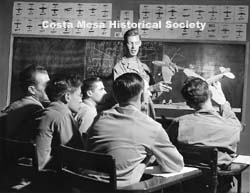
     A few days ago, OCC's student newspaper posted the above photograph of the old Santa Ana Army Air Base, which was located at the site of Orange Coast College from February 1942 to March 1946, when it was deactivated. (The Air Force was not created until after the war. Before that there was the "Army Air Corp.")
     I figured I'd look for more pics of the base. I quickly found this: Santa Ana Army Air Base. The site briefly describes the base's history.

Historic California Posts: Santa Ana Army Air Base [1942-1958]
(Air Corps Cadet Replacement Training Center, Aviation Cadet Replacement Training Center, Costa Mesa Air National Guard Station)

[Basic training for Army Air: 1942-5?]
     Santa Ana Army Air Base (SAAAB) was an air base without planes, hangers or runways. It was a huge basic training camp where newly inducted soldiers, earmarked for the Army Air Forces, were given 9 weeks of basic training and then testing to determine if they were to be pilots, bombardiers, navigators, mechanics, etc. From SAAAB, they went on to other bases for training in their specialties.
     The base was dedicated in March 1942 and grew rapidly as the need for pilots and air crews sky-rocketed. Turnover was rapid so that by the end of the year 23,470 soldiers had passed through SAAAB. By the end of 1943 that number jumped to 57,895.

[Additional assignments: 1942-5]
     In the Fall of 1942 SAAAB [also] became an Overseas Replacement Depot (ORD), housing Army Air Forces personnel awaiting transportation overseas.
     In November of 1943 members of the Women's Air Service Pilots (WASP) began training at the base, followed shortly by members of the Women's Army Corp (WAC).

[Reversing the process: 1945-6]

View of men at a Beer Party at the Santa Ana Army Air Base. Men are all dressed in military uniform. Some have sheets of paper that they are reading. The back of the photo is inscribed: "Philip J. Jack second from right top of picture with cigarette in mouth. He was at Santa Ana Calif from May 1943 to Oct. 1945. (OC Public Libraries)

     In 1945 SAAAB became one of six Redistribution Centers in the country for airmen returning from overseas who were to be assigned state-side duty.
* * *
[Digression: Hollywood]
     Being close to Hollywood and with such a large turnover of service personnel, the base attracted a lot of Hollywood celebrities who put on shows at the base.
* * *
[End game: 1945]
     In late 1945 Japanese aliens from the alien internment camps being returned to Japan by the Immigrations and Naturalization Service (INS) were housed here while awaiting transportation to Japan.
     SAAAB continued as a redistribution and separation center for a short time after the war.
     On March 31, 1946, the base was officially deactivated.
* * *
[Brief revival, 1956:]
     However, in 1956 elements of the 551st Antiaircraft Artillery Missile Battalion brought the Nike-Hercules system from Fort Bliss and temporarily installed and operated it at the old SAAAB site until their permanent installations (Site LA-88) in Chatsworth and atop Oak Mountain were completed.
* * *
[The end: 1958]

     In 1958 the base was declared surplus and soon afterwards the land was divided for many uses. In the postwar years private homes, apartments, two colleges, the Costa Mesa Air National Guard Station and the Orange County Fairground shared the land. Many of the base's original buildings remained in use for years by the colleges and the fair grounds. [end]

      Here are two photos from the above site:


According to Wikipedia,
     In 1958 the base was declared surplus and soon afterwards the land was divided for many uses. At present the site includes the Orange County Fairgrounds, Pacific Amphitheatre and Orange Coast College. Some of the original buildings were renovated and are being used by the present owners.
     In literature, the Santa Ana Army Air Base is notable as being one of the two settings -- but the only non-fictional one (the other, the fictional island of "Pianosa" in Italy) -- for the novel "Catch-22" by Joseph Heller.

This shows the site of the old base as it appeared in 1995
In OC, August, 1943. Died as B-17 tailgunner, 1944


Instruction at the base

Thursday, April 7, 2011

A point of information

Ayesha N. Khan
     As per the recent "Westphal v. Wagner" settlement agreement, the district paid for plaintiffs' attorneys in the amount of $250,000. (All of this went to Americans United for Separation of Church and State, which handled the lawyering for plaintiffs.)
     Readers have asked about the cost of the attorneys used by defendants (i.e., our district) in this case.
     This is a matter of public record. I checked SOCCCD Board of Trustees agendas starting in late 2009 and up to the present, looking for requisitions and payments to Jones Day, the law firm employed by the district in Westphal v. Wagner.
     Here’s what I found:

2010

May:
Under: Purchase Orders/Confirming Requisitions
P I 0-04424 JONES DAY Legal Services Westphal Case 1,000,000.00

Under: Payment of Bills
Dated check:
• $349,331 - 4/20/10

July:
Under: Payment of bills:
Dated check:
• $176,193 - 6/15/10
• $52,690 - 7/02/10

September:
Under: Payment of Bills
Dated check:
• $79,833 - 8/11/10

October:
Under: Payment of Bills
Dated check:
• $113,003 - 9/13/10

November:
Under: Purchase OrdersIConfirming Requisitions
P I 1-02362 JONES DAY Legal Servlces Westphal Case 1.000,000.00

Under: Payment of Bills
Dated check:
• $128,411 - 10/19/10

2011

January:
Under: Payment of Bills
Dated check:
• $11,124 - 12/10/10
• $130,565 - 11/22/10

John A. Vogt Jr.
All district checks to Jones Day thus far:

$349,331 - 4/20/10
$176,193 - 6/15/10
$52,690 - 7/02/10
$79,833 - 8/11/10
$113,003 - 9/13/10
$128,411 - 10/19/10
$11,124 - 12/10/10
$130,565 - 11/22/10

TOTAL: $1,041,150.00

About Jones Day and Americans United:
• Jones Day website
• Wikipedia entry on Jones Day • Jones Day’s Irvine office • Lead attorney on this case: John A. Vogt Jr. (Partner)
• Americans United for Separation of Church and State website • AUSCS legal director: Ayesha N. Khan (She was the chief attorney in this case.)
• Wikipedia entry: AUSCS

Wednesday, April 6, 2011

California is not Arizona, Don

     Matt Coker of Navel Gazing reports that despite the best efforts of OC’s own Donald Wagner and Jim Silva (and one other Republican), anti-immigration legislation modeled after Arizona’s notorious SB1070 failed to make it out of the Assembly Judiciary Committee yesterday.

Arizona's notorious Maricopa Co. Sheriff
Joe Arpaio endorsed Don Wagner

"Westphal v. Wagner" (prayer) settlement!

     "Westphal v. Wagner," the SOCCCD prayer lawsuit, is now settled.
     Americans United for Separation of Church and State (AUSCS), which represented the plaintiffs in this case, issued a press release today:

Americans United Hails Settlement In Case Challenging Religious Content At Calif. Community College Events

     Americans United for Separation of Church and State today announced that an out-of-court settlement has been reached in a lawsuit challenging prayer and other religious presentations at events sponsored by a Southern California community college.
     The settlement brings an end to a legal challenge filed in November of 2009 by Americans United on behalf of several students and faculty at the South Orange County Community College District.
     “I’m pleased that we have reached a fair settlement in this case,” said the Rev. Barry W. Lynn, executive director of Americans United. “Public community colleges should respect the religious and philosophical rights of all faculty, staff members and students, and I believe today’s settlement provides a framework to do that.”
     Plaintiffs asserted that school officials routinely sponsored official invocations at events for students and faculty at Saddleback College in Mission Viejo, including scholarship-award ceremonies, commencements and Chancellor's Opening Sessions (training programs for faculty).
Karla Westphal
     AU noted that attendance at some of these events is mandatory. For example, students who are awarded scholarships must attend a public ceremony or forfeit the financial aid.
     Under the terms of the settlement, school officials have agreed to discontinue official prayers before scholarship ceremonies and before the Chancellor's Opening Sessions. A planning committee at each college will decide each year whether to have a non-sectarian prayer or moment of silence during graduation ceremonies. (Previously, this task had been left to the college’s Board of Trustees, which almost always chose to include religious messages.)
     Plaintiffs in the Westphal v. Wagner lawsuit had protested the prayers many times over several years. The student government of Saddleback College twice passed resolutions opposing the prayer practice, and the faculty’s Academic Senate of Saddleback College, the Academic Senate of Irvine Valley College, the statewide Academic Senate for California Community Colleges and the South Orange County Community College District Faculty Association had also opposed the prayer practice.
     Those complaints have now been heard.
     Plaintiffs in the lawsuit were: Karla Westphal, Alannah Rosenberg, Margot Lovett and Claire Cesareo-Silva, all professors at Saddleback College; Roy Bauer, a professor at Irvine Valley College; Ashley Mockett, a former student at Saddleback and a current Saddleback student.
     The litigation was conducted by AU Legal Director Ayesha N. Khan, AU Madison Fellow Taryn Wilgus Null, former AU Assistant Legal Director Richard B. Katskee and former AU Madison Fellow Jef Klazen. Christopher P. Murphy of Mayer Brown LLP in Los Angeles also assisted.

     Below is the actual settlement agreement and attached resolution. The agreement is signed. The resolution will be approved by the SOCCCD board of trustees at the next board meeting.
     You can enlarge each graphic (page) by clicking on it.

(Click on graphic to enlarge)
Note: I have deleted the portion of the document in which the attorney for defendants and the attorney for plaintiffs sign on behalf of their clients. Rest assured that they have signed and in doing so they represent their clients. Please note that this signed agreement is dated March 31, 2011.

The Resolution:

Typical OC Supes

Shawn "Gasbag" Nelson
Supervisors Postpone Action on Lobbying Law (Voice of OC)

     The Board of Supervisors postponed action Tuesday on proposed changes to a county lobbyist registration law that would exempt most nonprofit groups, including the influential Orange County Business Council. ¶ The board has been wrestling with ways to exclude nonprofits from registering as lobbyists. It will take up the issue again at its April 19 meeting.
. . .
     Orange County is one of the last large government agencies in California to adopt a lobbyist registration requirement. San Diego County, for example, adopted its ordinance in 1999. Nonprofits aren't exempt from registering in San Diego County. ¶ That ordinance requires registration of any "individual who, on behalf of any corporation, firm, organization or individual other than himself attempts to influence any County decision by contacting, personally or by telephone" any member of the board of supervisors or about 20 other county officials or members of board and commissions.

Supervisor Nelson is carefully transported via trike

Tuesday, April 5, 2011

Shawn “Gasbag” Nelson has secret questions about John Williams investigation

Public Guardian questions sent to closed session (OC Watchdog, Kimberly Edds)
     A request by the county’s chief executive to spend another $15,000 to wrap up the county’s investigation into allegations of mismanagement by Public Administrator/Public Guardian John S. Williams was put off until Supervisor Shawn Nelson can have his questions answered in closed session.
Read the rest…

Monday, April 4, 2011

The politics of "colored people"

“I have never been able to discover anything disgraceful in being a colored man. But I have often found it inconvenient….”

Bert Williams
     Earlier today, I heard a great little news story on NPR about the NAACP and the so-called “new diversity” (listen to the story here).
     The gist of the piece is that the NAACP—i.e., the National Association for the Advancement of Colored People—had gone into decline but is now rebounding, in part because it in some sense embraces a “new diversity” such that the “colored people” of its name is increasingly understood as including, not only African Americans, but “people of color”* (i.e., all non-whites) and even gays.
     I say “in some sense” because, as the NPR story reveals, some blacks resist or reject this new diversity and regard the phenomenon of non-blacks—e.g., Hispanics—leading NAACP chapters as a kind of “hostile takeover.”
     Meanwhile, some African Americans in the NAACP establishment seem to welcome and celebrate the new diversity.
     Philosophically, this is a delicious issue, a real smorgasbord of reasonable but conflicting perspectives with no resolution in sight.
     The NAACP was in fact founded by blacks—and whites!—at a time (1909) when the term “colored people” was the least offensive term for blacks, but that, in fact, was also (sometimes?) thought to include Native Americans and even other non-whites.
     Sheesh.
     But, unless I’m very much mistaken, the NAACP was and has been dominated by African Americans (not Native Americans) and, during most of its century-long existence, it has focused on African Americans. And so, whatever the peculiarities of its philosophical origins, at some point before I came along (I’m 55), it had become the single most prominent organization of and for African Americans.
     And further, one might suppose, it is good that such an organization—one by and for African Americans—exists. That is, if there were no such organization, then—one might suppose—there ought to be one.
     Part of the trouble here is the term “colored people,” which is loaded with cool (and not-so-cool) issues. One such issue is the term’s curious status as both offensive and inoffensive. When used by clueless residual rednecks (who may or may not be racist), it is offensive, owing to that usage’s historical links to a racist past. On the other hand, when used (viz., in its name) by the NAACP, it is inoffensive, owing to the organization’s origins—at a time when the term “colored people” was the clear choice among the decent and progressive.
     But, again, unless I am very much mistaken, the NAACP continues to “use” the term (justifiably, I think) despite the term’s (otherwise) long ago ceasing to be appropriate for the group for which it was created. And, somehow, the term—remembered now by most of us as an artifact of an unfortunate past—has I think narrowed in meaning, no longer referring to Native Americans (et alia) but clearly only to African Americans.
     So it is understandable, I think, that some African Americans view the NAACP as an organization specifically for African Americans. It undeniably had become that kind of organization (many decades ago), and its very name arguably refers to African Americans, its century-ago meaning to the contrary notwithstanding.
Frederick Douglass
     NAACP’s (slightly troubled) embrace of all people of color (and even gays) as the referent of the phrase “colored people” strikes me as generous, magnanimous, and forward-thinking. I like the spirit of the “new diversity” crowd in the NAACP. But I am not inclined to carp about those blacks who want and value an organization specifically for African Americans—and who, for obvious reasons, take the NAACP to be that organization.
     Part of me wants to call this a “dilemma.” But, of course, if it is a dilemma, it isn’t my dilemma. This is an issue (if it is an issue) for, well, “colored people,” whoever they might be.
The man who has suffered the wrong is the man to demand redress . . . the man STRUCK is the man to CRY OUT—and … he who has endured the cruel pangs of slavery is the man to advocate Liberty. It is evident that we must be our own representative and advocates, not exclusively, but peculiarly—not distinct from, but in connection with our white friends.

*I hope that it goes without saying that “colored people” and “people of color” are very different terms, despite their grammatical similarity.

See also

• Lohan calls Obama ‘colored’, NAACP says no big deal
• Tea Party Express' Mark Williams: NAACP's Use Of 'Colored' Makes It Racist

NAACP graphic

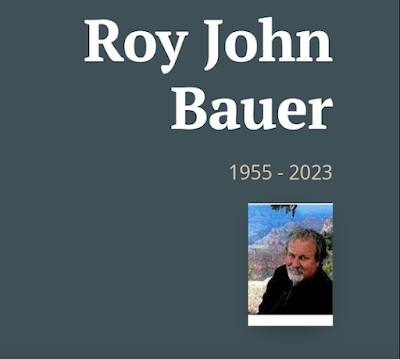
Roy's obituary in LA Times and Register: "we were lucky to have you while we did"

  This ran in the Sunday December 24, 2023 edition of the Los Angeles Times and the Orange County Register : July 14, 1955 - November 20, 2...