Tuesday, July 13, 2010

Our delightful world of doltocratic reality-detachitude

     “Detachment from reality.” There’s an interesting notion. All of us, I think, are somewhat detached from What Is. Few are entirely detached. There’s lots of room in the middle.
     Some people are both very and entertainingly reality-detached. Such a one is Mr. Steve Rocco of Orange. You’ll recall that, several years ago, the clueless and staunch people of the city of Orange elected him onto the board of the Orange Unified School District—evidently on the strength of his claiming to be an “educator,” something he isn’t. He showed up to board meetings with a signature nutty getup and a daft conspiracy theory having to do with sausages. He was incompetent. He was disruptive. He was a nut.
     There was nothing to be done about it, 'cause this is a democracy, and the people had spoken. His colleagues censured him (so what). They tried to recall him, but they couldn’t get enough staunch Orangeites to stop and think. They snarled instead.
     The people of Orange were saved from persistent Roccohood by a fortuity, namely, a redistricting, which redefined Rocco’s seat’s area in a manner that failed to include Rocco’s home, a treehouse in Hart Park. (I made up that last part.)
     Naturally, later, he was caught stealing ketchup from the Chapman University cafeteria. (He did not steal one of Chapman’s ironic Albert Schweitzer monuments. That would have been intelligible.)
     There was a trial. He blathered about his favorite conspiracy. More sausage. He lost.
     He ran for city council. No luck there. Then, recently, he ran for OC Public Administrator—against incumbent and über jackass John Williams, who happens to be an SOCCCD trustees. Naturally, despite two “scathing” grand jury reports about Williams’ disastrous performance and character, the voters reelected him. They did this even though one or two apparently knowledgeable alternative candidates, not including Mr. Rocco, were also on the ballot.
     (Once in a while, I get into a debate with somebody about whether you’ve got a democracy when the voters are persistently bone stupid (well, bone ignorant)—and also persistently incapable of recognizing that fact. Some say yes: it’s just a shitty kind of democracy is all, a Doltocracy. Some say no: focus on the manipulators, the “engineers of consent,” they say. They’re the real rulers. Owing to the apparently limited intents of the so-called “manipulators,” I tend to favor the first view.)
     Well, according to the Greater Orange News Service, Rocco is at it again:
Controversial former Orange Unified School Board Trustee Steve Rocco has pulled papers to run in Trustee Area 7 of the sprawling Greater Orange school district. Rocco served one turbulent term on the OUSD Board … and then a recall effort led by other Board members that failed due to lack of signatures. He eventually was ousted not by recall or election, but by a redistricting…. Trustees in OUSD must live in the Area they represent, but are elected at-large).Trustee Area 7 is represented by Trustee Rick Ledesma and his term expires in November. Ledesma was one of the few people who managed not to get into a conflict with Rocco, at one point even sponsoring Rocco putting two Agenda items on the Board’s agenda. When Rocco’s home was moved into Ledesma’s area, Rocco declared that he would not run against Ledesma….
     OK, so, on top of being a lunatic, Rocco is disloyal to his friends and doesn’t keep his word. But that just makes him ordinary.
     According to Mr. Cunningham over on the Red County blog, the people of Orange aren’t about to make the same mistake twice, but I’m not so sure. I recall talking to a hotshot political scientist in the middle of the Steve Frogue recall (back in ’98). Said Professor Hotshot: it could be that your recall effort will only make Frogue’s name vaguely familiar to voters as they enter the voting booth in a couple of years. Voters don't think; they don't pay attention. So they won’t remember that Frogue's a nut and a Holocaust denier; they’ll remember only his name.
     So, natch, they’ll vote for ‘im.
     In a way, I hope Rocco wins. He may be a nut, but he doesn’t seem to have vices exactly. (Not like Williams, who’s all Shit-Eating-Grin.) If you’re going to have a democracy that, owing to the foolishness of the people, barely works, it’s better to elect incompetent lunatics than incompetent, smiling Shit-shire Cats.
     It’s no less ridiculous, but it’s a smidge less corrupt.

Westphal v. Wagner moves forward

     Just got word that the lawyers filed our “opening brief” last night—in Westphal v. Wagner, our suit challenging prayer practices in the SOCCCD.
     As you know, the First Amendment to the U.S. Constitution expressly forbids government “establishing” religion. When trustees and college/district officials lead prayer (e.g., at commencement), they are acting as agents of the government. At such times, the government is leading religious prayer (“invoking” the Lord) before the religiously diverse community that the colleges serve.
     Among the plaintiffs are theists, agnostics, and atheists. They represent members of the community and faculty and students at the two colleges.
     I’m told that “defendants” (namely, SOCCCD Board Pres. Wagner, et al.) have 28 days to respond, but they’ll likely get an extension. After they file their response, we can file a reply.
     Then: oral argument in court.
     The lawyers happened to mention that there are 700 pages in the “Excerpts of Record,” which comprises evidence from both sides.
     Sheesh!

     For those who wish to read Red Emma’s book review in Sunday’s Times, here’s the link: Book review: 'Kicking In: Stories' by Richard Wirick

Change: shampoo once came in glass bottles

     Yes, I remember Prell in particular. In that glass bottle. You could kill a guy with it.
     (A reader inspired my Prellian reverie.)

     That reverie inspired yet another: I recall my family's pink '55 Ford station wagon:

     Here are Annie and I, leaning on the old beast. This would have been about 1958.
     We kept the darned thing well into the 60s. Drove down from BC to Southern Cal with it twice: in 1958 (Disneyland!) and then again in 1959. It's what we were driving when we finally got permission to stay in the U.S. in 1960.
     The color: it was a weird pink, but I do believe that Ford called it "salmon."


     Yet another pic of the salmon wagon, or at least its front end.
     "Who's this lady with dad?", I recently asked my mother.
     "Oh, she vas a mudder*—vutt do you call it? — in Hamburg, I tink," she answered.
     "A mother?"
     "Yes, you know. She ran a business vit prostitutes!"
     "She was a 'Madame'?"
     "Yes, a 'Madame'! She vas one of dose. Her daughter vas a friend of ours back den. Gisele. Dat's her little boy."
     "Gisele's boy?"
     "Yah, dat boy vas raised in dat whorehouse," she added, disapprovingly.


     Don't know what this is about. I think they had stopped along the "Pan-Canadian Highway"— a dirt road — and mom (in the middle) was helping start a fire so they could boil water for coffee or something.
     No doubt Blondie was helpful in that regard. That's her grandson over by the fish wagon.
     Dad tells me the boy ended up "really fucked up."
     "Yeah?"
     "Oh yeah."

     Gisele was pretty hot. I'm surprised I don't remember her.
     I bet she had a heart of gold.

     (*OK, I admit that I exaggerated my mom's accent. It isn't that thick. But her speech is very German nonetheless. Heimatland!)


* * *


You don't see salmon colored things much anymore. Above: a Salmon T-Bird.

My folks recently at the Bagdad Cafe
My mom's still a fan of all things "Hollywood"
My dad is still NOT
He liked the french fries though

Monday, July 12, 2010

The University of California and online degrees: money saver? crappola?

UC online degree proposal rattles academics (San Francisco Chronicle)
     Taking online college courses is, to many, like eating at McDonald's: convenient, fast and filling. You may not get filet mignon, but afterward you're just as full.
     Now the University of California wants to jump into online education for undergraduates, hoping to become the nation's first top-tier research institution to offer a bachelor's degree over the Internet comparable in quality to its prestigious campus program.
     "We want to do a highly selective, fully online, credit-bearing program on a large scale - and that has not been done," said UC Berkeley law school Dean Christopher Edley, who is leading the effort.
     But a number of skeptical faculty members and graduate student instructors fear that a cyber UC would deflate the university's five-star education into a fast-food equivalent, cheapening the brand. Similar complaints at the University of Illinois helped bring down that school's ambitious Global Campus program last fall after just two years.
     UC officials say theirs will be different.
     On Wednesday in San Francisco, UC's governing Board of Regents will hear about a pilot program of 25 to 40 courses to be developed after UC raises $6 million from private donors. The short-term goal is to take pressure off heavily enrolled general education classes like writing and math, Edley said.. . .
     Long term, the idea is to expand access to the university while saving money. Tuition for online and traditional courses would be the same. But with students able to take courses in their living rooms, the university envisions spending less on their education while increasing the number of tuition-paying students - helpful as state financial support drops.. . .
     UC wouldn't be the first university to offer undergraduate degrees online. Among the most successful is the University of Massachusetts' "UMassOnline," which includes graduate degrees. It reported revenue growth of 20 percent since last year, to $56 million, and 14 percent enrollment growth, to 45,815 students.. . .
     But UC says it's looking for something qualitatively different, possibly like Stanford University's high-end – and cyber – graduate engineering degree.. . .
     But some UC faculty and graduate student instructors believe removing face-to-face interaction by definition diminishes quality.
     In May, student instructors delivered a less-than-subtle warning to the regents.
     "We find Dean Edley's cyber campus to be just the beginning of a frightening trajectory that will undoubtedly end in the complete implosion of public higher education" in California, Berkeley doctoral student Shane Boyle testified.
     Using a slightly more sober tone, the Berkeley Faculty Association expressed similar concerns in a May report.
     "The danger is not only degraded education, but centralized academic policy that undermines faculty control of academic standards and curriculum," it said. "It is also likely that the whole thing will be a boondoggle."
     Furthermore, the report said, online instruction is "inappropriate for many subjects and types of learning.". . .
     The UC Board of Regents will meet Tuesday through Thursday at UCSF-Mission Bay Community Center, 1675 Owens St., San Francisco.
     Discussion: The Committee on Educational Policy will discuss five items, including the online undergraduate degree pilot project, beginning at 9:35 a.m. Wednesday.

Sunday, July 11, 2010

Higher Ed For-Profits: more worrisome factoids

Government Vastly Undercounts Defaults (Chronicle of Higher Education)
     The share of borrowers who default on their student loans is bigger than the federal government's short-term data suggest, with thousands more facing damaged credit histories and millions more tax dollars being lost in the long run.
     According to unpublished data obtained by The Chronicle, one in every five government loans that entered repayment in 1995 has gone into default. The default rate is higher for loans made to students from two-year colleges, and higher still, reaching 40 percent, for those who attended for-profit institutions.. . .
     They also show that the government's official "cohort-default rate," which measures the percentage of borrowers who default in the first two years of repayment and is used to penalize colleges with high rates, downplays the long-term cost of defaults, capturing only a sliver of the loans that eventually lapse.
     While the data obtained by The Chronicle are not directly comparable to the two-year rate, which reports defaults by borrowers rather than loans, they reveal that default rates continue to climb years after borrowers have left college, particularly among students who attended two-year and for-profit colleges.
     For loans made to community-college students, the 15-year default rate is 31 percent. David S. Baime, senior vice president for government relations at the American Association of Community Colleges, called that number "shockingly high."
     "It's really just a tragedy given the consequences of student loan default," he said.
     Borrowers who default on their student loans face significant personal and financial burdens. They become ineligible for additional federal aid and may have their wages and tax refunds seized by the government. Their negative credit records make it harder for them to obtain car loans, mortgages, and credit cards, and even apartments or jobs. When they can get loans, they pay higher interest rates.
     But it's the high rates of default at for-profit institutions that are likely to get the most attention from members of Congress, who have recently raised concerns about the cost and quality of for-profit higher education. Fifteen years into repayment, two out of every five loans made to students who attended two-year for-profit colleges are in default.. . .
     "We have a responsibility to ensure that taxpayer dollars are being spent wisely, and that for-profit colleges are serving students, not just shareholders," said Sen. Tom Harkin, chairman of the Senate committee, in his opening remarks. Shown the 15-year default data for for-profits after the hearing, he appeared taken aback. "Whoa," he said.
     While for-profits educate less than 10 percent of students, those colleges' students received close to a quarter of Pell Grant and federal-student-loan dollars in 2008, according to the College Board. And they accounted for 44 percent of defaults among borrowers who entered repayment in 2007, according to the Institute for College Access and Success, a nonprofit organization that advocates making higher education more affordable. When the government can't collect on those loans, taxpayers pick up the tab.. . .
     …Gail O. Mellow, president of LaGuardia Community College, of the City University of New York, said comparing community colleges with their for-profit counterparts ignores the fact that far fewer community-college students borrow. So while the percentages of defaults may be similar, the number of defaulted loans of former community-college students is smaller.
     Only 10 percent of community-college students took out federal Stafford loans—the most common type of federal education loan—in the 2007-8 academic year, and most borrowed less than $10,000, according to the College Board. At for-profit colleges, 88 percent of students took out Stafford loans, and nearly 20 percent of associate-degree recipients graduated with more than $30,000 in debt. Those borrowing rates reflect the higher cost of attending a for-profit college. In the 2009-10 academic year, the average for-profit institution charged $14,174 in tuition and fees, according to the College Board, and the average community college only $2,544.. . .
     By any measure, for-profit colleges account for a disproportionate share of student-loan defaults. Two years into repayment, 11.9 percent of borrowers who attended for-profit colleges have defaulted on their federal loans, compared with 6.2 percent of those who attended public colleges and 4.1 percent who attended private colleges, according to provisional data that the Education Department released in February. Three years out, for-profit colleges' default rate has nearly doubled, to 21.2 percent of borrowers, and the gap between the sectors has widened….

Annie and Roy, British Columbia, c. 1958

I'm told that we were very quiet and well-behaved kids. Our parents would take us somewhere, and we'd just sit on a couch (or, as they said in Canada, on a "Chesterfield"), playing quietly. We didn't produce noise. We didn't run around.
Today, I was at my nephew's birthday party. Good grief. You don't see kids being quiet and well-behaved much anymore. I almost never see that. The kids are nice, but they seem never to stop running around and they seem endlessly driven by impulses. They don't seem to remember anything I tell 'em.
But I'm getting used to it.
These kids always seem to want to wrestle me to the ground. Or I'm supposed to toss 'em around for hours.
I seem to still have some "kid" inside me. I connect with little ones.

Even Annie was quiet and polite. Yep.
Unless it was just the two of us.

She was a year older than me and she tended to dominate. There are many family stories about her little schemes and minor misadventures. There are few about me. I was a very quiet, good kid, they say. Never got into trouble.
We had good parents.

I was a very shy kid. That stayed with me.
I learned how to interact with people. But, inside, I'm still that shy kid, uneasy with strangers.
Annie is notoriously gregarious. Still.
She makes lots of friends.
I find most of them to be annoying.

Annie's always saying something. Mostly, I say nothing.
Even now.
I listen to people nowadays, and it is as though they are members of a talkative foreign culture.
I am drawn to the outdoors or to an empty room. Silence. It says nothing false.

It has struck me recently, all at once, that my life is now long enough that parts of it occurred "a long time ago." When I was a kid, I thought the forties were a long time ago: an era utterly eclipsed by two decades of change. Now, twenty years ago (1990) seems like yesterday.
Don't feel old though. Feel more or less as I did in, say, 1975.
And you?

Saturday, July 10, 2010

German immigrants in Canada, 1957

That's mom (Sierra) on the right.
These old pictures seem to record some pretty wild partying, but mom says no.
Lots of dancing, singing, she says. But it was all pretty innocent, she insists.
Dad says so too, so there you go.

Mom was quite the dancer. Don't know who this guy is.

Just about everybody smoked.
They did a lot of drinking too. Brewed their own beer.
There wasn't much to do, says my dad. Especially in the remote construction villages where we lived for a while.

Mom with guys and guns. Everybody had a rifle or two.
These people loved to wear crazy hats, at parties anyway.

Dad and a gal named "Gisele."
(She had quite the reputation, evidently.)

Mom and some guy, pointing at dad, who is armed with his Retina, I guess.

Gisele again. Mom laughing.

These two, Hermann and Marianne, are my folks' closest and oldest friends. I've known them all my life.
Upon retirement (maybe fifteen years ago), they moved back to Canada, owing to that country's health care system. They now live in Vancouver (my family lived there in 1959).
As a child, mom lived in the eastern part of Germany—Prussia—but she and her stepmother were forced to flee the Russian invasion, and they ended up far to the west, near Hamburg.
That's when mom met Marianne. The two girls went to school together, were confirmed together. Did everything together.
Meanwhile, Hermann was a huge "footballer," but he was trained in carpentry.
Dad lived far to the south, near Stuttgart.
They all ended up in Canada. But they really wanted to be in the U.S.A.
Too bad about the health care thing. Really too bad.


Annie and I were in bed, I suppose.

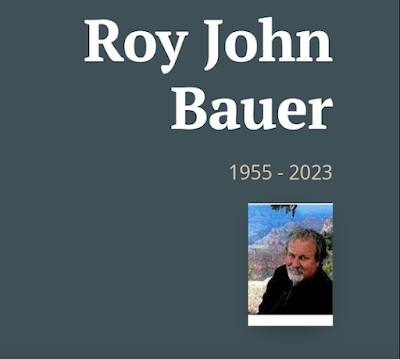
Roy's obituary in LA Times and Register: "we were lucky to have you while we did"

  This ran in the Sunday December 24, 2023 edition of the Los Angeles Times and the Orange County Register : July 14, 1955 - November 20, 2...