Thursday, December 18, 2008

Shoelaces, loafers, and tomatoes

1. SHOELACED?
Over on the College Life blog, Marla Jo Fisher has the latest on Marlon Martinez, who stands accused of murdering former UCI professor Lindon Barrett (Man accused of strangling professor will stand trial).

Evidently, Barrett was strangled with a shoelace. Martinez' case will soon go to trial.

2. MORE LOAFERS.

The Oakland Tribune reports on anti-war activists who have taken to brandishing shoes in support of the Iraqi who recently pelted the President with his loafers (Anti-war activists hold shoe-in at Marine recruiting station to show solidarity with Iraqi journalist):

CodePINK anti-war activists marched in front of the U.S. Marine recruiting station in Berkeley on Wednesday to support an Iraqi journalist who threw his shoes at President George W. Bush on Sunday.

Muntadhar al-Zeidi, who hurled two size-10 loafers at Bush during a news conference in Baghdad.

Melanie Morgan, the head of Move America Forward, a pro-troop organization, said CodePINK's protest Wednesday was "on par for their insulting and demeaning activism."

"They are always siding with the forces that are against America," she said….


3. UNIVERSITY PREZ BOB KERRY CHASED AND PELTED.

The New York Times (Protest at the New School Turns Unruly) reports that

Protests at The New School, where a student uprising over the leadership of the university’s president, Bob Kerrey, led to clashes with the police and at least one arrest on Thursday morning, took another wild turn later in the day.

A little after 11:30 p.m., Mr. Kerrey emerged from a university building … to a sea of a few hundred protesters chanting for his resignation. As Mr. Kerrey walked down Fifth Avenue toward 12th Street, about 30 protesters began following him, some of them shouting insults.

As the crowd’s pace quickened, so did Mr. Kerrey’s. Then, Mr. Kerrey, who lost a part of his leg in Vietnam and wears a prosthesis, broke into a run. The protesters gave chase. Mr. Kerrey turned left on a cross street and ducked into a brownstone.

At some point in the confrontation, a protester threw a tomato at Mr. Kerrey….


This morning in Silverado Canyon

I live in Live Oak Canyon, near Trabuco Canyon. Today, I decided to head on over to Silverado Canyon, hoping to see some snow. (Click on the photos to enlarge them.)
Sure enough, at the end of the canyon, there's a turnaround, and a Channel 7 Eyewitness News truck was there. The "crew" was a solitary driver/camera operator. He was on snow patrol, filming kids and moms romping in the stuff. He looked pretty jaded.

There was a dog, too.

My sister is on the market for a home in one of these canyons, but she hates these little side roads. They're too narrow, too steep, she says. I love 'em. Even in my big ol' Chrysler 300, I love 'em to pieces.

I love to take my sister up the steepest and narrowest roads. She covers her eyes.

Yesterday, I had to back up on one of these roads. I did it fast.

My sister said, "You drive backwards as fast as you drive forwards!"

"No, faster," I said. She freaked.

Did I mention that I got my last speeding ticket while driving home from traffic school?

The canyons are pretty sleepy, mostly. —And muddy, right now.

I forgot how cold snow is. It's great to look at, but that's about it. You don't actually want to touch it, unless you're a kid. 

Ah, but prudence is but experience, which equal time equally bestows on all men. Or so said Hobbes. 

I have my doubts. I saw that asshole George W. Bush frolicking in the snow once. He was grabbing handfuls of the stuff, and he was smiling. 

Dolt.

I took lots of pics, but these are the ones Annie picked out. She's an artist, and so I value her judgment.

About pics.

Naturally, this isn't Silverado Canyon. I took these pics driving into the college this morning on the toll road. See the orange balloon of Irvine's "Great Park" at the bottom? It didn't seem to be going anywhere.

Driving down Alton. Love that snow. To look at. Not to touch.

As I composed this post, Tiger Ann got in my way, insisting on sitting between me and my Mac's keyboard. So I decided to take a picture of the brat. You can kinda see her brattiness.

That Tiger Ann reminds me of those Hollywood glamor babes of the 30s, 40s, and 50s—you know: Marlene Dietrich, Merle Oberon, et al. She knows how to pose for a picture, boy. Rebel Girl's the same way.

This Morning in Modjeska Canyon


Wednesday, December 17, 2008

Man of the Year: Iraqi shoe guy


Collateral damage

Rebel Girl's Poetry Corner: "I insist on the infant hope"


Yes, more days have been eaten in the advent calendar than remain. (Figure out that syntax, Rebel Girl dares you to.) She's been grading too many papers and thus her own syntax is beginning to splinter. 

To the left hangs the gingerbread ornament that Rebel Girl and her son created yesterday, a creature that seems to sum up this stage of the holiday season.

They've been having fun baking, decorating, planning the first Christmas spent this side of the border in about 20 years as well as the 25th anniversary of Red Emma and Rebel Girl's union.

There is still much to celebrate despite what can and does go wrong.


And now, a poem for the season:

“Your Luck Is About To Change”
by Susan Elizabeth Howe

(A fortune cookie)

Ominous inscrutable Chinese news
to get just before Christmas,
considering my reasonable health,
marriage spicy as moo-goo-gai-pan,
career running like a not-too-old Chevrolet.
Not bad, considering what can go wrong:
the bony finger of Uncle Sam
might point out my husband,
my own national guard,
and set him in Afghanistan;
my boss could take a personal interest;
the pain in my left knee could spread to my right.
Still, as the old year tips into the new,
I insist on the infant hope, gooing and kicking
his legs in the air. I won't give in
to the dark, the sub-zero weather, the fog,
or even the neighbors' Nativity.
Their four-year-old has arranged
his whole legion of dinosaurs
so they, too, worship the child,
joining the cow and sheep. Or else,
ultimate mortals, they've come to eat
ox and camel, Mary and Joseph,
then savor the newborn babe.

Tuesday, December 16, 2008

A dark end for family friends

 
DON'T KNOW WHAT TO DO.

I’m a bit weirded out right now. It’s got to do with old family friends. My parents immigrated to Canada from Germany in 1951 (mom was 17, pop was 18). They met on the boat—a converted WWII “Liberty” ship, a real deathtrap—later got married, yada yada. My sister Annie was born in ’54. I followed in ’55. (Read about my family's history here.) 

The Canada years—we made the move to the U.S.A. in 1960—were pretty wild, in part because of all the new immigrants scratching for jobs, trying to make a go of it, dealing with each other and with the Canadians. My folks made lots of friends, many of them Germans like themselves: young, ambitious, full of dreams. 

 Helmut and Brigitte Schmidt (not their real names) were among these friends. Eventually, they, too, moved to the States, and, by the mid-60s, the Bauers and the Schmidts would get together like families do. I liked Helmut and Brigitte, but I didn’t much like the Schmidt boys. They were coarse, noisy. I always figured that you shouldn't have to be with people that you don't like. I was glad when my family lost contact with this crowd in the early 70s. Twenty-five or so years later, pop and Helmut ran into each other down near Leisure World, and, well, yada yada. My folks and the Schmidts seemed to grow close again, and all was well, I suppose. (I wasn’t around for much of this. I saw Helmut and Brigitte maybe a couple of times.) Then, maybe six months ago, Brigitte suffered a stroke, and she was pretty bad off. Helmut, who is very healthy (he's into the Senior Olympics), wouldn’t leave her side. He seemed utterly devoted to her.

It was touching. So said my folks. Recently, Brigitte was allowed to return to their place in Leisure World. But she wasn’t getting better. She was a little crazy and difficult. Helmut was determined to take care of her, but it was getting harder. He evidently felt that he was not up to the task. He showed signs of depression, we heard. My dad made some efforts to contact Helmut last week, but Helmut wasn’t answering his phone. Strange. 

Last week, in his apartment, he shot his wife dead and then he shot himself. The bodies were discovered on Friday. 

Helmut and Brigitte were nice, ordinary people. People liked them; they had lots of friends. This thing caught everybody by surprise. Especially my parents. What does it all mean? My parents sit and think. They run around, trying to do things. But they don’t know what to do. Nobody does.

The Morning Reading: Behind the Hills (Rebel Girl)

.    Recent IVC alum, Bradley Beylik has excelled at UCI in their exclusive literary journalism program and is now applying for grad school (Rebel Girl is writing his recommendation letters and so she knows.) Beylik was set on law school but is now purusing that white whale, the MFA in writing. Call him Ishmael. 
     "Behind the Hills," an essay by Beylik, appears in the current issue of KIOSK, the UCI Literary Journalism magazine. In it, he explores the canyon communities of Orange County. Rebel Girl and Red Emma make cameo appearances. Rebel Girl finds that she is depicted as chirpier than she imagines she really is but it could happen. She could chirp. She probably did. 

  excerpt: 

     Old Saddleback—visible from locations throughout the Los Angeles basin, the San Gabriel, San Bernardino, and San Jacinto Mountains, Catalina Island, and the groomed suburbs of Orange County—is made up of the two tallest peaks of the Santa Ana Mountains, part of the Cleveland National Forest. Its shape looms behind all the bustle of overcrowded streets and rampant suburban sprawl like a tired old sentinel. The twin peaks have tortured, weathered sides criss-crossed with firebreaks and truck trails, mostly devoid of trees. The top of Santiago, the taller of the two, is stuck full of antennas and transmitters of all shapes and sizes, a haunting replacement for the foliage that must have covered the mountains in green long ago. 
     On Southern California’s foggy days, the dark mass is shrouded in marine layer, seeming strong and ominous in its scarred hide. It conjures Moby Dick—immense and ancient, possessing an existence that is at once brutally simple and mysterious, and decorated with the marks of many encounters with men who have sought it out. 
     The mountains seem to keep watch from their heights above the suburbs, keeping record with their scars of all the doings of humankind that unfold around their feet. Less visible than the peaks, even to most Orange County residents, is the quiet canyon-and-mountain community that has been at the base of Old Saddleback for over a century. 
     Made up of several canyons—including Silverado, perhaps the most famous—scattered with sleepy little cottages, the community seems to have resisted the tide of overdevelopment and kitsch that has ravaged the rest of once-rural Orange County. In that way, the area represents the last of its kind—a rural stronghold in a sea of apocalyptic change. 
     The issues are many: environmental degradation, disappearing wildlife populations, encroaching development, and damaged ecosystems and watersheds. And these aren’t the only concerns for residents of the canyons. Other difficulties abound: landslides, flash floods, and a special brand of political entanglements. 
     Without input from canyon dwellers, big companies and nearby city governments draw maps for future exploitation of the land. A traffic- and water-bearing tunnel connecting Riverside and Orange Counties has even been proposed to run right through historic Silverado Canyon. In the face of these struggles, Silverado, though in many ways unchanged since its days as a mining boomtown, is today tragically threatened. But more than that, this disputed landscape represents a deeply American experience of survival and change, determination and loss. 
     The rugged mountains with their shadowy canyons tell stories of weary prospectors, defiant Indians, and determined explorers. For people who spend their lives in the anonymous suburban landscape of Orange County, the canyons and mountains are a source of urban myth and local lore, deeply connected to the fading glory of the American West, and to the contradictory national narrative of frontier living and resource exploitation. 

     To read the rest, click here.

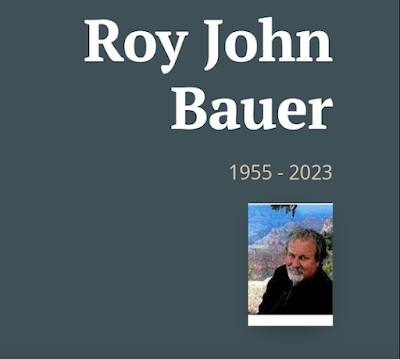
Roy's obituary in LA Times and Register: "we were lucky to have you while we did"

  This ran in the Sunday December 24, 2023 edition of the Los Angeles Times and the Orange County Register : July 14, 1955 - November 20, 2...